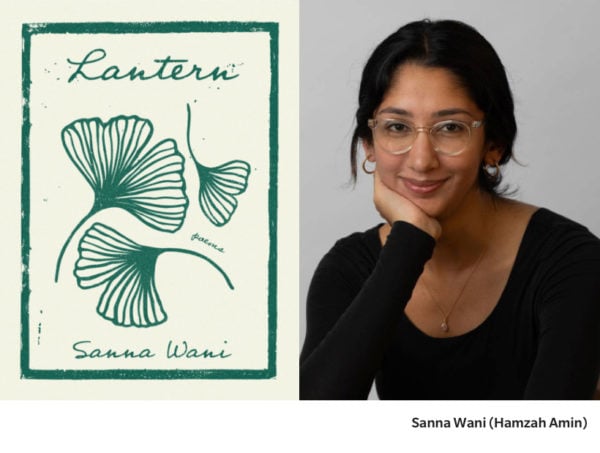
 Lantern is Sanna Wani’s anticipated follow-up to My Grief, the Sun, the winner of the 2023 Trillium Award for Poetry. The collection is defined by five elements – Craft, Love, Ethos, Faith, and Grief – signalling grand themes in broad brush strokes. A more finessed sectioning comes into focus with wide-ranging epigraphs that spark an ekphrastic dialogue between the speaker and canon.
Accessibility is the plat du jour as Wani enters into a world of nostalgia and memoir. She flirts with Rumi-esque contemplations as she sits between the relationship with worldly circumstances and that with God. Love is both a consideration and a question. God is prevalent and present, a wise, mostly silent friend in these poems, but one who is often without answers:
God says. You don’t talk to Me either.
Behind us, a child weeps. Outside, the sound
of a siren like a meteor, its parabola briefly over us.
God’s mouth moves with a song I can’t hear.
The speaker seeks awareness, love, and reconciliation with herself, family, and God throughout. Devotionals softly roil below the surface. In poems such as “Pottery Class on Dundas West, the deliberations reveal themselves as spiritual and sublime:
Consider devotion.
Consider the way devotion changes our disposition
towards everyday objects, like mugs. Consider your disposition
towards the object of your life. Consider its shape, what you would trim.
Consider the pedal and its degrees. Consider speed as an instrument of time.
These moments lead to a pleasant intimacy with the speaker where their delight in living and loving is transmitted to the reader. In the contemplation of a quartz, “Colour is a predicament of light,” and in the concrete poem “The Sky,” the joy is in the play of words: “All I need to feel beautiful is an absence of light All light of absence an is beautiful feel to need I All.”
Stylistically, the prose leans toward plain speech and there’s an overabundance of pronouns that border on mundane, for example: “In this moment, I am not in love with anyone. I am content with watching / the sun play in the water and the seagulls carry the sky.” Another poem begins: “I arrive early. I circle around looking for the best spot to park. It took / an hour to get here and it will take an hour to get back.” These moments are far too prevalent; at times more refinement of line-level craft would have been welcome.
However, at her best, Wani finds genuine surprise in images that matter, such as in “The Pottery Class on Dundas West”: “Consider, for once, the lake of your hand.” In “Lullaby for Gaza,” the speaker finds vivid immediacy:
My job is to tell you about the light,
dappled on the surface of the lake like a thousand sapphires, which if I had
I would see to feed those who starve. As the song ends, I watch the wind
running its fingers through the willow’s hair, like God’s hand
like a mother, somehow out there, soothing her child to sleep.
It is in the second-to-last section, “Faith,” where the poems become genuinely brave with revelation, betrayals, desires, and foibles, such as in “November 11, 2021”: “In Dante’s hell, betrayal is at the centre but in mine, / it’s blasphemy. I’m not loyal. I’m surviving a love that hates me.”
Lantern is about family love, the legacy of history, and the complexity of an individual in the diaspora. “I’m not praying these days but sometimes / I get up at fjar and stare at the sky.”




 Contact us via email