Five hundred perfect words.
That’s what Cristina Quintero aims for when she starts to write a picture book. And she’ll be the first to tell you it’s no easy feat.
“If you want to get 500 perfect words, you better put in 500 hard hours of researching, studying, interviewing,” she asserts on the phone from her home in Alberta, “to get a better understanding even of things you felt you had a grasp on.”
This meticulous approach to her craft is informed by both her professional experience and her personal life. Quintero worked at Henday Association for Lifelong Learning for many years; working with kids who see or experience the world differently than their peers kept her “curious, open, soft-hearted, and maybe a little more gentle,” she says.
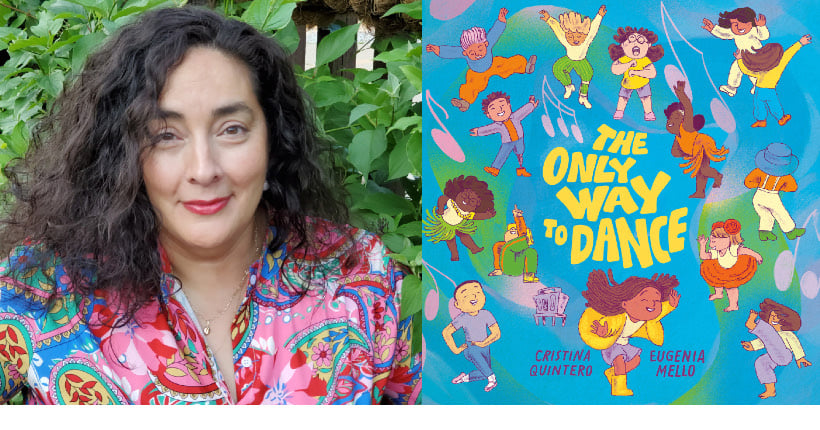
These traits imbue the pages of her sophomore picture book, The Only Way to Dance (Tundra Books, Aug. 18), which shows young readers the ingredients of dance (a beat, a space, a song) and the reasons we dance (luck, tradition, joy), which are the same across cultures. As Quintero sees it, the subject is a natural progression from her first picture book, The Only Way to Make Bread, because “we all move to a rhythm that lives inside us, our heartbeat.”
Her own foray into dance as a child was brief, but it did shape how she would forever see the art form.
“My mom bought these old ballet slippers, the soft ones,” she recounts. “We were at the gym for a class when she looked down and saw I was only wearing one, and she was so mad because she thought I’d lost the other shoe. Until she noticed I was holding hands with a little girl who had the other one on because her family couldn’t afford them.”
For Quintero, the space for dance is in the kitchen at family dinners or in the backyard at an event as much as in structured settings, because there are children that don’t have access to a dance studio. The Only Way to Dance is her “call to community,” with equal parts playfulness and respect.
“A four-year-old is a person with four years of experience in this world, and I want to treat them with the care and respect that a four-year-old deserves,” she says. “To introduce them to topics in a way that is respectful of the person they are and the person they have the ability to become.”
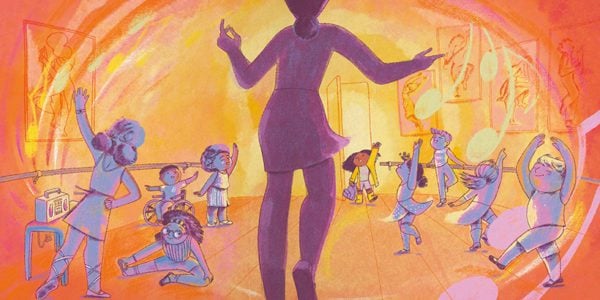
Illustration: Eugenia Mello.
She says that her childhood years, when she and her newly immigrated parents lived in a building brimming with multicultural neighbours, also shape her perspective.
“I remember Sarah; her family immigrated from India. There was a family from Cameroon on the left-hand side. A family from Cambodia lived about halfway down the hall. We had neighbours from Jamaica. Literally from every single part of the world that you can think of,” she recalls. “It showed me that the world is so big. It was hard for all of us in that building complex. If it’s hard for adults, and we understand all these things, how much more so for kids who don’t understand?”
This is why she feels it’s important to offer kids the hope that comes from “the muscularity of doing,” and why the illustrations (done in collaboration with Argentinian illustrator Eugenia Mello) depict the physicality of dance – the shimmies, the pirouettes, and the flips.
“If you look through the book, you’ll see the shapes of people. You’ll see limb differences. You’ll see age differences,” she says. “It’s not tokenism. It’s a respect and an acknowledgement that we were all born to dance.”
The Only Way to Dance, like The Only Way to Make Bread, is set in a building complex similar to the one Quintero lived in as a child. Both books, which are the first in a planned series, focus on a topic Quintero sees as universal – a cultural commonality that should be celebrated, and now more than ever, as the book’s release comes before what she describes as “a hard moment” in Alberta.
“We are looking at a referendum this fall that a small, very vocal minority asked for, [that] will ask questions about immigration, and whether immigrant children have a right to an education – really horrific things,” she says. “I’m not sure we’re fully prepared at this moment to have some of those conversations, but I do think there are some things that are universal, around which we can offer children hope, and one of those things, for me, is environment and the way in which we encourage kids to get their hands dirty for scientific, social, and psychological reasons – it’s so important for kids to do something positive.”
When Quintero looks back on her family’s immigration to Canada in the ’70s, leaving behind the entrenched poverty in Colombia, she recalls her mom’s dark sense of humour (which she still has), but she notes there was, and has always been, this insistence upon joy in all its forms, among them dance.
“Yes, we can pass down trauma, but we can also pass down joy,” Quintero says. “We can choose to be joyful, and the more we choose joy and connection, I believe, that’s where the magic happens.”




 Contact us via email