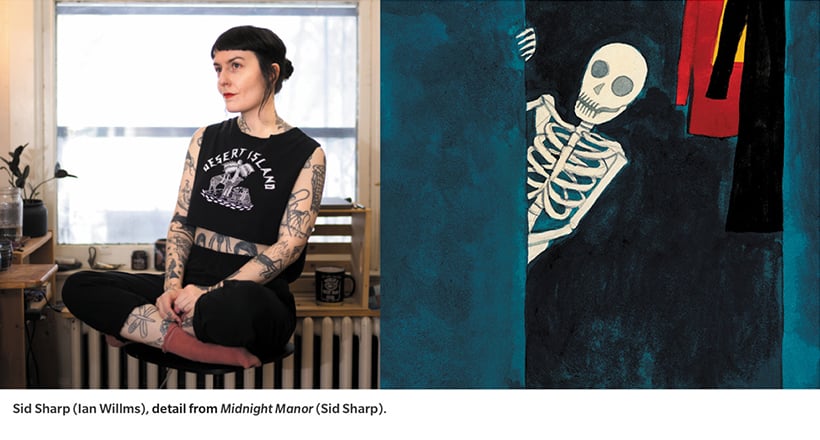
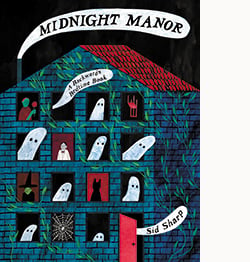
Sid Sharp is an Eisner-nominated author-illustrator whose books include the graphic novels The Wolf Suit and Bog Myrtle. The latter was a finalist for the Governor General’s Literary Award. Sharp was recently named a 2026 Sendak Fellow, a residency administered by The Maurice Sendak Foundation “that encourages, teaches, and supports artists who tell stories with illustration.” The Midnight Manor (Annick Press, out now) is Sharp’s first picture book.
Sharp spoke to Q&Q about their lifelong love of books and art, what inspired Midnight Manor, and the media they’d love to try next.
 What sparked your interest in illustration?
I was one of those kids who was always drawing and making their own little books, and I never stopped. I feel that’s a boring answer because it’s probably what everyone says, but I’ve really been doing it all my life, and it’s always been my favourite thing to do. It brings me this level of instant tranquillity and focus at the same time. A kind of flow state. It has been a very comforting constant in my life. I always treat drawing like a weird little private ritual rather than a means to an end.
Who or what has been a major influence on your illustrating style?
When I was growing up, it was Maurice Sendak, Jules Feiffer, and Tomi Ungerer. All the children’s books I read were a little bit off-kilter, a little bit twisty and thorny, something with a little bit of edge and bite to it. Then, as I got older, I really fell in love with Egon Schiele and Kiki Smith, painters, who have an illustrative style and are often telling stories with lines. I work at an antiquarian bookstore where we have a lot of strange old books, and that’s been huge for me. I’m constantly picking up new weird illustration sources from the past that are hard to find anywhere else. They’re nice to be around. You look through the pages and see the little dirt stains from all the previous owners, and there’s something really satisfying about it.
Did you know from the outset that you wanted to illustrate children’s books?
It’s what I wanted when I was a child. As I got older, I thought I was going to make serious graphic novels for adults, which I would still like to do. It took a while for me to come back to loving children’s books. When it was first suggested to me, I thought, “No, I wouldn’t be any good at that because my work is too dark, too racy sometimes, and so it doesn’t make any sense.” I kind of got talked into it. Basically, my editor said, “Well, don’t put the racy stuff in, but weird kids who like scary, gothic stuff should get books too, right?” She said I should make a book for the little kid that I was who liked weird dark stuff. I fell in love with the process, and now I want to keep doing it forever.
What kind of reaction do you get from kids who sink their teeth into the kind of stories you write?
It’s always really nerve-wracking when a book is done and not yet out in the world because you spend so much time writing it with the help of other adults, talking about it with other adults, going over the art with other adults. Even the early reviewers are all adults, so there’s a huge sigh of relief when it goes out into the actual world and children start enjoying it, and I’m like, “oh, good, I passed the real test.”
Curiosity, I guess, is how kids approach my books, which is what I love so much about them. They always have a million questions about why I chose to do something the way that I did. What was this character thinking in this moment? What happened to this random little thing in the book? Where did the squirrel go after the book ended? It’s so wonderful to have those conversations with them because that curiosity means the book is alive to them. To be honest, kids often don’t really care about me as the author of the book. Their parents – not all the time, but sometimes – will say, “This is Sid who made that book you like,” but that won’t necessarily be the part that’s the most exciting to them. They’ll be like, “I want to know about where the sheep went after this,” because the book is what’s really truly alive and a friend to them.
What inspired Midnight Manor?
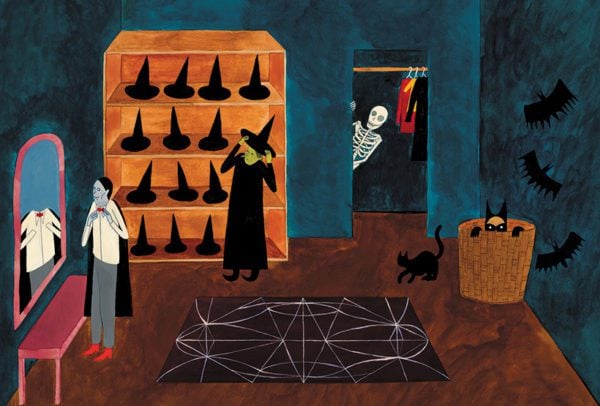
I was having a conversation with my editor about how it’s too bad I wasn’t going to have a new book ready in time for fall 2026, so there would be two years between my books, as I’ve been doing. I’m working on a graphic novel that’s taking ages. She said, “Well, what if we just do something small and cute? Do you want to make a little tote bag or a set of prints or something like that?” We started chatting about what cute little fun art project I might like to do with Annick Press, and the more we talked about it, the more I got really excited about the idea of this weird house where everything is wrong, and by the end of the conversation, I said, “Oh no, this is a book.” We were thinking of something small, but now I have to make this book, and it is a bit smaller because it’s my first picture book. That conversation kicked my mind into hyperdrive, and I got too excited not to do it.
How long after you had the idea was the book ready for printing?
This one was quicker than the other two, I believe, because it’s shorter. But it was still a good 10 months. The first eight months of that were me struggling with the writing, which is embarrassing, because there are like 12 words in the book. But I struggle much more with writing than I do with drawing and painting. I have to get through the gruelling process of writing something that I am pleased with and proud of, and that takes forever. The reward I get at the end of doing the hard job of writing is getting to spend two months having the most fun of my life painting it.
Does the writing need to be completed before the images come? Or do the images come as you’re writing?
They come simultaneously, and I bounce back and forth between them. But before I can stop sketching and start painting, I need to have the words finished. I need to have a finished concept, even when I’m doing other types of illustration for editorial. The hardest part is really solidifying it. It feels like it should be easier than it is, honestly, but I’ll write 500 words, and they won’t be the perfect words, and then you have to keep doing it over and over again until you feel like they might be.
Is there a certain number of drafts you typically complete? Or does it change from book to book?
It’s hard to say because it ends up being this sort of bizarre, constantly changing process. In terms of finished drafts, I would say there’s usually at least three full runs from start to finish within my sketchbooks before I start getting ready to draw it properly on the big sheets of paper I’m actually going to use. I don’t really make dummies like some other illustrators do. They kind of just all live in my sketchbooks and start and finish at random intervals.
What’s your medium of choice?
I draw in pencil, and then I paint over it in watercolour, gouache, India ink, and acrylic ink. Sometimes other random stuff. People sometimes like to know that when I was a broke art student and I didn’t have enough money for texture medium, in order to put more texture into my watercolours, I would mix dirt into my paint instead. I still do that sometimes just to get a little bit of grit in there.
The early painted drafts of The Wolf Suit, my first book, have dimmer colours, more like how I paint for adults. It took me a while to figure out how to make my illustrations very dark and very bright at the same time.
Are there any media you haven’t tried that you’d like to?
I am thinking about getting a little bit more sculptural in the future. I’m always doing little sculptural projects for myself in my home, making weird paintings of animals and vehicles and stuff out of scrap wood that I find. It would be fun to figure out a way to incorporate a bit more of that into the illustration. And I love working with papier mâché; I don’t do it enough, so I think that would be really fun, too.
I was going to ask you what you do to nurture your passion for illustration. Is that where sculpture comes into play?
I need to treat it like it’s my best friend and my favourite thing to do instead of my job. Treating it like it’s sacred, a ritual, and something that’s private and just for me, even if I know it’s going to end up in bookstores, is very important to me. The weeks when I’m stressed because I’ve got a bunch of deadlines are, unfortunately, the weeks I’m most likely to phone something in – and I never want to phone anything in for the books. It’s important to me to budget myself a lot of time, make a cup of tea, wander into the studio, light incense, put on some droney music, and think of it as something I’m doing just for me. It’s really hard work, and I’ve said to people before that it’s a lot of toiling, but luckily I love to toil.
If you could illustrate any classic children’s book, which would it be and why?
I go through periods of being very obsessed with old folk tales. The scarier, the better. There are a handful of Hans Christian Andersen stories that are terrifying that I would love to illustrate. I love Hans Christian Andersen. And of course a few Grimm Brothers stories. The Six Swans story, where the woman has to make sweaters for her brothers, is definitely a huge one for me.
This interview has been edited and condensed.
This article contains affiliate links. Quill & Quire has partnered with Booksellers.ca, a network of more than 180 independent bookstores across Canada, so we may earn a small commission when you purchase through links on our site — at no additional cost to you. More about Booksellers.ca.


 Contact us via email