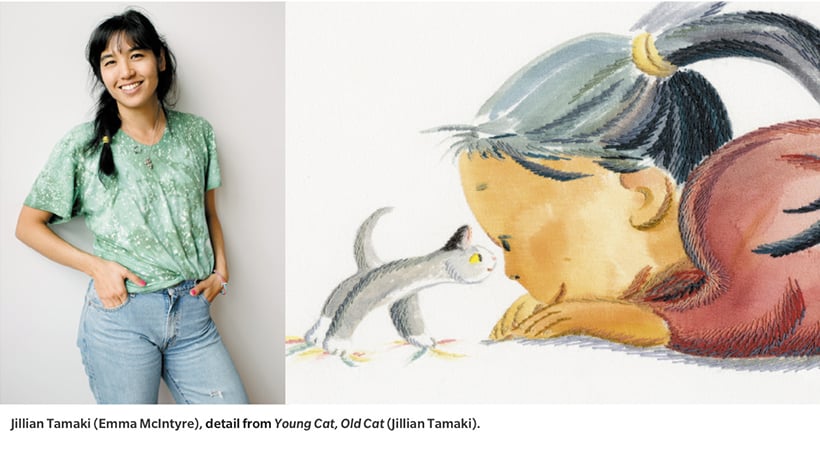
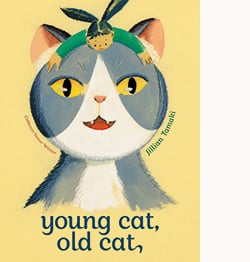
Jillian Tamaki is a cartoonist and illustrator who has published comics, picture books, and adult and young adult graphic novels, among them SKIM and This One Summer, which was co-created with her cousin Mariko Tamaki, and won the Governor General’s Award for Children’s Illustration in 2014. Her latest picture book, Young Cat, Old Cat (Groundwood Books, out now), illustrated with embroidery and appliqué, is inspired by her late beloved cat, Gretel.
Tamaki took a break from her New York book tour to speak to Q&Q about her changing influences, her artistic journey, and exploring embroidery as an art form.
 What sparked your interest in illustration?
There is a lot of serendipity in this, because I went to Queen’s University for a year thinking I would study art history and work in museums because I always had an interest in art history. I did some fine art work there, as well. Then, at the end of the first year, I realized I’m not a fine artist. I don’t want to make stuff. I don’t really want to just study things, but, again, I’m not a fine artist, so I’ll become a graphic designer.
I went back to Calgary and went to ACAD, now Alberta University of the Arts, to study graphic design, not knowing the program was illustration-based, as well. At that time, if you did graphic design and wanted to be a graphic designer, you had to take illustration classes. So I really fell into it. I always loved books. I always loved magazines. I always loved pop culture and comics, but I had no idea that was a job you could have. It was complete luck, and I was better at illustration than design. It goes to show sometimes we don’t plan things out.
Who or what has been a major influence on your illustrating style?
It changes all the time. When I was a student, I was very interested in George Grosz and German expressionists’ powerful drawings in ink. Eventually that sort of ceased to be as much of an influence and was replaced by manga, Hayao Miyazaki, and Studio Ghibli films.
After that, I was into the classic illustration of Arthur Rackham. And now I’m really inspired by people like Quentin Blake, people whose “handwriting” is very evident in their work and their line. A very direct, unvarnished connection between your brain and your hand is what I’m excited about now. Everybody’s handwriting is very different, but we have all these ways of smoothing that out. As an illustrator, you’re always trying to attain a sense of polish and perfection, but what if you didn’t do that? People like [Blake] are unreserved, unselfconscious, and that’s something I strive for – and I’m constantly failing at.
With AI, anybody can generate a hyper-polished digital image, and I noticed that I get a jolt of excitement or freshness seeing somebody’s hand in their work. I think that ties into Young Cat, Old Cat. There’s a real interest in craft and ceramics and sewing and embroidery and felting, things that are handmade. I sense that energy.
Did you know from the outset that you wanted to illustrate children’s books?
Not at all, actually. Everything is baby steps with me. I got a job after college working in video games at BioWare, which was illustration-based. I did some concept work, but mostly painting little texture squares. While at that job, I was also starting out in editorial illustration. I spent years in editorial illustration making comics on the side because I never thought comics would be my main thing. It was always a side thing, my personal work. I eventually did some illustrated books, and my first picture book came out in 2017.
I have always worshipped books. As a kid, I would keep my favourite books in plastic baggies to keep them perfect. I was always getting the same books out of the library. I never thought growing up that I could be a person to make books, and always thought, “Am I good enough to make a picture book?” That’s partially why it took so long. I wanted it to be the right thing, and I wanted to do the best job I could. There was a lot of pressure. There’s still a lot of pressure around the format because it’s such an important format for how it exists in the world. To me, it’s the pinnacle of illustration. It’s so difficult. I find it as difficult as doing a 400-page comic, and that’s not to say that a comic is easy at all. That’s very difficult, too. But there’s something about a comic that’s long. You can kind of hide, and not every picture needs to be totally perfect. What’s happening in the panel just needs to be legible, but with a picture book, there’s so much weight to every page and every word. And it’s supposed to do a job, right? You’re supposed to be able to read it aloud; it has to work as an auditory medium. That element is not really present in other types of books or illustration.
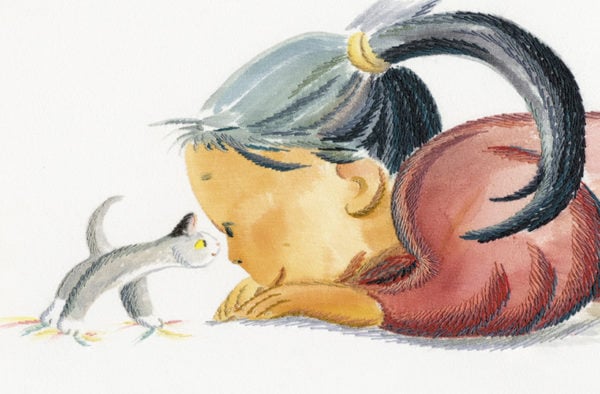
What inspired Young Cat, Old Cat?
It’s inspired by a cat I had. She died a couple of years ago at Christmastime. I had her since I was 23, getting her right after I graduated college, and she lived for 22 years. Just totally ancient, and I’m in my mid-40s now. My whole youth pretty much was spent with this cat. I got her in Edmonton, she moved with me to New York, and I moved with her back to Toronto. She was a big part of my life, and as she got older and older, I reflected a lot about aging and bodies. It’s about the cat, but it’s also about you. And I’m thinking about my parents, as well, and just how we change, or how what we can do changes, and how our relationship to other people changes, as well, over time. I’ve always been somebody who is very interested in aging. I feel I’m less interested in death itself, perhaps.
Even in my earliest books I’ve drawn myself very old or tried to project myself into the future and think about what it’s like to be an older person. I watched this kitten grow up and live her whole life in front of me and become a very old animal – that was quite a profound experience. I think all my picture books try to draw upon meaningful experiences that I’ve had. Same with Our Little Kitchen, which was based on years of volunteering in a soup kitchen.
Can you speak about the process of using textiles for the illustrations?
I’ve been interested in textiles since I was a teenager making quilts. I’ve always been very attracted to material and fabric. But, again, it was like comics. It was always a side thing that I did after work was done. About 15 years ago, I wanted to try embroidery, so I dove right in, and I actually found it to be not hard because it’s just like drawing.
There are a lot of motor skills that are different from illustration, drawing, or painting, but in the end, you’re creating a line, which is the same as drawing to me. I took to that like a duck to water. I put some early things I made online, and from that I got a couple of book covers commissions for Penguin Classics. Embroidery is so labour-intensive and time-intensive, and hard on your body. I had it in my back pocket that I wanted to do something with that medium again, but it would have to be for a really special project.
There was so much research and development, false starts, and churning through wrong solutions or solutions that didn’t quite work with almost every spread. You get a little better as you go along, and by the end, you’re knocking them out a little faster, but the book took 18 months to complete. Quite a bit of that was trying to figure out how to paint on fabric, which is not something I typically do. What ink? What fabric? How to work with wool? How to translate drawings into this new medium? If you factor that in, it’s scary how much time went into each spread.
Are there any media you haven’t tried that you’d like to?
Oh my goodness. I feel like textile is extremely deep, and I don’t even need to move on from textiles to try something wholly different. For example, appliqué, which is something I do a lot in my quilts, and there’s a teeny tiny bit of it in this book. Maybe not in the next book, but who knows? I thought I would be so burnt out by the end of this book, but I want to keep on exploring because it’s just infinite, right? There are infinite things you could do with fabric, thread, yarn, and paint.
What do you do to nurture your passion for illustration?
I never ever want to feel jaded or feel that it’s a job because it’s the best job ever. I’m privileged to be able to make art. If you’re not excited or you’re phoning it in or you’re going through the motions, I feel that translates through the artwork itself. I think the best thing to do is to look at art, be inspired by other people. I love museums. I love books and I also like to be engaged with the world. I am so re-energized by a bike ride in Tommy Thompson Park or going on a hike on the Bruce Trail. I’ll come back, and I want to draw stuff I saw. Nurturing other parts of your life gives you raw material. Sometimes I think studio artists want to stay in the studio, and I could be like that, too, but I need to remind myself to go outside and have experiences. It takes some of the pressure off: I don’t have to generate excitement and energy out of thin air. The world can provide some of that to me.
If you could illustrate any classic children’s book, which would it be and why?
I love drawing animals, and Aesop’s Fables is full of animals. They’ve been done a million times, so I feel that’s permission to do something really crazy. There are so many ways to go!
This interview has been edited and condensed.
This article contains affiliate links. Quill & Quire has partnered with Booksellers.ca, a network of more than 180 independent bookstores across Canada, so we may earn a small commission when you purchase through links on our site — at no additional cost to you. More about Booksellers.ca.


 Contact us via email