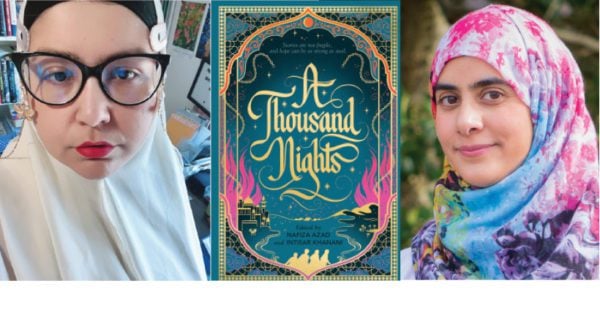
l to r: Nafiza Azad and Intisar Khanani
A Thousand Nights is an anthology of YA stories written by 16 Muslim women who reclaim narratives inspired by The Thousand and One Nights.
Within its pages, one refugee meets another and another, and with each meeting, a new character takes on the role of storyteller, creating a tapestry of stories that mirror the reality that our lives and struggles are intertwined.
The beginning of the second chapter speaks to this interconnection of characters: “Marvi slips from the story into Nusaybah’s dreams, breathing into them a sense of determination that reshapes her uncertainties into the confidence that what she’s journeying toward is better than what she left behind.”
The danger in creating a collection of this nature is the risk of losing each author’s unique voice to a bigger story, but, thankfully, this is not the case with A Thousand Nights. While similar themes such as hope, resistance, longing, and fear resurface, each author retains her distinct style and roots herself in her own specific language. These tales move beyond the one-dimensional trope of the refugee experience as one of victimhood and, instead, reflect the fullness and complexity of the human experience.
Readers who are acquainted with Sufi fables will find the lexicon sprinkled across stories familiar. There are several appearances of jinn, or genie; “After tapping the flint thrice, it blazed into a red inferno of a torch, and true to the artifact’s enchantment, the fire was without smoke. Next, she unwrapped the cube of quartz, thinking to hide in the folds it created in reality if she encountered a jinn.”
Foods that hold cultural and symbolic meaning are recurring motifs in the stories: “In his mind’s eye, he saw a pomegranate that had grown unnaturally large and red. When his eager hands parsed the flesh, the seeds spilled into his lap like rubies pried from a tyrant’s crown.”
A note from the editors would’ve been a welcome addition to provide insight into the concept and the organization of the stories, particularly for educators and students who may be curious about the editorial and creative process.
While the collection may draw upon old, familiar tales, it is undoubtedly an anthology for current times, and will resonate with readers across cultures, traditions, and faiths.
A triumph and rarity, A Thousand Nights will become a beloved tome on the bookshelves of Muslim girls and women who have longed to see themselves in a genre that too often excludes them.
This article contains affiliate links. Quill & Quire has partnered with Booksellers.ca, a network of more than 180 independent bookstores across Canada, so we may earn a small commission when you purchase through links on our site — at no additional cost to you. More about Booksellers.ca.




 Contact us via email