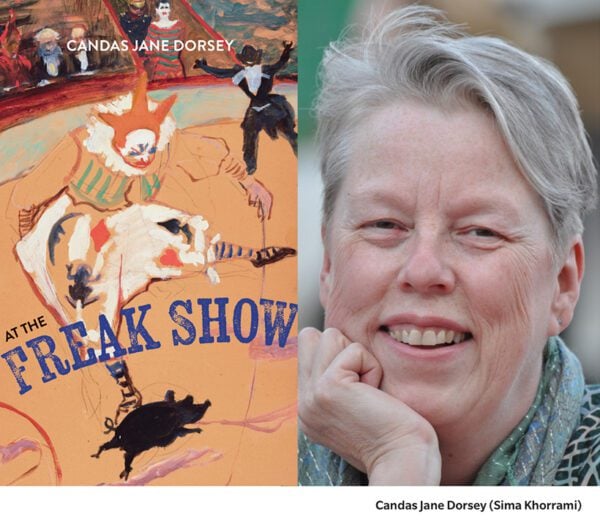
Candas Jane Dorsey is best known for her speculative fiction, particularly the Aurora-winning Black Wine. Her latest novel, which primarily follows the trajectory of a singular figure, Asa, is set in a contemporary landscape that ranges from a small Canadian Prairie town to the world’s entertainment stages. It is an inventive, at times somewhat bewildering, narrative. At the Freak Show is a kaleidoscope of transformations, both willing and unwilling, a world of twins, doubles, mirror reflections, and illusion, of forgetting and remembering, struggles for identity, and self-creation.
For Sarah/Sal/Sally/Asa Perdition (also mispronounced Asia, Aja), and finally, the singular non-binary Asa, the primary freak show is themself and how they are viewed by others. The surviving half of conjoined twins attached from rib to thigh, Asa’s body is keloided after years of surgery, a “scruffy postsurgical patchwork dolly” with “limping uneven hips … puckered skin and twisted muscles.”
Their early life is defined by disfigurement, and attempts to surgically transform it: “Hordes of doctors, always in Vs like migrating geese, the specialist leading the flock and the residents in lockstep like those legions in the almost-parallel mirrors, welcome to the freak show, spread your legs, show us the scars, let us admire again the surgeon’s skills, what am I doing here?: a small step now to doubting herself, I must be broken always.”
Raised as a girl, Asa is haunted by the glimpses caught in mirrors of a boy, and eventually learns of the other – her twin, Angelo – and that she shared male sexual traits with her twin until the doctors decided that Asa would be assigned female once surgically separated. At times, perhaps in Asa’s mind’s eye or imagination, when his existence and death are central to Asa’s own search for self and gender identification, a mirror-world narrative of Angelo slides into the story.
The second Freak Show is a worn-down club where comics and drag queens perform and where Asa begins her transformation from “thin, tattooed, scarified, scarred” waif into a singer and pop star, a charismatic presence when onstage. As Asa explores, she identifies as female, then male, then, unsatisfied by such limitation, rejects the binary to be simply, purely Asa.
In some ways, the novel is a kind of ugly duckling story, in which the duckling – sometimes enigmatic, often charismatic, with a seeming knack for knowing what others are thinking – draws into their orbit a mix of individuals who are on their own quest for meaning or identity. Some become collaborators whose stories flow along with Asa’s (and who are changed by Asa’s intervention), or those whose lives flare up then pass – some in sympathy, and some in anger over Asa’s gender fluidity. Pain and violence are part of many of the lives, but so are thoughtful and loving bonds; death, however, is a constant shadow in Asa’s life. The concept of the “freak” is explored through various lives and in the observation of what is usually considered conventional behaviour. The theme of the constructs of gender and sexual identity is echoed throughout, from the chorus-like Saskatchewan drag queens who transform themselves backstage at The Freak Show to Asa’s unlikely collaborator, a retired schoolteacher who writes romance novels masquerading as a man writing under the pseudonym of a woman.
The novel is written in chapters of varying lengths, roughly chronological but fragmented, which keeps the reader off balance as Dorsey teases out revelations and the stories of those whose lives intersect with Asa’s. Dorsey works ambitiously with a large canvas that, like Asa, refuses to be defined by a single narrative strand. She daringly gathers many lives, alternative histories, stories, and forms. Occasionally a section is less convincingly part of the larger narrative or drifts toward the didactic – a few chapters read like stand-alone short stories or meditations – but the writing only rarely falters or flattens.
At one point, when advising one of her entourage about speaking to the media, Asa mischievously suggests implying complexity to hide the ordinariness of her life after a concert: “Nobody likes a simple story. There are always frills and patterns cut into the shadow puppet to make the play more interesting.” Without any of the cynicism, this could be considered Dorsey’s technique: the many stories, allusions, and repeating patterns convey the complexity and particular beauty of the world of this freak show.
This article contains affiliate links. Quill & Quire has partnered with Booksellers.ca, a network of more than 180 independent bookstores across Canada, so we may earn a small commission when you purchase through links on our site — at no additional cost to you. More about Booksellers.ca.


 Contact us via email