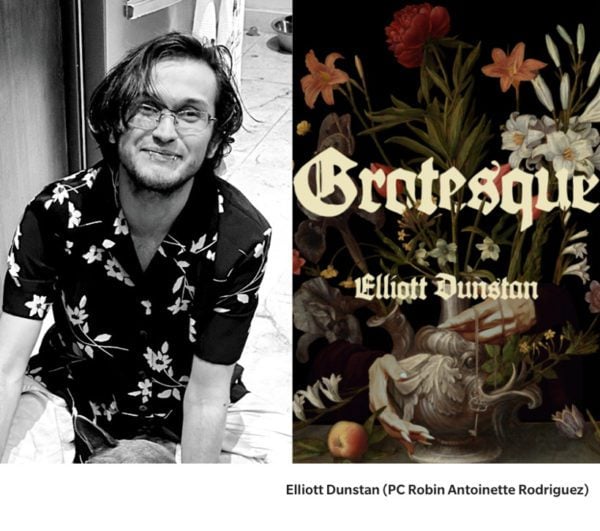
Grotesque, the stunning debut novel from Ottawa Valley writer Elliott Dunstan, begins with a brief exploration into the nature of the relationship between monsters and human beings: “Sometimes it seems to me that without the freaks and monsters it otherwise consigns to the underbelly, human society would quickly devour itself – whether in lust or fury, it’s hard to say.”
For the (as yet unnamed) narrator, this isn’t an abstraction; it’s personal. “I don’t say it lightly. After all, it’s easy for a freak to call itself indispensable.” The narrator, the self-described freak, works at a private club, where mysterious figures cater to the dark needs of their clientele. “What would you do without us? Ask your husband to leave bitemarks on your neck? Confess to your affianced lover that you want them to bruise you like they hate you?”
Context rushes in: as Grotesque opens, it’s 1848 in Bedhyndann, Cornwall, a once-small fishing village turned minor shipping centre. The club, hidden in subterranean tunnels under an apothecary, is run by Victoire, a siren, and staffed by, among others, a werewolf, a hulder, and our narrator, Denvyth, a golem, who was created 200 years earlier in the solitary house at the top of the hill overlooking the town.
Shifting back and forth between timelines, Grotesque fills in Denvyth’s story, including a brief liaison with a Royalist soldier, the punishment his master metes out for that indiscretion, and his master’s disappearance, which leaves the golem alone for more than 150 years. In the contemporary storyline, Denvyth finds himself growing attached to a client known as Summers, who has, it is revealed, links not only to Denvyth’s life, but also to his master’s disappearance, and to a dark, cosmic horror beneath the town.
That overview, by the way, just barely scratches the surface of this dazzling novel.
In a book of impressive creations – the fictional Bedhyndann is so fully rendered, the reader might feel they could navigate it, were it not for the winding streets and narrow alleys – Denvyth stands as one of the most original characters in recent memory.
He is trapped in an androgynous physicality; “I SUPPOSE THIS IS PARTIALLY MY FAULT,” his creator, whose dialogue is expressed in all caps later in the book, says at one point. “I DIDN’T BUILD YOU RIGHT IN THE FIRST PLACE. THAT PESKY LITTLE PART OF THE SPELL THAT NEEDED YOU TO BE NEITHER ONE NOR THE OTHER.” Denvyth struggles with his gender (wearing a semi-tumescent dildo under his clothes), his sexuality, his loneliness and longing, his past crimes, his destiny, and the fact that he will, essentially, dissolve if his clay flesh is exposed to water. By immersing readers within the golem, Dunstan forces them to confront the very nature of humanity.
Grotesque is, at its core, a novel about the search for identity, acceptance, and community, nestled within an epochal gothic rendering of gods and monsters, steeped in sex and violence (and, particularly, where those elements overlap), at once beautiful and hideous. Much to its credit, Grotesque never settles into a single predictable genre; is it a horror novel? A mystery? A historical? A character study? A new mythology?
It’s all of that, and more. Strap in (or on) and savour the ride.
This article contains affiliate links. Quill & Quire has partnered with Booksellers.ca, a network of more than 180 independent bookstores across Canada, so we may earn a small commission when you purchase through links on our site — at no additional cost to you. More about Booksellers.ca.




 Contact us via email