“Do women walk differently than men?”
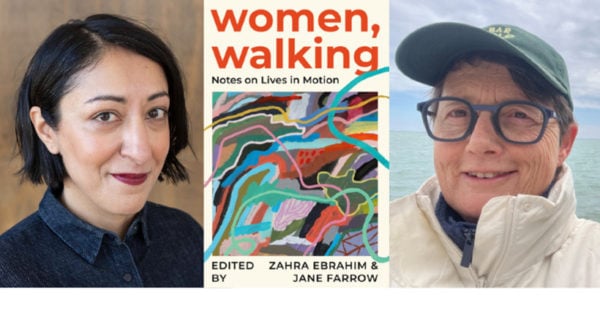
This is the opening question of Women, Walking: Notes on Lives in Motion, an anthology that suggests walking can be so much more than a simple method of getting from one place to another. Each contribution, whether an essay, poem, interview, or illustration, touches on a different feature of a woman’s day-to-day experience in motion. By curating this extensive collection of 30 contributors, editors Zahra Ebrahim and Jane Farrow assert that the ways of responding to the opening question are as multi-faceted as the voices contained within – and the resulting whole offers the resounding answer: “yes, they do.”
For women, walking can be a reclamation of time and attention – especially in a world where women, as caretakers, do so little for themselves. Walking can get us on the arduous but necessary path away from what harms us, or towards what will save us. It can be a way of testing endurance, processing grief, and starting anew.
Paige Lindsay beautifully spotlights the way a server moves around a restaurant (“She mixes things up with the occasional dance move – a kick ball change, grapevine, or spin …”), while The Girl with the Voice explores the meaning of walking in protest (“My shoulders shift forward, slightly hunched, carrying a heaviness. Leadership is not upright and cinematic. It is muscular”). Through both words and illustrations, Catherine Hernandez thoughtfully documents a lifetime of walking, winding down her journey with a vital question during a time of collective trauma: “How can I put one foot in front of the other when there is no map for the road ahead?” (The answer is equally moving: “Perhaps I will follow the sound of marching. Perhaps we can pave a new way together.”)
Many of these pieces examine the relationship between walking and fear, and how movement can transport us both into and away from immediate threat. In a standout essay, Pauline Craig writes of being followed by a man one hot summer afternoon after mistakenly meeting his gaze, and how “the motion of my body sublimated my fear into rage.”
Walking can also be adopted as a tool of exposure, to deliberately face what scares us. “If I give into fear, how can I rest on stumps surrounded by glittery Tinker Bells?” Jan Thornhill asks while advocating for walking in the woods at night. “Fear will not stop me from doing what I love,” she adds. “Unencumbered with full acceptance of its dangers, I will walk into the woods today and I will walk into the woods tomorrow.”
Despite the fraught nature of what it can mean to walk through this world as a woman, this collection leaves room for the lighthearted, and for the freeing nature of a simple stroll. A delightful conversation between editor Jane Farrow and Miriam Toews documents types of walking, the pair comically articulating the differences between swaggering, staggering, moseying, beelining, and something Toews refers to as “tall-foreheaded kinda walking.” Artist Diane Borsato takes the time to catalogue the things she’d like to steal while walking around her neighbourhood, including the forsythia bush at the music teacher’s house, and a pink champagne–coloured rose at the end of her street.
“For me, walking has held promise of wholeness from the start,” Pauline Craig continues in her moving exploration of walking, safety, and empowerment. “It has been my means to contact what is wild, feel out who I was and am, where I begin and end, and who I may become.”
Women, Walking easily proves why the anthology as a form is so valuable. The collection takes broad – even vague – subject matter and examines its various facets with laser focus, spotlighting diverse viewpoints, myriad offshoots, and multiple takes. It dives deep into something so obviously everyday and elevates its meaning to offer a moving tribute to something as simple as women putting one foot in front of the other.




 Contact us via email