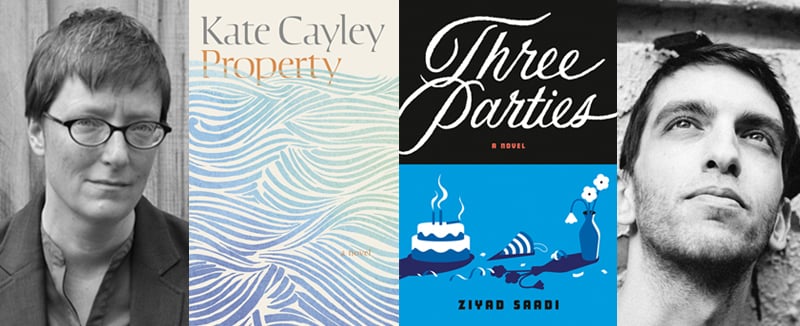
Kate Cayley (Livia Ambros); Ziyad Saadi
Set on a “splendid” June day in 1923, the apparent placidity of Mrs. Dalloway – in which a well-heeled Londoner runs errands in preparation for a dinner party – confounds expectations, thanks to Virginia Woolf’s depiction of her characters’ turbulent inner lives. While the suicide of war veteran Septimus Smith speaks for itself, the thoughts of Clarissa Dalloway – who has “just broken into her fifty-second year” and whose life is viewed by some as “a tissue of vanity and deceit” – also regularly touch on the absurdity of existence and the inevitability of death.
Exceptional begets exceptional in the case of Kate Cayley’s Property and Ziyad Saadi’s Three Parties, two debut novels that interpolate Woolf’s seminal, century-old work. Both authors transpose Woolf to contemporary North America: Toronto for Cayley, Detroit for Saadi. Though respectful to the source material, the authors’ capable modernizing nods to the timelessness of Woolf as well as to the value of 21st-century adaptations.
Unexpectedly, the opening pages of Property bring to mind the choral, six-person narration of The Waves, Woolf’s 1931 novel. In part one (titled Morning), a series of unnamed sections begins with a foreboding account of the “vicious patience” of rats. From there, Cayley composes taut studies of anxious characters, beginning with an unnamed woman nudging her sleeping dog: “Wake up, you fucker,” she thinks. In a formerly Portuguese neighbourhood, Ilya, Maddy, and Nat – along with “the chain-smoking woman with the dog,” “the old woman behind the curtains,” “the bird woman” – begin their days, unhappily, fretfully, angrily.
Whatever the condition – “ruin was everywhere,” reflects someone; “frumpily queer and middle-aged,” concludes somebody else – Cayley’s strikingly discontented characters face a regular day quietly thoughtful and knotted with dread.
Nat, planning a dinner party in the “beautiful repellent room” of a “pristinely gutted and reconfigured house,” agonizes about her wife, her past, her kids, and her future.
Inside a nearby “ruined house” – in a neighbourhood, Nat observes, of “dingier houses inhabited by people she didn’t really know, the houses not yet bought by people like herself” – the troubled Ilya broods over family (including his mother, one of the “useless old women waiting to die”), the work accident that damaged his hands, and the fact that he cannot “be deceived into hoping for anything.” To borrow from Woolf’s contemporary T. S. Eliot, he’s a hollow man, a fragment, “shade without colour.”
Remarking on “junior bitches” in her field of vision, the woman with the dog thinks, “they didn’t know how your whole life came back and knocked the wind out of you.” If there’s one line that captures the novel’s outlook, that might be it.
Maddy is struck by the “unstinting useless gladness” of the “almost comically inadequate” amateur singer and accompanist she overhears; that “gladness” is about as much optimism as Cayley allows.
Sentence after remarkable sentence, Cayley’s portrayal of a day in a neighbourhood simultaneously dazzles and induces a deep discomfort. The novel’s atmosphere is close: claustrophobics, beware! And, between awareness of the suicide of Woolf’s novel and the despair that looms within the minds of the characters, the novel takes on a steady harrowing momentum: something bad is going to happen, and soon – but to whom, and when?
The death comes – expected, and yet not as expected, and deeply moving – as does the dinner party. And Earth continues to turn. Beautifully bleak and ultimately tragic, Property’s sole consolation results from its own singular beauty, which is paradoxical in an account of the human condition that disturbs with such grim certitude.
By comparison, Three Parties, set in 2016, first registers less as based on Mrs. Dalloway than inspired by it. The irrepressible protagonist is a few decades shy of middle-aged, for one. There are chapter titles, for another. And humour is not in short supply.
On an auspicious Sunday, for which Firas Dareer has planned a four-course meal and invited two dozen guests, the accomplished intern at an architectural firm is pondering the previous morning’s commemorative breakfast of banana chocolate chip pancakes. His thoughts are interrupted: “OH MY FUCKING GOD!” his sister exclaims, “DJ Shiv is making a cameo at the Grind tonight!” That bright, boisterous mood, with not infrequent laugh-aloud moments, prevails in the novel’s first half.
Firas has planned the party to the smallest detail – with contingency plans, even. His 23rd birthday will be marked by an announcement, one with “inevitable fallout.” Firas expects shock from his devout Muslim mother (a “soft-core denialist of evolution”) and father (“whose most precious value was his standing”). The guests, meanwhile, will be there to shield the birthday boy from repercussions.
Firas is gay, we learn, and if his party is going to be a disaster, it has got to be a fabulous disaster. After all, earlier parties (his 12th, for instance) had ended in misery.
And yet. His sister won’t co-operate, the florist won’t co-operate, and, surely, Maysa, the Dareer’s maid, has sabotage in mind. Never mind the escape of his grandfather, “a charmless Cary Grant,” from the nursing home.
Undercurrents abound. Despite his apparent upward mobility and queer social capital, Firas senses something is “amiss” in himself – and with his family (with its “things unspoken”). The “creeping resentment towards the world,” seems tied to a shrinking, a reversion “to the nine-year-old who fled Gaza starving for a sense of identity, his parents quick to force-feed him the American dream despite its indecipherable taste.” Troublingly too, his younger brother Mazen, once popular and “lit from within,” has grown withdrawn.
Saadi’s considerable feat is an impressive tragicomic balancing act. A quick wit, aptly solipsistic, and teeming with opinions and quips, Firas – who understands the wisdom of his ex, Anton, who attended University of Michigan because “the young man on its brochure reminded him of the porn star who made him realize the truth about himself” – has a notional relationship to Clarissa Dalloway. At least initially. The Woolfian undercurrents, though, steadily seep through to the surface of this novel that shares tropes in common with family-holiday-reunion comedies. Recent and bygone family history refuses to wither away, and Firas gradually senses himself outmatched by circumstance.
A death occurs, the party goes nowhere close to as planned, and Firas comes to see that “considerate and calculating” Time “intended … a night of truth.” The hangover will last a lifetime.




 Contact us via email