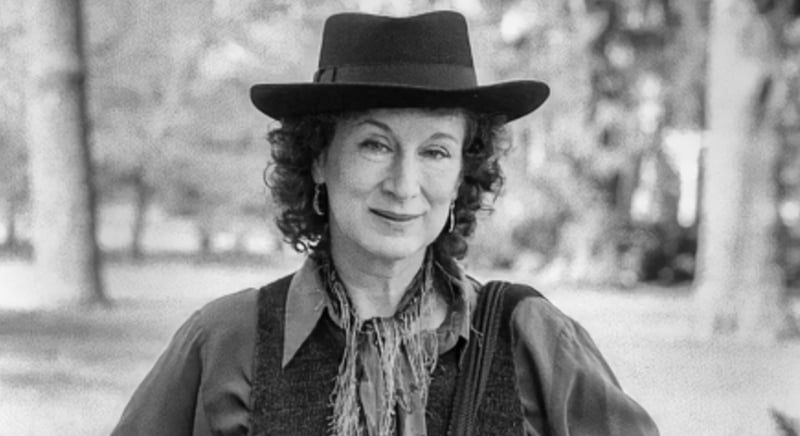
Margaret Atwood (Douglas Elbinger)
There’s an old joke that goes something like this: How many people do you know who went to Harvard? If you’re not sure, the answer is zero, because anyone who went there will make certain you know within 20 seconds of meeting them. It takes Margaret Atwood fewer than three pages in the introduction to her new book to alert readers that she attended Harvard. This comes in the context of a 1967 interview she did after winning a Governor General’s Literary Award for her debut full-length poetry collection, The Circle Game.
Readers will be forgiven for noting a pattern in the opening gambit of what is, at close to 600 pages, quite a long volume. A PhD at Harvard? National award recognition for a first book of poetry (at a time when, as Atwood notes, the relatively new GGs were generally reserved for old warhorses of Canadian verse)? What we are embarking on appears to be the memoir of someone who, having achieved literary and academic success in her early 20s, has lived something of a charmed life.
The path Atwood charts in Book of Lives is notable for its uncommon good fortune. A relatively happy middle-class childhood and adolescence, marred only by psychological bullying at the hands of a nine-year-old nemesis (upon whom Atwood would take literary revenge many decades later in her novel Cat’s Eye). High school at Toronto’s Leaside High, then a bastion of academic excellence, followed by an undergrad at the University of Toronto. There she encountered a young Dennis Lee, who would go on to establish House of Anansi Press, where he published her 1971 poetry collection Power Politics and commissioned her 1972 survey of Canadian literature, Survival. Graduate studies at Harvard, partially funded by a scholarship she’d been encouraged to apply for by Northrop Frye. A first novel, The Edible Woman, published in Canada by McClelland & Stewart, in the U.K. by André Deutsch, and in the U.S. by Atlantic Monthly Press, three industry stalwarts at the time. And that’s just the beginning of a literary career that would elevate Atwood to international celebrity – the closest a poet and literary novelist can get to rock-star status.
Not that Atwood didn’t undergo years of frugal living, renting tiny rooms and skimping on food – while furiously writing her early published works alongside a doctoral thesis aimed at landing teaching jobs to support her creative endeavours. Also relatable is the anecdote about sitting at a table in front of a Coles stationery store hawking books, with the lone person to approach her wanting to know where the Scotch tape was shelved.
Despite this, there is a sense that Atwood grew into herself at a propitious time in Canada, when Canadian literature was just beginning to blossom as a national concern, and cultural institutions promoting it were more plentiful and robust. Her first appearance on CBC television occurred when she was in Grade 10; the producer was a neighbour, the subject was a praying mantis Atwood owned that would sit in her palm and drink sugar water out of a spoon. She notes she was once able to finance a trip across the Atlantic on the QE2 by selling a travel piece to Toronto Life. And to raise money for the nascent Writers’ Union of Canada, she participated in a review that included a skit featuring three noted literary editors of the day: the Toronto Star’s Douglas Marshall, the Globe and Mail’s William French, and Saturday Night’s Robert Fulford. Atwood’s early career flourished in a literary environment those currently at the same age would not remotely recognize.
Atwood herself seems aware of the serendipitous nature of her youth. Perhaps this accounts for the relative lack of balance in the book. The 1969 publication of The Edible Woman occurs close to the 300-page mark, confining the major part of her career to the second half. We don’t get to her most famous work, 1985’s The Handmaid’s Tale, until page 432, leaving the following 40 years – which included such major novels as Cat’s Eye, The Robber Bride, Alias Grace, The Blind Assassin (which won her the U.K. Booker Prize after many previous nominations), and the MaddAddam trilogy – to be run through at a breathless pace in the final 150 pages.
The bulk of the book is dedicated to more quotidian concerns, including successive lodgings – today’s writers, struggling to make rent in Toronto, Vancouver, or Montreal, may blanch at the number of houses Atwood was able to secure on a writer’s income – her courtship by and marriage to Jim Polk, and her long-term relationship with her late partner, Graeme Gibson. One thing that might surprise readers who have assumed that Atwood’s feminist bona fides render her hostile to men as a species is how many boyfriends she seems to have had. “I don’t know how this happened,” she claims, “boyfriends somehow just appeared, like mushrooms after a rain.”
Atwood does reserve space in these pages to settle some old scores. Of the antagonists who come off worst in the book, Shirley Gibson, Graeme’s ex-wife, is given the hardest time; Atwood accuses her of colluding with the late writer Scott Symons to “spread it around Toronto” that she “was a terrible person.” Atwood also has some choice words for Margaret Laurence, who “made scurrilous phone calls” castigating Atwood as “an evil being” after Atwood tried to intercede in the matter of the other Margaret’s alcoholism. Jan Wong gets shellacked for a frankly odious profile of Atwood in the Globe and Mail. And Atwood re-litigates her experience as an online villain in the wake of the UBC Accountable affair involving former University of British Columbia creative writing teacher Steven Galloway.
But the memoir as a whole is not splenetic, and Atwood’s reputation as a sharp-tongued rhetorician is denuded by her evident humour and self-deprecating pose. Her humanity and empathy are most readily apparent when it comes to Gibson; the later pages describing his descent into dementia and ultimately death are profoundly emotional and grief-filled.
The tone of Atwood’s book is conversational and meandering, touching on what catches her memory’s fancy at any given moment. This results in some unfortunate longueurs, while other stories seem glossed over at too frantic a pace. (Or ignored altogether, as in the death of her long-time Canadian editor Ellen Seligman, who also happened to be the second wife of Jim Polk. It’s a small pond, indeed.) Yet what is most remarkable through these 600 pages is the monument of literary output the author has built up over what is by any estimation an astonishing career. Atwood makes much of Canadian politesse, suggesting that our greatest compliment is “not bad.” If something is truly spectacular, we say, “not bad at all.” Reaching the end of Atwood’s frequently engaging, occasionally bloated reminiscence, what one is left with is simply this: Not bad. Not bad at all.




 Contact us via email