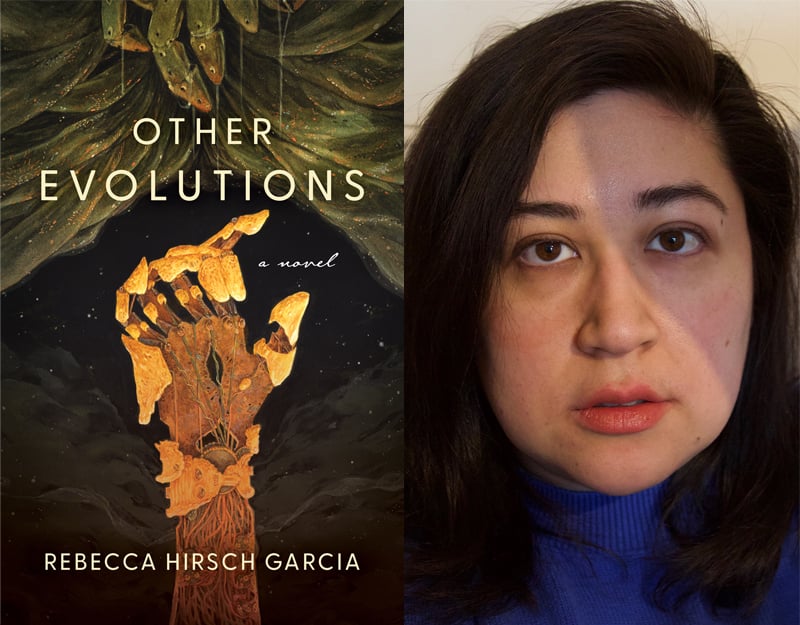
Rebecca Hirsch Garcia’s fiction resists labels. In her work, human ordeals and the fantastic can intersect to poignant effect. Other Evolutions, the O. Henry Award–winner’s first novel, fuses a coming-of-age story with a family tale and ventures into the futuristic realm.
Narrated by Alma Alt, the younger daughter in a close-knit, interfaith, interracial, Jewish-Mexican family, the novel follows her trajectory from childhood to adulthood, revealing the sense of otherness that shadows her days. Tempered by a discerning wit, this outsider perspective deepens as Alma navigates hardship.
Growing up in comfortable conditions in Ottawa, the self-possessed Alma idolizes her older sister Marnie. Despite a largely happy start, Alma, who inherited their mother’s darker features, struggles early on with colourism. “No one ever explicitly called aunt Eshkie a bigot and she was careful not to be something as unfashionable as an outright racist, but she always treated my mother and me as inconvenient intruders in the family circle,” Alma observes. “Even my Marnie, for all her fair skin and blonde hair, was viewed as fruit from the poisoned tree.”
A chance encounter with Oliver, a neighbour, when she is fleeing a family row, sparks a crush that lingers beyond childhood. Later, a fight with Marnie leads the teenage Alma to a disastrous accident that results in the loss of her arm and Oliver’s death.
Separation, both physical and psychological, is a key theme. The eponymous evolutions suggest, in part, the surprising shifts and phases that sculpt an identity. Using episodic scenes that skilfully maintain momentum, the plot moves from Alma’s adolescent journey with disability and grief to an adulthood altered by past trauma.
Unforeseen outcomes extend to the female members of her immediate family. Marnie, abandoning previous artistic promise, becomes an engineer and settles into domesticity, and their mother, Merced, returns to rural Mexico after a health scare. Just as Hirsch Garcia excels at detailing Alma’s sun-dappled interior life, she adroitly charts the changing relationships with those around her.
Family dynamics and a focus on the body also figured in the Ottawa author’s 2023 debut short-story collection, The Girl Who Cried Diamonds and Other Stories, which was shortlisted for the Danuta Gleed Literary Award. The surrealism that tints that collection surfaces again in Other Evolutions when the 20-something Alma spots Oliver alive and well at the site of the tragedy.
“The Oliver I had seen was neither old enough to be the Oliver I had grown up with nor young enough to be an Oliver conceived and birthed in his wake,” Alma explains. “He was an in-between Oliver, an Oliver at eighteen, perfectly crystallized at the moment before his death.”
The introduction of the uncanny here serves to highlight the unpredictability of life, underlining the concept that personal histories are a series of evolutions. Even as this thread of the novel veers into speculative territory, it never descends into gimmickry. Alma is revitalized by the possibility of Oliver’s presence and the emotional gravity and shrewd perception applied to Alma’s surroundings illustrates Hirsch Garcia’s skilful storytelling.
Pursuing autonomy and purpose, the primary characters contend with how they see themselves as compared to how others see them. Hirsch Garcia patterns the novel with ideas about home, kinship, and class, and portrays the capricious ways individual acts and events recur through bloodlines and across time.
Smart. Strange. Sterling. Other Evolutions is a reflection of the complexity of every life – constructed from disparate experiences and charged emotions, shaped in the end by unexpected turns.




 Contact us via email