In a perpetually online, frenzied, and FOMO-driven world that celebrates hustle culture, demands efficiency, and, in ways, eschews true connection, “slowing down” is often held up as a self-care goal, but one that is rarely realized.
Being able to stop and not just smell the roses, but to exist among them, quietly perceiving, learning, and reflecting on the world around us has become an admittedly Romantic notion.
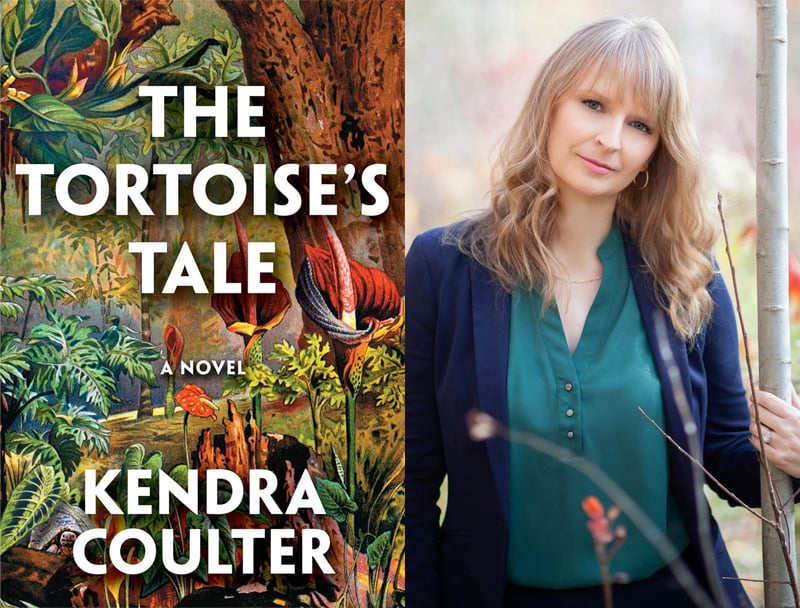
But, for some 240 beautiful pages, we get to experience life from this perspective. The Tortoise’s Tale is an insightful, delightfully unique debut novel from nonfiction author and Western University professor Kendra Coulter.
Whisked away from her homeland immediately after hatching, our titular tortoise knows little beyond the private estate on which she is kept. But, steadfastly curious, extremely intelligent, and painfully empathetic, she learns much through her interactions with humans over her many decades of life.
“How people decided what to do and not do with animals, even those who were very similar, was a mystery,” she contemplates, wondering why some of her animal compatriots are caged while she roams the grounds freely, though none of them remain unscathed from the taunting, disrespect, and worse occurrences that are enacted by visiting humans.
Alongside moments of disheartening cruelty – which range from pokes, cruel words, and thrown objects, to someone pushing our narrator into a swimming pool – there is thankfully light, mainly in the figure of Lucy.
The young niece of the estate’s proprietor, Lucy lovingly ascribes the epithet of “Magic” to the tortoise after their first meeting, marking the start of an extraordinary lifelong bond. Her visits are sometimes regular, and at other times sporadic, but Magic’s love for Lucy beams to the brim throughout, even when she is absent.
Lucy and the resident caretaker are among the few that recognize the tortoise as someone rather than something. And indeed, Coulter’s skilful crafting of Magic’s rich inner life makes it easy to forget that our protagonist is not, in fact, a human who wishes that all creatures could coexist “enthusiastically despite our great differences.”
Even with the hope that characters like Lucy offer, there are the regular reminders of Magic’s animal reality that jolt the reader into confronting our species’ often problematic relationship with the flora and fauna around us; at best we often fail to take the natural world into consideration, at worst we actively destroy it.
Coulter is the author of such nonfiction works as Animals, Work, and the Promise of Interspecies Solidarity and Defending Animals: Finding Hope on the Front Lines of Animal Protection, so the underlying advocacy for the well-being of animal life is not surprising. But, that doesn’t make the tale of a being who bears witness to an evolving cast of animals and humans on one California property for more than 120 years any less artfully rendered.
While there are moments in the latter part of the novel that can feel as if Coulter is trying to tackle too many topics at once, the interrelated themes of feminism, veganism, climate change, and more that she shoehorns in do tie into the main question of how humans relate to the natural world.
Overall, the wisdom of one particularly empathetic tortoise is the perfect vehicle to illustrate the interconnectedness of our world and the necessary ethos of respecting all forms of life equally.




 Contact us via email