Julie Flett, author and/or illustrator of more than 20 books, is beloved among readers young and old. To date, she’s won the Governor General’s Award twice for illustration for On the Trapline and When We Were Alone. Her upcoming book, We All Love (Greystone Kids, Feb. 10), is a companion to We All Play and the next instalment in her We Do Too! series.
Flett spoke with Q&Q about her process, what inspired We All Love, and what it means to be awarded the Vicky Metcalf Award for Literature.
What role have stories played in your life?
A pretty big part. We recently listened to Cree language professor, author, and artist Solomon Ratt tell stories on New Year’s Eve. He’s a beautiful storyteller. He created such a warm space, it reminded me of home, of my dad, his humour and gestures and sounds; it warmed our hearts, and I couldn’t think of a better way to bring in the new year.
I also think of what [Chippewa author] Louise Erdrich once said: “Stories are what we have, really, to make sense of things. It’s through them we learn how to keep going.”
What sparked your interest in illustration?
I listened to a lot of stories as a kid, but drew far more than I read, always drawing and making things. I worked on my first book in 2004 with Theytus Books – and I fell in love with it. I fell in love with sitting with the text and putting together what I heard and saw, and then watching children pick up the books and where they saw themselves in the work. My sister, who was working with Theytus at the time, brought me in. I didn’t have a background in illustration, but I’d been drawing all my life, and she asked me if I wanted to give it a try. There were not a lot of Indigenous children’s books at the time, so not only did I love working on the book, but then knowing the impact it had on others, I thought: yes, this is what I want to do.
Did you know from the outset that you wanted to create children’s books?
I made lots of little drawn books as a kid, stories about my sister and me. And interestingly, it wasn’t until my sister introduced me to the world of bookmaking as an adult that it really took hold.
How much of your inspiration comes from the natural world?
A big part of it. I always start book projects – develop my illustrations – with the landscape. The land always informs the overall feel of the book. Drawing a landscape is like drawing a poem, and the more books I do, the more the world of creatures, the land, and us inform the stories I work on.
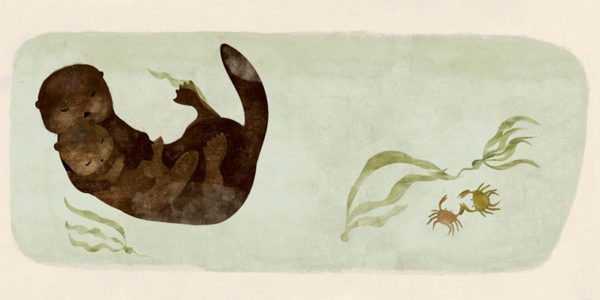
Illustration: Julie Flett.
As an author-illustrator, what comes first, the story or the art?
The feeling comes first and then sometimes it’s the illustrations that need sketching out, and other times it’s the text; often I go back and forth between the two. I remember working on the story Birdsong with Greystone Kids: it was supposed to be a wordless picture book, and halfway through the process, the words came to me pretty strongly. Working on the We Do Too! series, this process really went back and forth. For the series, often I’ll watch or think about the animals in the book, and they’ll start to tell the story, whether that’s through text or image.
Do you recall what inspired We All Love?
I write a little about this in the backmatter, about how I’d been thinking about this story for a long time, about the love that’s in everything we do and are. I thought about the stories kids share with me after readings together, and the things they love: grandmas who rub sore tummies, seeing their loved one waiting for them after school – all of those connections. And the things that keep us curious and connected: flowers communicating through molecules and sound, turtles dancing to magnetic fields, the stars and music through math and story, mama bears rescuing their cubs, and shrews navigating their way.
What do you hope young readers take away from We All Love?
Kisâkihitonaw translates to we all love each other – and I love the thought of doing a reading together with a group of kids and then listening to their stories about love: their own connections to friends, family, creatures, the earth, and all, whatever resonates with them. There’s really nothing better than knowing that a book can be a forum to have these conversations together.
What does it mean to be awarded the Vicky Metcalf Award for Literature for Young People?
I learned about the Vicky Metcalf Award through the Writers’ Trust, and I had no idea I was up for the award. I’m still processing it, in a wobbly-leg way. It’s such a beautiful award. When I think of Vicky Metcalf’s body of work and her advocacy for children’s books as an author and librarian, I just feel so tremendously grateful to be included alongside all of the other children’s bookmakers who have been impacted by her work and this award. And what a privilege it is to write and draw and advocate for children; I couldn’t feel more grateful and encouraged.
This interview has been edited and condensed.
Photo Credit: Courtney Molyneaux.




 Contact us via email