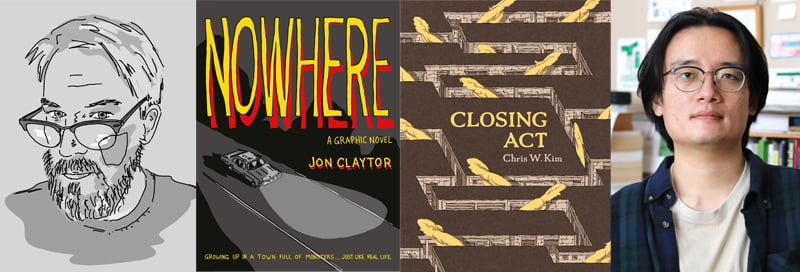
l. to r.: Jon Claytor; Chris W. Kim.
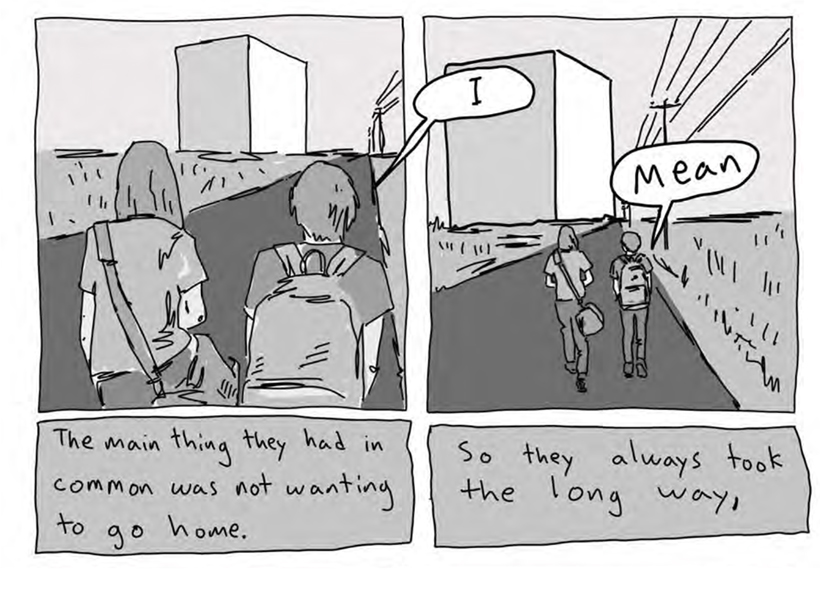
In Jon Claytor’s graphic novel Nowhere, a young boy finds himself stranded in Beauséjour, a small town that seems cursed with every manner of paranormal activity: zombies roam the streets at night, demonic landlords seek to squeeze the last dollar out of their tenants, and ghostly parents fail to provide much guidance for their wayward children. Above it all, a mysterious white cube looms, a massive bit of postmodern architecture plopped into a cow pasture that none of the town’s residents can remember having been built.
Twelve-year-old Joel is living indefinitely in a roadside motel, splitting a cramped single room with his melancholic mother, alcoholic stepfather, and a small menagerie of pets. Enrolling himself in school and eventually connecting with a gang of local kids, Joel initially expresses only mild curiosity with the strange happenings unfolding in Beauséjour – understandably, his adolescent mind is more focused on hanging out with his new friends at the arcade, avoiding his verbally abusive stepfather, and most of all bonding with Charlie, a local girl whom Joel dreams of making a movie with, though the pair struggle for inspiration. “Ugh, our movie would just be us wandering around aimlessly,” Charlie notes, “we’d need a better pitch.”
Jon Claytor
With its 1980s setting and nostalgic love of the movies, Nowhere wears its cinematic influences on its sleeve: The Monster Squad, IT, Twin Peaks, Christine, and The Fly all loom large, and genuinely fun moments incorporate and gently tweak the tropes Claytor surely absorbed in his own childhood (younger readers will doubtless feel the Stranger Things vibes). Nowhere feels like randomly flipping channels on an old black-and-white TV, pausing to watch disparate scenes that are familiar and can even be intriguing on their own: a sentient, broken-down Chevrolet Impala that cruises the streets at night; vampiric police officers that demand to be invited into your home without so much as a search warrant; and depressed, only slightly terrifying clowns confessing their inner fears to disinterested therapists. This channel-surfing, stream-of-consciousness rhythm is both Nowhere’s signature mode and its greatest weakness. The chopped-up narrative creates a distinctive mood of paranoid childhood anxieties, but the disparate elements never come together to form something greater than the sum of its parts.
Claytor deploys a raw art style that lends a sense of refreshing immediacy and sweetness to this quirky Bildungsroman; Joel writes down his observations of his “strange life” in his journal, and the pages of Nowhere, with their black, white, and red colour palette, sometimes feel like they’ve been torn straight from a spiral-bound notebook. Claytor openly plays with the tools of digital art, including a too-frequent use of copy/paste techniques that, with a few exceptions, feels lazy rather than pointed. The drawings can have a pleasantly loose quality to them, and Claytor’s faces call to mind the drawings of Arizona O’Neill, right down to the circles indicating the characters’ rosy cheeks.
At its best, Nowhere is a thoroughly nostalgic and occasionally poetic homage to the strangeness of childhood. But like his protagonist, Claytor seems to be stuck in a bit of a loop here. At the end of this nearly 450-page graphic novel, the reader has the impression of being back where we started, on very familiar narrative territory.
Whereas Nowhere depicts a small town that seems to be caught in a time loop, Chris W. Kim’s Closing Act takes place in a claustrophobic urban landscape that is defined by a state of constant flux. When Lea’s bag is snatched by a young thief in a hoodie, she recklessly chases after him into an alleyway and becomes lost in an ever-changing, parallel universe that exists within the more commonplace streets of a bustling city. Here she meets various “alleyfolk,” the oddball denizens of this liminal space, including Dee, a map-maker who tries in vain to chart the mutable pathways of this shifting and collapsing microcosm; Yannis, an artist who captures the bizarre cityscape in delicate architectural drawings; and Jo, a woman who passes her time on the rooftops observing the comings and goings of the other alleyfolk, much to their annoyance.
If Nowhere presents a world in which all of cinema’s monsters are real, Closing Act stakes a claim in the literary playground of fabulists like Italo Calvino and Jorge Luis Borges, taking a simple metaphorical conceit and teasing out its ramifications to their logical endpoint. As the winding, maze-like alleyways grow smaller and smaller, the various alleyfolk approach the seemingly inevitable collapse of their universe with differing philosophical attitudes: some desperately seek to escape, others stoically adapt to the world around them, and some adopt a cheerfully zen attitude about the whole thing. The world Kim depicts in these pages is certainly “a strange, synthetic vision,” but it all seems to follow a secret, hidden logic that drives both the reader and Kim’s characters ever deeper into the labyrinth.
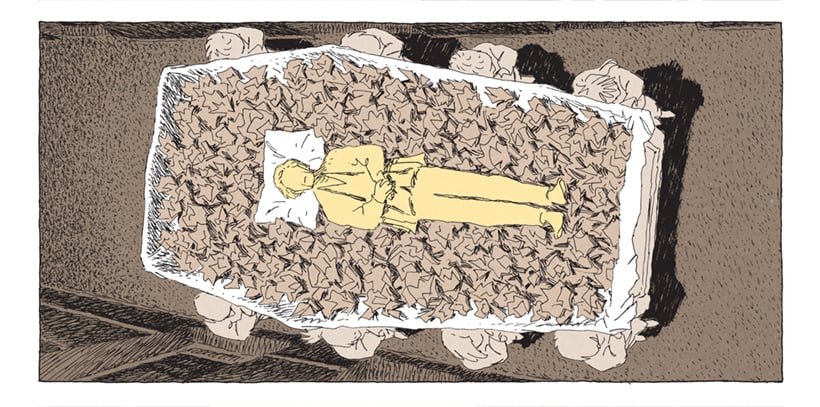
The alleyfolk’s lives are a microcosm of the outside world: they trade worthless trinkets with each other and nurse petty grievances that occasionally explode into moments of pointless violence. Like an amateur anthropologist, Lea comes to understand the quirks of the individual alleyfolk as well as their broader culture. In one strange and beautiful scene, mourners line the alleys for the funeral procession of a man laid to rest in a gigantic coffin that is designed to just fit in the narrow confines of the alley; a superstitious, likely futile attempt to keep their world from shrinking even further. Everyone in Closing Act is trying their best to adapt to a world they never chose and whose rules feel arbitrary and mysterious: “Different neighbourhoods will be forced together and create strange hybrids. A whole new etiquette will develop around navigation…. Open space will become a luxury.” The parallels to our own world – ever-more crowded, chaotic, and confusing – are both evident and pleasantly slippery.
Chris W. Kim
Drawings and maps are key elements to the narrative of this graphic novel, and Kim blends a range of artistic techniques to bring the alleyways and their denizens to life. His mark-making is varied, from fine-line characters that seem like they are about to vanish off the page to scritchy-scratchy shading and the occasional bit of bold brushwork, a mix that brings to mind David Mazzucchelli, another artist whose work engages deeply with architecture and space. Kim maintains an icy remove from his characters’ lives; Lea’s downcast, mask-like features hide more than they express, and the alleyfolk’s emotional realities remain obscure, as if observed by an alien intelligence.
In Closing Act, Kim presents a claustrophobic vision of a world that is growing smaller and stranger by the day. Both familiar and bizarre, this graphic novel would fit perfectly on the shelf alongside Calvino’s Invisible Cities and Borges’ Labyrinths.
Excerpted from Nowhere, copyright © 2026 by Jon Claytor. Reprinted by permission of Goose Lane Editions. For more information, please visit www.gooselane.com.
Excerpted from Closing Act, copyright © 2026 by Chris W. Kim. Reprinted by permission of Conundrum Press.




 Contact us via email