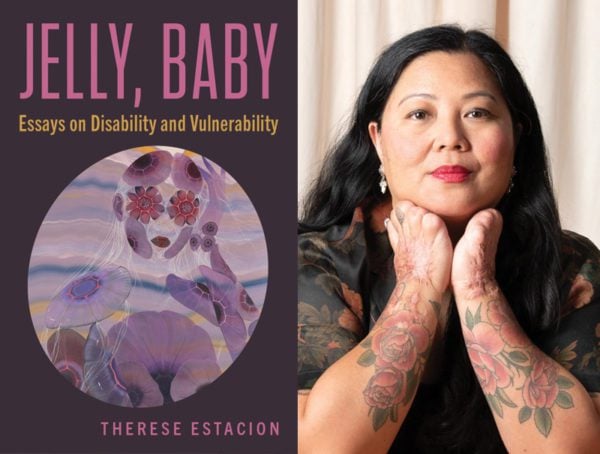
Therese Estacion (Isabelle Côté)
One of the long-held concerns of the international disability community is that the non-disabled world prefers to keep disabled writers confined to a prescribed box wherein we write endlessly and non-confrontationally about loss but never express our rage. Until now. In the six lyrical essays of Jelly, Baby: Essays on Disability and Vulnerability, poet Therese Estacion sings rage in full voice. Every note resonates with what it means to live permanently vulnerable to ableism; Estacion had her legs and fingers amputated and her reproductive organs removed after a bacterial infection. In an unflinching follow-up to her much-lauded first volume of poetry, Phantompains (also published by Book*hug, in 2021), Estacion orchestrates a moving, musical work of disability justice that explores the reprising interplay between loss, grief, vulnerability, and rage.
Estacion’s book is both an accessible memoir and a work of unapologetic advocacy. She writes about being rejected on sight at a job interview, asked by a flight attendant to prove why she needs an accessible washroom, and how she has come to see children asking endless questions about her prosthetic legs as entitled brats. In a brave move, she calls out two entitled non-disabled poets for their “use of prosthesis as a poetic device, as objects to use and appropriate in order to explore the meaning of their own interiorities. I want to let them, their editors, their publishers know they’ve made an error.” Noting that silencing is systemic (until recently we were “locked up, sedated, lobotomized, ushered secretly in the underground tunnels of ivy league schools so [we] could be experimented on—and murdered”), she correctly notes that CanLit makes little space to address our current silencing.
It is in her exploration of the aswang, a murderous, “monster” figure from Filipinx folklore that she most successfully entwines rage and grief: “If I were an aswang, I would enjoy the terror. I would enjoy stabbing. It would be nice to finally get to stab someone for bragging about … how many fucking steps they got in at the gym, or how they wouldn’t know what to do if they ever broke a leg or a finger. (Stab!) Oh, that’s nice. Stab, stab, stab.” An aswang can also be a baby eater, which launches Estacion into a fabulous rant about hating all things baby, from “shitty baby shower gifts” to having to share an accessible bathroom, concluding, “I just want to kill them.” She ends with touching grief, “But most of all, I hate all the times I’ve held their babies and knew I had to give them back.”
It is these passages, that abled audiences likely misread as humorous hyperbole, where she most clearly reaches and uplifts her disabled audience. We applaud her conclusion that the aswang might not be a monster after all: “She gave me permission to feel my rage and hate. She lit a torch, handed it to me and said, Burn.”
Most commendable is Estacion’s refusal to end with the pandering trope of “overcoming” disability. Instead, she remains “too vulnerable an animal” in a “gelatin self” that “can never be separated from grief” and can always be “dissolved by ableism.” She offers only tentative acceptance of her new prostheses: “Perhaps we will talk more. Perhaps we will begin to dream.” She vows only one thing, “let us continue.”
Many of the first Canadian books by disabled authors were written for non-disabled audiences. Today, we can all celebrate progress. Jelly, Baby joins Leah Lakshmi Piepzna-Samarasinha’s The Way Disabled People Love Each Other as an important contribution to a new era: books written by and for disabled people, where non-disabled readers are a welcome, but rightfully a secondary, audience.




 Contact us via email