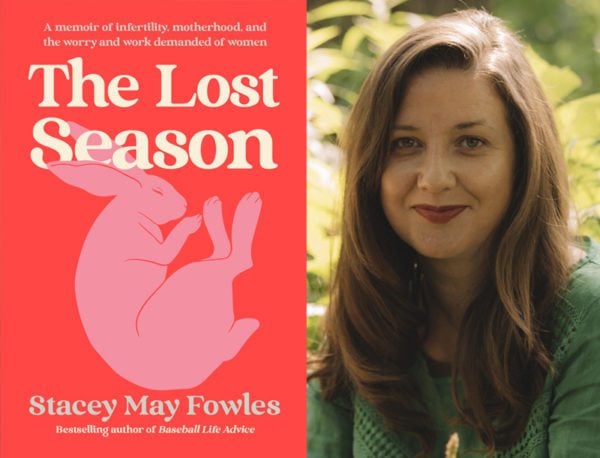
Stacey May Fowles (Jenna Marie Wakani)
These days, the term “liminality” is used to describe just about any place or thing that gives a sense of ambiguity or unease, but when folklorist Arnold van Gennep first coined it back in 1909, it had a very specific meaning: the point in a rite of passage when the participants have shed their former social roles, but have not yet gained the ones they will have when the ritual is complete. Think of a baby midway through a baptism – they’re not unbaptized anymore, but they’re not really baptized yet, either. Liminal comes from the Latin word limen, which means threshold, and it describes a state of disorienting suspension between the past and the future.
It’s this space that Stacey May Fowles explores in her latest work, The Lost Season: A Memoir of Infertility, Motherhood, and the Worry and Work Demanded of Women. Like many women, Fowles found the transition into becoming a mother unexpectedly challenging, particularly when it came to the loss of her old identity as an essayist and freelance sports journalist. She’d pictured herself attending spring training and book launches with an infant strapped to her chest, breezily having it all; instead, she found herself bedbound while recovering from a traumatic birth, watching the work opportunities that used to flow into her inbox slow to a trickle. It didn’t help that her pause at the threshold of motherhood was more protracted than most: after an extended period of infertility and then a pandemic that began when her daughter was a toddler, Fowles’s lost season occupied years of her life.
Most people engage in the act of mythologizing their important moments: how their childhoods shaped them, how they met their partners, the high and low moments of their careers. Humans are natural storytellers, and creating a narrative arc out of the messy, mostly random events that happen to us helps us make sense of our lives. Having a child is no different; there’s a reason that birth stories are such a popular genre of social media posts. But most of these personal myths are generally only interesting and important to the people telling them, unless they happen to be a particularly gifted raconteur. Fortunately, Fowles is.
Part of what makes Fowles’s writing so stellar is that she never shies away from scrutinizing her own thoughts and beliefs; when she catches herself feeling disdainful of the other mothers at the library song circle for their saccharine smiles and seeming enthusiasm for “The Wheels on the Bus,” she sees her own insecurity reflected in that moment of judgment. Another strength is Fowles’s generosity in sharing painful personal details, many of which will resonate with women who are going through isolating experiences like infertility and postpartum anxiety. Mostly, though, The Lost Season succeeds as a book because Fowles is really good at her craft.
In one of the final chapters, Fowles describes finding the beauty in living “a small, good life,” one that differs from the life her rapaciously ambitious workaholic former self had thought she wanted. Her sentiments are no doubt correct, but this book proves that her aspirations to greatness were too.




 Contact us via email