Anakana_Schofield (Arabella Campbell)
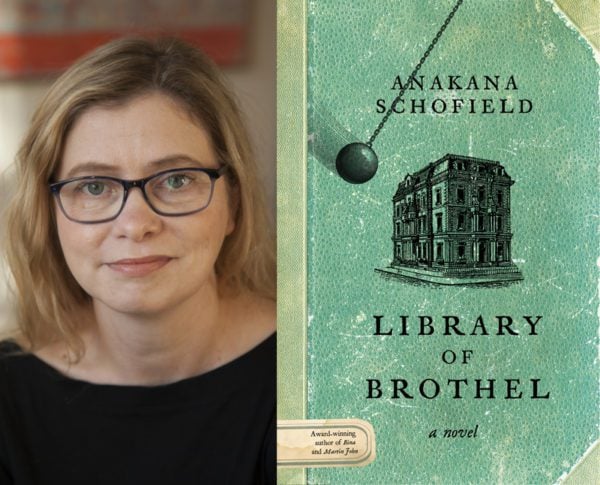
In 1941, the Argentine writer Jorge Luis Borges published a story called “The Library of Babel” about an infinite and eternal library containing everything ever written, or that ever will be written, in every language in the world. It seems apparent from her choice of title that Irish-Canadian author Anakana Schofield desires her readers to bear in mind Borges’s absurdist, theosophic tale while reading her fourth novel, notwithstanding the obvious discrepancies between them.
Unlike Borges’s library, which is mathematically rigorous (each of the “indefinite and possibly infinite” hexagonal galleries comprising five shelves along all sides save two), Schofield’s sprawling, late-19th-century edifice is a haphazard collection of rooms (“almost identical … except many have sinks and several have fireplaces”) dedicated to all manner of esoterica: there is the John Keats Room and the History of Public Transit Room, along with more specialized fare such as the Giraffe Room, the Virgin Deities Room, the Tax Ballads in the Eighteenth Century Room, and the Extinct Russian Horses with Fringes Room. The proprietor of each individual chamber is known by his or her room name – thus the operator of the Henry George Room is called Henry George Room, and so on. The lone exception is Scrabble Room, who also goes by Scrabble Woman, “for she is a woman.”
If this seems somewhat arbitrary, it is of a piece with the novel’s entire strategy. “Let us call it the Library,” reads one of the book’s opening lines. “The Library of Brothel. Our Brothel of Library. We’re still deciding which name to give it for you. It doesn’t need to be set, does it?” Indeed, not a lot is set in this labyrinthine and numinous anti-narrative that spends much of its time flagrantly rejecting the conventions of a well-made novel. Themes around the precarity of labour, worker dignity, and sexual politics (a recurring motif in Schofield’s defiantly feminist work) are discernable, but anyone looking for traditional approaches to other novelistic properties may come away frustrated. There is no plot to speak of; characters, as we have seen, have largely been denuded of recognizable identifiers – most obviously their proper names. The woman in charge of security is called Security and the chief librarian is referred to by the vaguely communist moniker Noble Leader.
As for the setting, the building, which some workers are afraid is soon to be condemned, especially as more patrons move online, sits on Broadway in Vancouver, and there are scattered references to the CBC, but not enough in aggregate to add up to a realistic landscape. It is perhaps best to consider the novel like a work of abstract expressionism, with cumulative details creating a non-representational image that a reader may interpret through variations of shading and colour.
Much of the tone, as befitting a Schofield novel, is satirical, and there is the occasional side-swipe at current events, such as a mention of “anti-vaxxers wearing MACA hats.” (A footnote informs us that MACA stands for “Make America Canada Again.”) The novel unfolds in 2024, so there are references to the “Great Virus” that isolated community members from one another and left the library bereft of patronage, along with sarcastic notes on our post-COVID existential state: “We need to convey an urgent requirement to return to interaction or risk social extinction and see the planet left with the continuing existence of only the seven most annoying individuals, who practise levels of narcissistic individualism that would cause a stroke for the average rail passenger innocently staring out the window.”
In her previous work, Schofield struck a pleasing balance between form and content; here the balance tips too far in the former direction, with not enough left to make the latter satisfying, let alone, in places, comprehensible. There is grand stylistic ambition here: if her previous novels leaned heavily on her abstemious Irish ancestor Samuel Beckett, the abiding spirit in Library of Brothel would appear to be James Joyce by way of the Latin American fabulist alluded to in the title. Isolated moments work nicely, and there are flashes of the wicked humour that has always been one of Schofield’s finest attributes, but the whole thing struggles to cohere.
John Barth, in an essay titled “The Parallels!,” distinguished between algebra and fire, terms he similarly borrowed from Borges. “Let ‘algebra’ stand for formal ingenuity,” Barth wrote, “and ‘fire’ for what touches our emotions.” Both are required for what Barth called “passionate virtuosity” – the condition novelists should ideally strive for. A preponderance of algebra, Barth suggested, results in “mere geewhizzery,” while too much fire “makes for heartfelt muddles.” In her 2015 novel Martin John and, especially, its 2019 follow-up, Bina: A Novel in Warnings, Schofield got this ratio almost exactly right. By focusing too much on algebra in her latest, she risks alienating readers who long for a little bit more humanity to accompany the flamboyant technique.




 Contact us via email