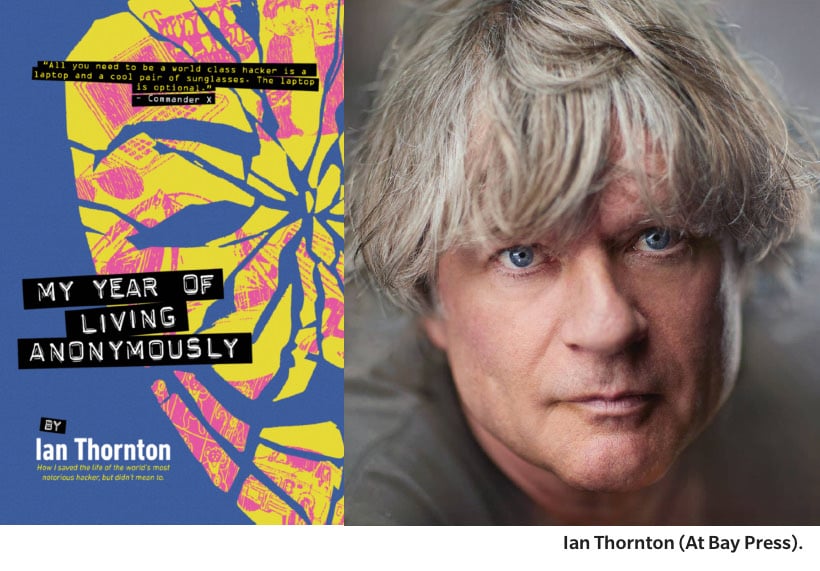
In 2016, Ian Thornton was walking through his downtown Toronto neighbourhood with his two small children. He wasn’t thinking about hacking collectives or geopolitical change, but he was working on a second novel, which meant he was in a period of close and careful observation, seeking inspiration anywhere.
He kept seeing a man who was living rough and asking for change; the pair struck up a casual rapport. The man was friendly with Thornton’s children, and Thornton, noticing he was a reader, decided to give him a copy of his 2013 debut novel, The Great and Calamitous Tale of Johan Thoms: How One Man Scorched the Twentieth Century but Didn’t Mean To.
But the casual sidewalk connection changed when the man revealed his true identity: he wasn’t, in fact, Gordon Powell, but Christopher Doyon, also known as Commander X, the legendary Anonymous hacktivist sought by the FBI since 2011. This revelation kicked off an intense year of friendship during which Thornton and a friend worked with Doyon to help him share his story in a documentary directed by Gary Lang called The Face of Anonymous, which ultimately premiered at the 2021 Hot Docs Film Festival and was shown at a few international film festivals and aired on TVO.
Doyon left Toronto in 2017, boarding a Greyhound bus to start a journey that took him through the U.S. to Mexico. In 2021, he was deported to the U.S. to face a decade-old hacking charge in California. Thornton chronicles his friendship with Doyon and Doyon’s Toronto life in his new book, My Year of Living Anonymously: How I Saved the Life of the World’s Most Notorious Hacker, but Didn’t Mean To, published July 14 by At Bay Press.
Thornton recently spoke to Q&Q about his first nonfiction title.
Ian, this is a wild story.
It’s insane.
You take readers on a real journey from the everyday city occurrence of passing someone on the street to almost making a documentary with Werner Herzog and then observing and recording a notorious hacker wanted by the FBI leave Canada to sneak into and out of the U.S. A decade later, does it still feel as wild to you as it reads?
At the time and for years after – and still, when I was just editing the book – the wonder of it all came back, the anxiety of it all came back. It was such a pendulum of emotions. The chances of this having happened just from dropping two dollars into a cowboy hat – it was really falling into this vortex of a real-life Mr. Robot. It’s something I’ll always be very grateful for.
I noticed him because I was pushing a stroller down the street. I wasn’t rushing for a streetcar to go to an office job. I was in writing mode, when the antennae are up. As writers we look for the smallest detail in the street, in a drop of rain, in the way a car goes past, in something you hear on the radio. Anything can be an inspiration. It’s a heightened sense of being where we try to connect with clues and inspiration.
We look down at [people on the street], and we patronize them and there he was – between asking for change he would go to the old Starbucks at the corner of Queen and Ossington, tap into the Wi-Fi when he had enough money for a mocha with six sugars, and he could bring down a North African dictator – which he did, he helped to bring down [Hosni] Mubarak in Egypt and Ben Ali in Tunisia – and then go to sleep in front of the old people’s home in Trinity Bellwoods Park at night with his laptop wrapped in bubble wrap under his head. We look down at these people but there they are, having serious geopolitical impact.
What do you think it was about your first encounters with him that made it become something so much more?
I think part of it stems from him. He looked at me in a certain way. I’m a nosy novelist; I knew there was a story behind those eyes. I wasn’t looking for a story, but I’ve always been attracted to characters and the disenfranchised. Looking back now, I feel like he was kind of checking me out; he was looking for an ally and I clearly fit the bill after six weeks of a friendship when I believed him to be a chap called Gordon Powell who was nice to my kids. He was a reader; that’s the other thing. He was reading a thick sci-fi novel, and it was so different from the other people on the street. I’d just had my first book published and it was nice to see someone with their nose in a book as opposed to holding a cardboard sign asking for money for weed. There was a kinship there for a literary type who was clearly having it rough out on the street but was still devouring literature.
When did you first decide you wanted to share this story as a book, and why?
It started off with a desire to tell the story on a screen, and as we went along it was evident there was a book in there as well. After he left, which was in September 2017, it started to become clear that if there’d been this interest in the screen version that I should probably write it up as a book as well, for which [Doyon] gave me his blessing.
Can you tell me a little bit about your transition from writing fiction to writing nonfiction? How did that feel?
I find with fiction, one can only go to the creative well so much. I threw everything into my first novel. To have a story to tell where all the details are there and I didn’t have to rely on my own flight of fancy was somewhat of a relief. All the cornerstones, all the touchstones were there, so it was connecting the dots and retelling something that was already fact and history. The pressure was off to have to create something magical, because something magical was happening right in front of my eyes.
How did you go about reconstructing your earlier interactions with Chris from before you started recording him for the documentary project?
I transcribed a lot of his interviews, and used that as a springboard. Then, I went back through my notes, I went back through my contemporaneous emails to myself, to my contemporaneous texts and started to build it out from there making notes as I went along – “oh yeah there was this story,” and “oh yeah there was that story” – and then tried to slot those in in the right place in the timeframe and then it started to come together.
What do you hope readers take from your experiences with Chris?
It would be almost trite to say not to underestimate people on the sidewalk, because one could live a whole lifetime and not stumble across such a story again. But it doesn’t have to be about stories, it can just be about decency to people and to know that there are stories and trajectories and sadnesses that take people to the street.
The one thing that I like to add as a postscript here is that when Chris was out in minus 35 degrees, Ben Ali was in his gold palaces in Tunis and Mubarak had his death camps outside Cairo. They were despots, and Chris was living outdoors in the cold. By the time those two were either buried or jailed for life, Chris was in a hammock in Mexico smoking a spliff and having a beer.
I’ve got goosebumps just saying that again, because that makes me really, really happy.
This interview has been edited and condensed.




 Contact us via email