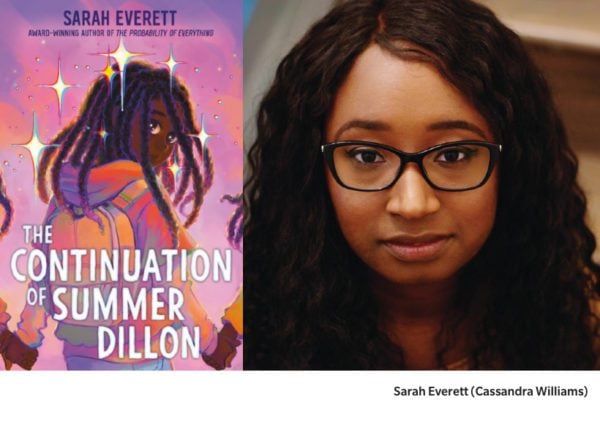
What is a human being? The Enlightenment Age, also known as the Age of Reason, foregrounded humanity’s natural autonomy, in stark contrast to earlier periods where human beings were seen as entirely beholden to religious and monarchal will. With technological advancements – pacemakers to help our hearts beat, glasses and contacts to help our eyes see – what constitutes the human body has become part of the debate. Now, in 2026, award-winning Canadian author Sarah Everett shows in her middle grade novel The Continuation of Summer Dillon that these philosophical anxieties surrounding the meaning of humanity are just as poignant and relevant to children as they have been for scholars across the centuries.
Summer 2.0 is an android created as the doppelgänger of Summer Dillon. The original Summer Dillon is dead, and in the wake of their grief, her parents commission the creation of Summer 2.0, a task carried out by the mysterious entity known as The Scientist. In this world, androids aren’t uncommon. And indeed, as Summer 2.0 finds out, many unresponsive, failed Summers were created to try to approximate the life and personality of the Dillon’s dead daughter. But while Summer 2.0 attempts to be the best “Summer” she can, she faces questions of identity and belonging that are not easily solved. Summer’s sister, Alice, doesn’t trust Summer 2.0 and treats her with disdain, despising the fact that her parent’s decision to continue her little sister didn’t seem to include her feelings. Furthermore, some people in the country hate and fear androids because they consider them different from humanity. But is she? She doesn’t have a heart or a brain – not exactly. But she experiences the same panic and anxiety of losing her loved ones and her very place in her new family – and in the world – when she begins to glitch and her android body begins behaving differently than it was designed to.
Sarah Everett tackles issues of identity without talking down to her middle grade audience. The frankness with which she deals with issues surrounding the nature of a child’s body and mind, and the seriousness of the changes they go through, show that she intuitively understands how prevalent these questions already are among preteens. The mournful narrative, haunted by grief, only highlights Summer 2.0’s innocence as she struggles to find her new normal, even if it means giving her body up to science for experimentation (mimicking painful histories of medical experimentation on Black bodies). Even as she explores serious and complex themes, Everett makes sure to keep the pacing fast, the short paragraphs flowing, and the writing accessible to young readers. Contending with grief is inescapable in this novel: the original Summer, a sweet, but unsure child, remains a very real presence conveyed through the heart-wrenching prose, journal entries, and footnotes. The novel’s unwillingness to erase the first Summer is itself a bold declaration that the dead continue to have a presence among the living, like ghosts. When the Dillons decide to get rid of the other Summers that were created in search of the perfect fit, when even Alice writes a letter to The Scientist agreeing with their discontinuation and recycling, the book challenges people to think deeply about the meaning of life, death, community, and belonging. Watching Summer 2.0 struggle to grapple with these deep philosophical questions as she faces recycling herself is an enlightening and heartbreaking experience.
What makes us human? What makes us us? What makes us part of a collective? What happens when we transition and change? Do these questions cease to matter when we die? Do we cease to matter? The Continuation of Summer Dillon is an important opportunity for both parents and children to consider what they believe.




 Contact us via email