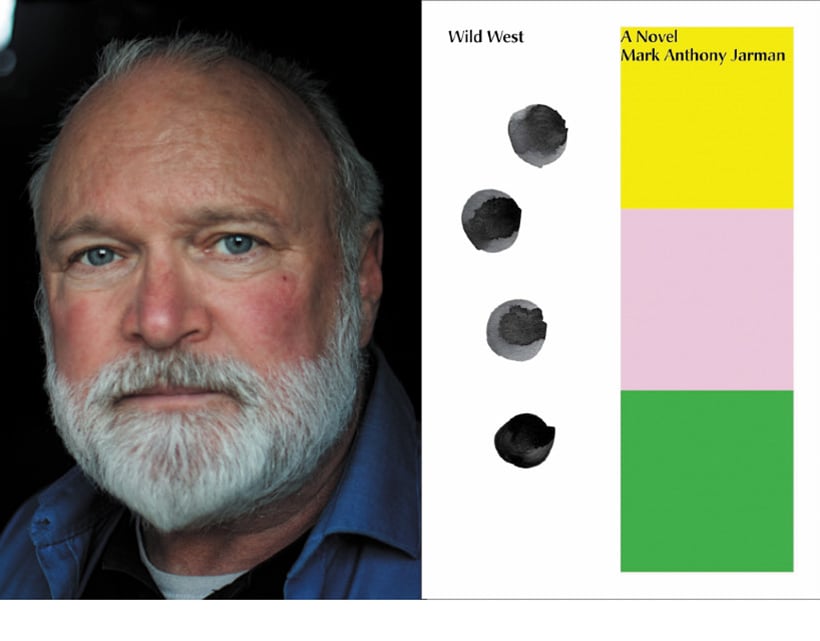
When Flying Books publisher Martha Sharpe initially proposed that author Mark Anthony Jarman compile a novel out of a clutch of short stories set in the 19th century of Louis Riel and General George Custer, the author’s reaction was not enthusiastic.
“I resisted it,” he says now.
“Totally resistant from the start,” Sharpe says.
That resistance led to almost three decades of back and forth between the two, even as Sharpe moved from her position as publisher at House of Anansi Press, where she brought out Jarman’s 2000 collection 19 Knives, to a stint at Simon & Schuster, to founding a mini-chain of Toronto bookstores called Flying Books, to establishing her own publishing imprint of the same name.
Sharpe eventually wore the author down: Wild West, Jarman’s second novel, is out this week from Flying Books. But, like the novel itself, its creation was a wild and often bumpy ride.
Jarman’s reluctance had little to do with the material, which traces the peripatetic and violent journey of an unnamed narrator across the U.S. and Canada, from Little Bighorn up through Assiniboia and Batoche in Saskatchewan, during the time of Riel and Gabriel Dumont’s North-West Resistance. It had much more to do with the notion of a novel itself.
“My brain is wired to the short form,” Jarman says. “I think the story is the best form.”
It’s a literary form that Jarman has mastered over the course of numerous acclaimed collections, including 19 Knives, My White Planet, and this year’s Smash and Grab. In 2023, when Biblioasis brought out Burn Man, a career-spanning collection of stories chosen by Jarman himself, The New York Times praised the author for his ability to “set off entire fireworks displays on every page,” and called his writing “lush and searing.”
Those qualities are also apparent in Wild West, which moves from Fort Garry in what is now Manitoba and the execution of Thomas Scott by Riel’s provisional government, across the U.S. border and back, finishing in 1886 at Lac Ste. Anne in Alberta. The novel is replete with the kind of linguistic pyrotechnics and baroque violence Jarman is known for, often in the same passage: “O bloody period the knife draws to a quicksilver end, and my eyesight turns orange, turns inward, gears up into an interior explosion, flashes of pain in a rude galaxy of light, chemistry split by lightning, a blood riot.”
In this, the novel bears a close affinity with Jarman’s short fiction, which is the context in which much of it originated. While 19 Knives is probably best remembered as the source for “Burn Man on a Texas Porch” – a technical powerhouse and one of the best stories ever written by a Canadian – it also contained “Skin a Flea for Hide and Tallow,” about an unnamed narrator who had fled Fort Garry and travelled south through Montana and Nebraska, eventually riding in the company of George “Iron Butt” Custer. That story, along with others from different books – including “Night March in the Territory” and “Assiniboia Death Trip” from My White Planet and “Gravedigger Blues” from Smash and Grab – form the bedrock of the novel, reordered and augmented with new material and an epilogue.
Though Sharpe was convinced the anonymous voice in the stories could serve as a single protagonist over the course of one narrative, fitting the pieces together took some finessing, especially in the face of Jarman’s disinclination to work on a longer, sustained fiction. (He had
published one novel previously, 1997’s hockey-themed picaresque Salvage King, Ya!, along with a couple of travel memoirs.) The two kept up a correspondence after Sharpe left Anansi and she would occasionally ask whether he had more material featuring the narrator from “Skin a Flea.”
“‘Skin a Flea for Hide and Tallow’ felt like a little glimpse at something much bigger to me,” Sharpe says. “I asked Mark, ‘Do you have more pieces that are about this unnamed guy?’”
Over the years, Jarman would intermittently feed her bits of work until finally becoming frustrated at the prospect of having nothing more to show. During this period, while Jarman continued to publish collections of stories and Sharpe worked toward launching Flying Books, it became apparent, at least to Sharpe, that there was a distance between her vision and Jarman’s.
“I had all along been trying to think of it all as one novel,” she says. “While Mark himself definitely wasn’t.”
Indeed, Jarman’s self-definition as a story writer continued to hold sway over the course of two decades’ worth of Sharpe’s prodding. “I resented the idea that the story was the little kids’ table and then you graduate,” Jarman says. “But every publisher wants that.”
It was a similar public comment by the author at the Toronto launch for Burn Man, which took place at the College St. location of Flying Books, that caused Sharpe to finally snap. She took every fragment that Jarman had sent her over the years, including scratch-pad notes, unconnected thoughts, and ideas, and assembled them into a single file, which she admits was disjointed and chaotic, but in which she could see at least the outline of a coherent novel.
“It wasn’t a narrative itself. It was just pieces,” she says. “I just wanted to see if it could be done.”
Jarman credits Sharpe for pointing out the places that required reworking or additional material to connect the narrative dots, including the inclusion of a prologue and an epilogue,
things that initially felt very alien to him – if not to his writing students at the University of New Brunswick. “I always kind of mock my sci-fi students, who always have to have a big prologue and then you get to the story. Why was this thing in the beginning? It was almost mandatory,” Jarman says. “But it was very handy, actually, to be able to fool around with the prologue and the epilogue and see what might go where.”
In the end, it seems to have worked out: after almost three decades of needling and cajoling, writing and rewriting, what has emerged is a novel that flows seamlessly, as though that was what it had always wanted to be.
“I asked Martha, ‘Do you think it’s working?’” Jarman says. “I just kind of hope for a reader.”
Sharpe’s response belies coming to the end of what is undeniably a long road for her, Jarman, and the book’s beleaguered central figure: “Hope so.”




 Contact us via email