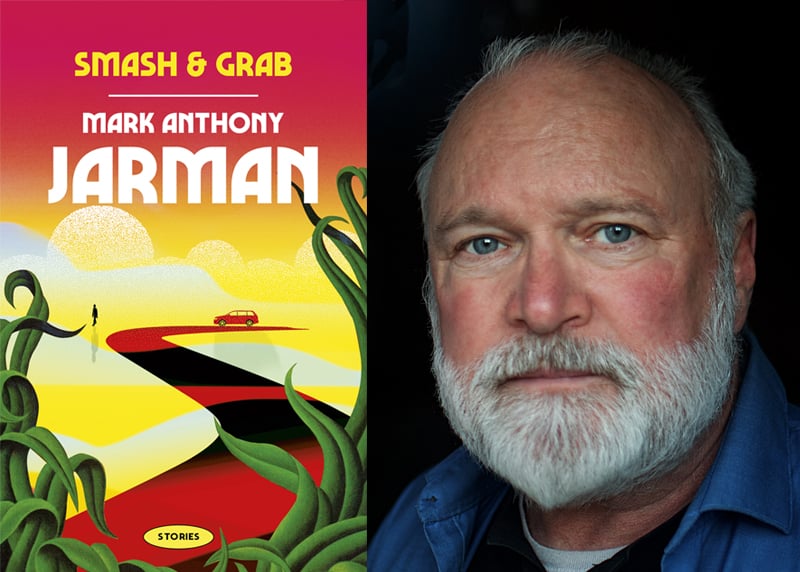
Mark Anthony Jarman (Muhammad Al-Digeil)
The first line of “The Bailiffs Arrive with Their Grey Eyes,” the last story in Mark Anthony Jarman’s latest collection, compares the incidents about to unfold to “some forgotten folk tale.” It’s a particularly appropriate categorization, given the author’s penchant for linguistic extravagance and tilted perspectives. It’s also somewhat paradoxical, coming as it does at the start of one of Smash and Grab’s more accessible pieces.
Like “The Cutpurse of Venice,” an earlier story in the collection, “The Bailiffs” is essentially a travelogue. It veers from Italy to the Balkans to the East Coast of Canada, as well as back in time – as far back as the geological continent of Pangea – following a pair of characters, one who closely resembles Jarman, and a woman named Emma, both of whom reappear in “The Cutpurse” and elsewhere throughout the book. It also features an agglomeration of references, from Kerouac and On the Road to Buddy Holly, This Mortal Coil, and the Beach Boys, to Dante and Savonarola.
All of this – the blurring of genre and deliberately exaggerated incident, and the magpie-like combining of disparate elements in unexpected ways – is typical of Jarman’s approach in the current volume. One moment in the story exemplifies the author’s tactic of juxtaposing various ideas to provide an unexpected insight:
The famous monk [Savonarola] went up in smoke, Dante driven out, beheadings common as baptisms. But who remembers their accusers? Medici popes spoke and vanished in smoke, misguided Pope Gregory determined to kill all cats, and Pope Urban rolled a big Suburban on Rue Morgue Avenue. Do we agree that my family dementia is a kind of beheading?
The turn from musing on the fate of Renaissance clerics and epic poets to the narrator’s own family history of dementia is pure Jarman, as is the insouciant wordplay of “Pope Urban” and “a big Suburban” or the allusion to Poe via Bob Dylan in “Rue Morgue Avenue.” Jarman packs more into his sentences than any half dozen other authors combined.
And that’s before one even gets to the substance of his stories. Jarman doesn’t traffic in conventions such as plot, and even story is frequently nothing more than a means to an end, that end being a bravura display of linguistic and syntactical pyrotechnics, often married to acerbic observations. “Oh Well (Parts 1 & 2)” takes its title from an early Fleetwood Mac song, allowing Jarman to provide a snippet of caustically funny music criticism: “The jukebox plays a 45 by early Fleetwood Mac, back when I liked them, before guitarist Peter Green took the bad acid, years before the arrival of Stevie Nicks and her faux sorcery malarky.”
Some entries in Smash and Grab do contain what might be considered more traditional story arcs. “That Petrol Emotion” focuses on a woman in Ireland who hits a young boy with her car then spends the rest of the story trying to decide whether to turn herself in – while also musing on Bono’s infuriating sanctimony. (Somehow, Jarman being Jarman, this all holds together.) In “The Cutpurse of Venice,” a Jarmanesque figure is stalked through the streets of the titular city by a determined pickpocket. And “The December Astronauts (Moonbase Horse Code)” – the most atypical story in the book, and one of the most atypical in Jarman’s entire output – is a science fiction tale about an astronaut on a moonbase mourning a broken relationship.
Other stories are less married to traditional trappings of the well-made tale. In “The Bodies,” which opens the collection, two men come across a pair of corpses in some underbrush; what would be the key inciting incident in any other story is more or less forgotten as the remainder unfolds. “Northern Ontario Silver Mine” is a microfiction about a woman who gives birth on a helicopter as she is medevaced out of a remote mining site. “Twa Corbies” is an impressionistic montage focusing on the idea of emigration from the Irish Civil War through modern migrants drowning in an attempt to reach a new land where they can live free of oppression and violence.
Some of these shorter stories feel less completely realized than the longer pieces, and “Gravedigger Blues,” set during the era of Louis Riel, Gabriel Dumont, and the North-West Rebellion, is overly reminiscent of earlier Jarman stories such as “Assiniboia Death Trip” and “Skin a Flea for Hide and Tallow.” But this should not detract from the general pleasures on offer in a collection that swerves from one subject to another, one approach to another, in the same magpie fashion its title implies. The volume’s cumulative riches are plentiful and unique to one of the most invigorating and unconventional writers of short fiction around.




 Contact us via email