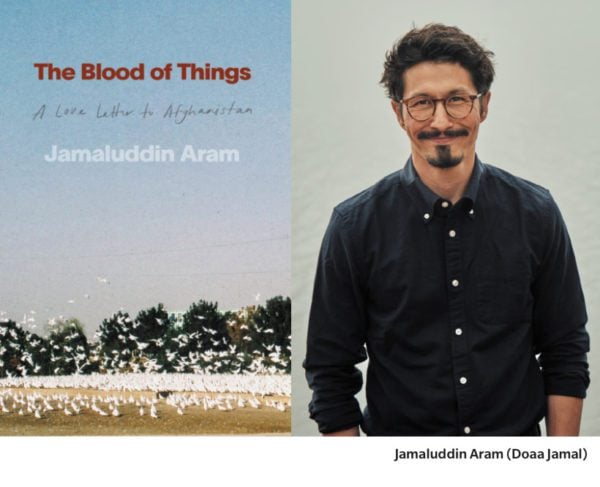
The collection of essays The Blood of Things: A Love Letter to Afghanistan, Aram’s first nonfiction book following his 2023 debut novel Nothing Good Happens in Wazirabad on Wednesday, has an ostensibly straightforward thesis: what divides people isn’t language so much as it is “the lack of a common experience which language (spoken and implied) is part of.” Aram endeavours throughout the collection to express his experience and invite the reader in, bridge difference, and foster understanding. His goal is to create an intimacy between the reader and himself and his people: his family specifically and the Hazara people of Afghanistan generally.
Aram quotes William Kittredge to express why this project is important to him: “Knowing the story of your people in a kind of gossipy detail means you can name at least some of your most intimate connections to what has been called the blood of things. It means knowing the names of places, and who named them, and what happened there.”
It is through this knowing and, I would argue, the sharing of this knowing, that “the incessant world is closer to becoming a territory where you might be able to take some rest.” This is at once a selfish and profoundly selfless book. In sharing these essays, Aram builds a soft refuge that offers the calm needed to construct a hopeful future.
The collection’s eight essays are situated at the intersection of poetic personal writing, historical analysis, and searing criticism. Aram, who moved from Kabul to Toronto with his family in the early 2010s, grounds personal memories within cultural and historical context, moving gracefully between the personal and the larger political reality; simple revelation and exposition can deliver a gut punch, whether he is writing about his mother or about the disgraced former president of Afghanistan, Ashraf Ghani.
In the second essay, called “Afghanistan, the Beautiful Land of Endless Suffering,” Aram writes about President Ghani and the 2021 fall of Kabul, when the Islamic Republic of Afghanistan was overthrown by the Taliban, who instated the Islamic Emirate of Afghanistan in its place. Ghani fled successfully to safety, while thousands of civilians gathered at the airport in Kabul in an attempt to flee Taliban rule; some were successful while others were not.
“Most have no papers and arrived in the night from the provinces,” Aram writes. “Then the day breaks and the white sun rises, and men, women, and children die of heatstroke, of thirst, and in stampede.” Aram tells the story of two friends, one of whom is able to evacuate with her family while another is not. He describes how young men “clung onto the sides of a taxiing cargo plane on the first day the government fell and so began the largest civilian evacuation in history.” Every season in Afghanistan is now migration season, he writes, “most people that I know have left or dreamed of life elsewhere.”
Aram’s precise voice is more sparse than lush, reminiscent of Joan Didion’s control. But don’t expect to find a dispassionate coolness here. Nearly every essay vibrates with rage against a cruel God generally, and a culture of racism and debilitating love for guns specifically, and lands its energies upon a love for friends, family, and for the rebellious and enduring strength of the Hazara. Aram finds hope for the future of the country within its own people. It’s an empowering discovery.
The sixth essay is called “Small Memories,” yet the recollections of Aram’s grandparents contained within are anything but. The chapter paints portraits of resilient men and women through vignettes of eccentricities, silence, and tenderness: a grandmother who walked him to school, an opium-eating grandfather who was kind and respected women, and great-grandparents whose lives were filled with love, misery, pain, and happiness. We get a glimpse of one vibrant family, as well as their community, and it’s impossible not to fall in love with every member. The essay epitomizes Aram’s poetic ability to convey the whole through the particular: aching and loving as it lifts its subjects toward the sublime.
In the penultimate essay, called “The Hazaras, The Kite Runner, and the Dance of the Dead,” Aram performs a close read of Khaled Hosseini’s bestselling novel, and it is electrifying. He illustrates how the book perpetuates otherizing and racist ideas about the Hazaras, effectively furthering a colonial narrative crafted in Afghanistan in the late 19th century. Hosseini’s book centres its Pashtun protagonist as a saviour and the Hazaras as sacrificial lambs. It is a fresh and much-needed criticism that shows how rage is crucial for dismantling oppressive ideologies. Aram’s close read shows you cannot overcome something you haven’t seen.
Despite the wounds and anger, The Blood of Things builds a space for rest. The flow of the essays — part poetry, part remembering, part recounting — draws the reader in toward an understanding of Aram’s family and history and, by extension, ourselves. In this refuge we can stay, or take what we have learned to our own communities. In recalling ourselves, Aram shows, we recall our communities. This beautiful, at times enraged, at times intimate collection, defies convention; through his words, Aram creates a shared experience and understanding of a people and a country he has had to leave behind.




 Contact us via email