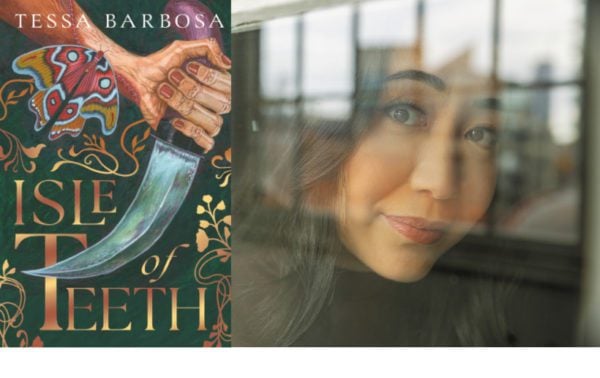
Matiu, the main (human) protagonist of Vancouver-based Filipina Canadian writer Tessa Barbosa’s second YA fantasy, Isle of Teeth, is caught between two worlds. His father, Jaothan Frankel, was a scientist and a former Archduke of Martinel, a remote outpost of the Lyssian empire. His mother, Estrella, was a spiritual leader of the Songi people, whose lands were conquered by the Lyssians, and who eke out survival as second-class citizens, scorned and attacked for their faith (“Nothing lives or dies without the will of Lady Death”), their culture, and the colour of their skin.
More than 17 years before the events of the novel, the couple “returned to Song, where we set up a laboratory on the Isle of Teeth, a sacred island beside the Lady’s sacred mountain, and we began our bitter work,” Estrella writes. Through a patchwork assemblage of Songi corpses and animal parts, they created five revenants, designed, in part, as “a weapon to wield against the Lyssian Empire,” but with a limited lifespan. Enter Calyx, the third of the revenants (and our main non-human protagonist), who was “born” just a few weeks before Matiu and a short time before her oldest sibling, Carpal, lost control and went on a bloody rampage, a night remembered as “the Reckoning.”
Matiu, now, is a cadet in his final days of training. He plans to join the Lyssian military in an attempt to fully purge himself of his Songi heritage and to win the role of heir to his uncle, the new Archduke. When a childish prank leads him onto the forbidden territory of the Isle of Teeth, the lives of Matiu and Calyx reconnect, though neither recognizes it at first, as the world around them descends into violence, savagery, and rebellion.
There is much to be impressed by in Isle of Teeth. The world-building is intensive (as the above summary might suggest), but emerges naturally, and without a distracting amount of exposition. The socio-political overtones are plainly evident but largely non-didactic (in her author’s note, Barbosa writes that the novel is “informed by research into the Philippine-American War (1899–1902)”, lending a thrum of verisimilitude to the fantasy. The interweaving of past and present, of magic and science, of family and community, is powerfully constructed, and the relationship between Matiu and Calyx, each dealing with their own pasts as their ends rapidly approach, feels natural and unforced.
Unfortunately, the novel as a whole does something of a disservice to this material; there’s simply too much for the length of the book. As a result, the story becomes compressed, with significant events included almost in passing, rather than being fully depicted or explored. The pitch is almost consistent throughout, with climactic scenes accorded the same weight as more casual moments. The emotional arc of the novel is similarly compressed: Matiu repeatedly experiences the same sudden shocks of understanding, and key moments slip into sentimentality. The reader is likely to emerge from the book frustrated, and considering what could have been.
This article contains affiliate links. Quill & Quire has partnered with Booksellers.ca, a network of more than 180 independent bookstores across Canada, so we may earn a small commission when you purchase through links on our site — at no additional cost to you. More about Booksellers.ca.


 Contact us via email