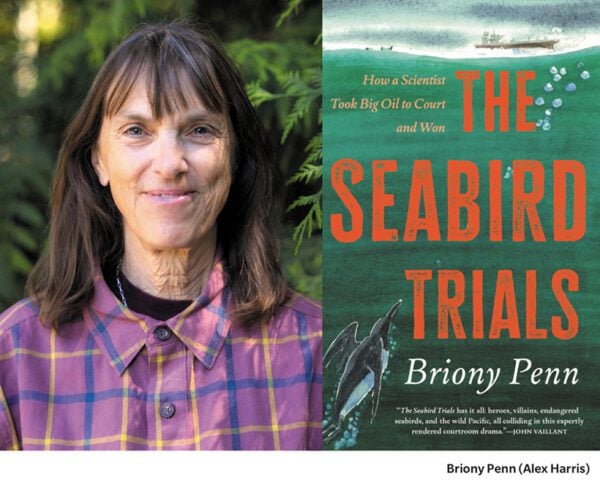
In a kayak, bobbing at sea off Galiano Island while surveying a cormorant rookery, author Briony Penn learns of the death of Harry Carter, a legendary seabird biologist, to whom she is connected by a filament of memory. They met only once, when he was a 13-year-old boy from whom she, then a nine-year-old girl, gained a new connection to the natural world when he led her in a dazzling leap, on skis, off a mountain ridge.
With this book, Penn, an award-winning environmental historian (Following the Good River, The Real Thing), takes another dazzling leap.
In The Seabird Trials: How a Scientist Took Big Oil to Court and Won, Penn follows Carter’s fight for ecological justice when he served as a star witness in an oil spill trial that became one of the greatest environmental David-and-Goliath stories of all time. Carter, a young Canadian scientist, stood up to big oil in the 1986 Apex Houston case, an environmental drama that pitted Carter and the U.S. Department of Justice against corporate greed.
The 1986 Apex Houston barge and tug oil spill off the central California coast dumped about 25,800 gallons of crude oil into the Pacific Ocean, leaving nearby shores littered with dead and dying oiled birds. The spill killed a dozen endangered marbled murrelets, 6,287 common murres, and thousands of other species, and destroyed a critical common murre breeding colony on Devil’s Slide Rock. The tragedy was so profound, and so visible, that for the first time in history, state and federal agencies pursued compensation for natural resource restoration.
Carter, who had spent years studying seabirds of the region and had personally documented every oiled and dead carcass after the spill, is a worthy protagonist, “a detective who had worked the case for more than ten thousand murder victims.” He knew how to solve the murder, not with emotion, but with science and data.
Penn relies on 4,500 pages of depositions and legal transcripts, as well as correspondence, to create a braided narrative of short, dynamic chapters that is legal, scientific, historical, and deeply personal. Penn expertly builds suspense, shuffling legal arguments with science and history.
When Penn holds the reins as narrator, the story sings: “It was not a time to leave the sheltered San Francisco Bay area for the fury of the open Pacific. Only high financial pressures could have offset low barometric pressures to push a barge and tug into the storm.” When she pulls from depositions, she draws readers into a gripping legal drama. As she tracks oil spills and the history of ecological and environmental regulations, we understand how vulnerable we all are to “the denial industry of climate change.” And when Carter dies prematurely, she breaks our hearts.
More than just the chronicle of an important legal milestone, this book is a call to action that uses the Apex Houston legal battle to map out a strategy to win an environmental war that has not ended.


 Contact us via email