Using stories as a tool to survive life’s hardships is the best thing E.G. Alaraj believes she inherited from her parents.
They both experienced abuse and abandonment as children, and as a result, lived the lives of orphans even though their family members were still alive. They clung to art, literature, and music for the tenderness that was devoid in their family/human relationships.
“My parents understood their social backgrounds were insufficient for the task of raising children so they provided us the knowledge of human tenderness through high quality books, scripture, and artwork,” Alaraj says. “This was such a tremendous gift, which I am pleased to offer back to society in the form of this book.”
My Language Is a Garden (Orca Book Publishers, Feb. 17) is her sophomore picture book – her first was the lullaby When Stars Arise – and takes the form of a poem. The book was born out of the struggles she and her husband faced in connecting their children with his heritage language of Arabic. At the time the children were young, Vancouver only had a small Arabic-speaking community, her husband’s family was unable to visit, and there was vilification of Arabic speakers. Speaking Arabic would allow the children to communicate with older generations, provide a sense of spiritual affinity, and give them access to a wealth of familial knowledge. But the issue of language runs even deeper than that for Alaraj.
“My husband is not a native English speaker. For him to share information with our children it must be conveyed through a second language. He can never directly say what he wants to say. There’s frustration for him; he wants to be able to guide his children and to raise them, but language is a barrier,” Alaraj says. “There’s so much of their father that our children can’t know if they don’t learn Arabic. This isn’t just about learning a language, it’s about their connection to their father and his entire being.”
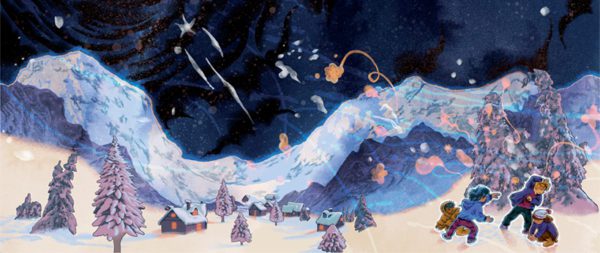
Illustration: Rachel Wada.
Alaraj feels the reluctance she initially witnessed in her children, and children in general, toward learning a parent’s heritage language is exacerbated when they enter the school system. “Their peers are always speaking English, so they’re more interested in a language that can help them connect with their peers,” Alaraj says. “They can’t anticipate what the costs will be of [not learning a heritage language]. If we put all of this [pressure] on our children, they will likely reject the language and the knowledge system because it’s not coming across in a way in which they feel nurtured.”
Alaraj began writing My Language Is a Garden in prose, but at the halfway mark she realized the structure wasn’t going to work; the layers of meaning she wanted to include weren’t going to fit. Thankfully, she had an unexpected breakthrough: she woke up at 5:30 a.m. one morning, and the poem was in her mind. “The words and the rhythm and, well, everything, and I took out my phone because it was so dark, and there was no pen and paper handy, so I punched everything into the notes app on my phone,” Alaraj recalls.
Writing the picture book as a poem was an especially happy outcome for Alaraj, as poetry is her natural writing voice. She loves how much meaning one can pack inside a small poem, and “how the words sing together to create a picture of harmony that so beautifully carries the theme.”
My Language Is a Garden was created to help Alaraj and her husband, as well as parents who find themselves in a similar situation, convey the desire to share their heritage language with their children. And one thing she hopes those parents carry from the book is the tender reminder that “everything blooms in its own time.”




 Contact us via email