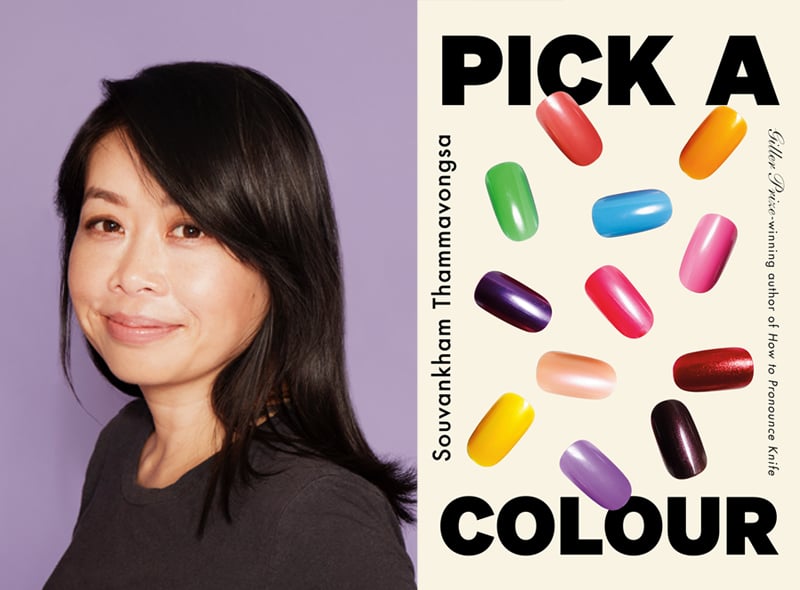
Souvankham Thammavongsa doesn’t feel entirely comfortable working in the novel form. Although she wrote the first draft of her debut novel, Pick a Colour, in six weeks, the award-winning poet and short story writer says that the prospect of devoting herself to long-form fiction was daunting, and perhaps not for the reason one might expect.
“I was humbled by the form,” she says on a late summer Zoom call. “I don’t know how to take up space.”
This may seem surprising, given Thammavongsa’s evident literary stature: she won the Giller Prize for her 2020 short story collection How to Pronounce Knife and is the only writer to win both the Trillium Book Award and the Trillium Book Award for Poetry (for How to Pronounce Knife and her 2013 poetry collection Light, respectively). But the statement reflects the author’s inherent modesty. When she was called upon to co-edit the 35th anniversary anthology Journey: Celebrating the Journey Prize alongside Alexander MacLeod, she and her co-editor agreed that they would not include their own work in the book, despite the fact that “Mani Pedi,” which was shortlisted for the prize in 2016 and is included in How to Pronounce Knife, is by any estimation one of the best Canadian short stories of the current century.
As it happens, “Mani Pedi” also has a close relationship to Pick a Colour, published this month (Sept. 30) by Knopf Canada. The story focuses on an ex-boxer called Raymond who takes a job cleaning up in his sister’s nail salon. He quickly becomes a hit with the salon’s female clientele and transitions from janitorial duties to giving manicures.
Pick a Colour also takes place in a nail salon – the competitor to the story’s Bird Spa and Salon. Like the earlier iteration, the novel features an amateur boxer at its centre, but in this case it’s a woman, Ning, the salon’s owner. She and the other aestheticians, all of whom share unspecified Southeast Asian heritage, wear nametags with the same name, Susan (their given names would prove difficult for the largely white clientele to pronounce), and gossip about the women they serve in a language their clients can’t understand.
Coming in at under 200 pages, and told in the same laconic, plain-spoken voice that will be familiar to readers of Thammavongsa’s poetry and short fiction, the novel takes place over the course of a single day and adheres to the Aristotelian unities of time, place, and action. “It is a novel in form but not in feeling,” Thammavongsa says. “It’s held together within a universe that can only exist in one place.”
The book, which can be read in a single sitting, is a sharp dissection of cultural stereotypes and class disparity, as evoked brilliantly – and, it must be said, extremely humorously – in the ironic distance between the privileged patrons of the salon and the much more savvy and perceptive employees. “I’d always been bothered by the way a nail salon worker is treated whenever I’ve come across that gaze in a book or even in the news,” Thammavongsa says. “I have this incredible opportunity to change that assumption and say that this is actually a woman of power. Yes, she is bending her head and is down low and is at service, but she knows so much about her client, whether they tell her or not.”
Much of this comes down to the presentation of the material, with its intense focus on the nail salon workers’ concerns and considerations. Here, Thammavongsa makes a distinction between point of view and perspective in her work. “For a writer, point of view is easy: you just choose,” she says. “But perspective is where a writer’s talent and magic really come to life.”
By this metric, it’s possible to imagine the audience for Pick a Colour comprising what literary critic Elaine Castillo called the “unexpected reader.” While it might be assumed most people coming to the book would closely associate with the salon’s patrons, for the author, it is important to put those readers in the perspective of the employees. “When we read the novel, we are not readers reading about a nail salon worker at work,” she says. “We are, in fact, a nail salon worker reading about clients and how they treat us.”
Essential to this approach is the ironic distance between the customers and the salon workers, all of whom speak to each other in a foreign tongue (which is never precisely identified), even though we are reading their discourse in English. This simultaneously welcoming and alienating strategy is key to what Thammavongsa is attempting to communicate in the novel. “We are reading the English language – the English language is right in front of us,” she says. “But I am asking you to pretend the English language is not there.”
Thammavongsa compares this to the title story in How to Pronounce Knife, in which the characters focus on a silent letter, a sound that should be there but is not. The comparison is also apt, given the novel’s intertextual connection with “Mani Pedi.” Not only are Raymond and Ning both boxers, but the salon in the novel is down the street from the one in the short story, and the novel ends with the Bird Spa and Salon’s proprietor – unnamed in the story but here called Rachel – visiting her competition for a manicure. Pick a Colour can reasonably be considered an instalment in the Souvankham Thammavongsa Extended Universe.
“I am not doing anything new by taking a short story and expanding it,” Thammavongsa says. “It’s been done by Faulkner. And I love that because it is so hard to build a world and build characters and to be able to continue their life within a fictional universe – it’s a nod to the readers who know your work but also it’s an ease for you to lean on as a writer.”
Although she claims not to have done extensive research for the novel, Thammavongsa did train as a boxer for a year and a half in order to understand the language and practice her character would have been exposed to and, also, for one other reason. “I wanted to know what it felt like to take a punch,” she says. But the training was useful in other regards. “In boxing, we learn when you control the centre line, you control the fight,” she says, before noting that the same principle can be applied to threading eyebrows in a salon.
Thammavongsa is a very mechanical writer, so it makes sense that when she talks about boxing, she is focused on the technical aspects of the sport: where to place your feet so that you don’t wobble when you get hit, or the idea that it’s not brute force that ultimately determines the winner of a fight. “I was surprised at how, when you know the sport on a technical level, you can throw a punch and hear the power in it,” she says. “I was surprised that I’m actually stronger than I look and stronger than I think I am.”
Given that, it seems germane to ask whether training as a boxer helped Thammavongsa overcome at least some of her anxiety about taking up space. “Yeah. For sure,” she says. “I came from such tiny forms. And in those forms, I write such tiny things. Writing a novel made me not just appreciate the novel form; it also made me appreciate poetry and the short story. And it made me miss those forms.”
Photo of Souvankham Thammavongsa by Steph Martyniuk.




 Contact us via email