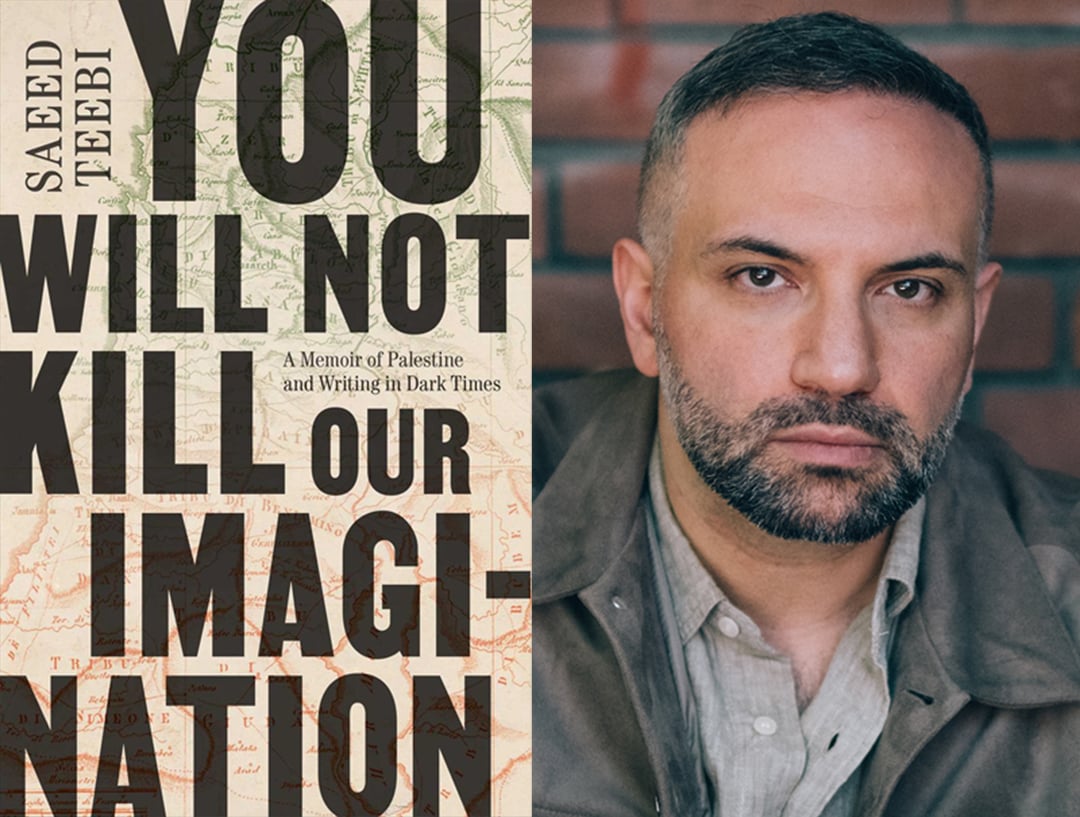
Saeed Teebi did not plan to write a memoir.
You Will Not Kill Our Imagination: A Memoir of Palestine and Writing in Dark Times, out now from Simon & Schuster Canada, was born of necessity.
In 2023, Teebi had been trying to write a novel while Gaza was being invaded.
“I thrive on the escapism of being in worlds of my own creation rather than being in our current, very unfortunate world, but [the memoir] was spurred by a complete paralysis when it came to any kind of creative activity,” says Teebi, whose debut short story collection, Her First Palestinian, was shortlisted for the Writers’ Trust Atwood Gibson Prize in 2022. “I simply could not fathom living in these imaginary worlds; it seemed frivolous to me.”
Teebi wanted to combat the powerlessness of witnessing the attacks and felt that as a writer there was something else he could do. He took two months off from his law practice and accepted the weight of this undertaking.
“I struggled a lot with how much to say and how to say it. I try to be as giving as possible, but it came at a great cost,” he says.
The writing process was gruelling because the intimacy of the personal and the political is urgent for Teebi – the people of Gaza are “the reason I did this in the first place.”
Like the complex stories in his debut book, which explore the nuanced experiences of the Palestinian community through fiction, Teebi turns a similarly exacting but generous gaze on his own life and family history to remind us of the power of storytelling.
He begins by tracing his family’s home and displacement from Salama, a small town that was depopulated in 1948. While looking at a map of Palestine from a National Geographic issue from 1947, Teebi laments that he does not know more about the journeys of his grandparents, whom he never had a chance to meet – Saeed was born to Palestinian parents in Kuwait and has lived in Canada since 1993.
“I can see the names of towns my grandparents probably passed on their way: Beit Dajan, Isdud, El Majdal, El Jora, Khan Yunis. But I do not know where they stopped, or what they did at the stops. … Said and Nima both passed away before I was an adult; I had no chance to ask them. Their story’s features are blurry to me,” he writes. “The vanishing of stories is not a side effect of displacement, it is a primary objective. The stories, untied from the land, dissociate and dissolve.”
This attempt at remembering sets the tone for the bracing vulnerability of his memoir, where “the greatest battleground is always that of story.”
While Teebi returns to his family throughout the memoir, he also details his experiences with social media censorship as a Palestinian, the limits of being a witness, and the harrowing work of unravelling the dominant narratives of Palestinians in order to tell his own story.
His writing searches for answers to the questions that have shaped his work so far. What is the ground on which narrative is built? What is the relationship between land and story? What must be told, re-examined, and dismantled in order to speak freely as a Palestinian?
Teebi’s answers reflect the understanding that the imagination is intertwined with the land.
“Storytelling tells you who you are, what you stand for, what’s important to you,” he says. “It’s very easy to go through life and not think about questions like, ‘who am I?’ but as a writer, you’re forced to confront them if you’re doing your job correctly, at least to me. Storytelling tells us who we are and we don’t know who we are until we tell our story.”
In You Will Not Kill Our Imagination, Teebi tells us who he is, who his people are, and who we are – living in a time of genocide when simply being a witness isn’t sufficient and the lines between virtue signalling, activism, and censorship are blurry.
“A certain kind of artist is compelled to say the unsayable because they cannot bear not expressing the truth as they know it. They are the witness that has not been prevailed upon – by concerns for their safety, or for their reputation – not to enter the witness stand of the public. And the temerity of the artist inaugurates and encourages temerity in the masses,” he writes. “This kind of artist is different from one that witnesses only so that they can throw their hands up, besieged by tragedy but resigned to being unable to cause any real change. Art in that case becomes a form of political action, even while maintaining its form and function as art.”
Teebi embodies precisely this rare quality: temerity, the audacity to take a stand and let that resonate through one’s life and work.




 Contact us via email