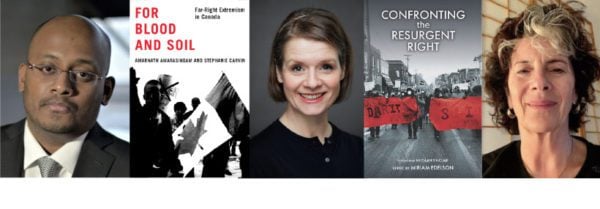
As Canadians warily observe the turbocharged right-wing extremism undergirding Donald Trump’s America, two new titles serve as disturbing reminders of our own “Maple Leaf” violence, a shameful reality deeply rooted in Canadian history and increasingly shaping contemporary political discourse.
For Blood and Soil: Far-Right Extremism in Canada provides an accessible historical and contemporary overview of Canada’s homegrown racist and far-right violence: KKK mass rallies in the Prairies and Ontario, high-profile Holocaust deniers Ernst Zundel and James Keegstra, neo-Nazi skinheads, and the 2022 insurrectionary convoy movement that occupied the nation’s capital, blocked border points, and sought the Trudeau government’s overthrow.
National security scholars Amarnath Amarasingam and Stephanie Carvin are frequently sought out as media commentators following horrors such as the June 2026 Montreal shooting by an apparent adherent of the misogynist “involuntary celibate” movement. But while they eschew obscure academic terminology, their fairly brief book tends toward the dry and factual, reading at times like a well-researched government brief. Their efforts could have benefited from more human voices drawn from their own research into why, exactly, alienated individuals swear allegiance to such frightening groups as the Proud Boys, Soldiers of Odin, Canadian Combat Coalition (“C3”), and white supremacist fight clubs.
For Blood and Soil’s scope is limited by its conscious choice not to analyze broader socio-economic influences and institutional spaces where such manifestations of hatred marinate. Indeed, the narrow framing could lead some readers to conclude this creepy subculture is about knuckle-dragging, basement-dwelling bad apples rather than shock troops of a broader ideological agenda. While the authors ably explore some of the personal pathologies of trauma, addiction, anxiety, social isolation, and abuse that can lead some to join extremist groups, they curiously avoid naming (and similarly dissecting) mainstream enabling entities such as the federal Reform Party and the People’s Party of Canada. They also neglect the words and actions of provocative politicians such as former prime minister Stephen Harper, Alberta Premier Danielle Smith, and Conservative Party Leader Pierre Poilievre, who has spouted anti-immigrant “barbaric cultural practices” rhetoric and supplied love notes to the trucker convoy. If mentioned at all, they are consigned to footnotes.
Amarasingam and Carvin do raise important issues that may help inform strategies to undermine and disarm the far right. Their discussion of the “keyboard commando” issue, for example, helpfully questions the extent to which exposure to troubling web content leads to violent acts. While they provide an overview of some Canadian and European “countering violent extremism” (CVE) programs, they miss a critical opportunity to take a deeper dive into how such initiatives may, despite worthy intentions, generate fear, self-censorship, and racial and religious profiling when they disproportionately target Muslims and other racialized groups. Indeed, the authors mention but give short shrift to the well-documented human rights violations of the U.K.’s notorious Prevent program.
For Blood and Soil recommends proactive measures to address social, economic, and psychological factors while balancing civil liberties against the dangers posed by the far right. But those reasonable sounding ideas seem disconnected from a critical piece of the CVE puzzle: how can police and national security agencies tasked with countering extremism honestly confront this trend when they’ve often failed to ensure that their own organizations are free of racist, homophobic, and misogynist practices?
That’s a conundrum addressed in the robust Confronting the Resurgent Right, a diverse collection that convincingly argues the current wave of hate is not an unfortunate condition marked by lack of education and tolerance, but rather one encoded in a neo-liberal system enforcing austerity measures while still failing to address the genocide of Indigenous people.
Editor Miriam Edelson was motivated to tackle this project by the Ottawa convoy occupation. Numerous contributors explore the troubling ideologies promoted by the convoy leadership and the powerful mutual aid community responses that emerged during the crisis. One fascinating chapter outlines the dynamics behind the unique grassroots Ottawa People’s Commission, which heard from all voices impacted, including the occupiers.
An introductory framing chapter spotlights how normalization of hatred in mainstream politics grants social permission to violent fringe entities, while expertly painting the legislative, public opinion, and media backdrops that shape narratives demonizing immigrants, LGBTQ2S+ communities, and Indigenous Peoples. This is followed by contributions ranging in focus from settler colonialism and queer communities’ history of resistance to fascist violence, to the impact of gendered Islamophobia, attacks on trans students, and the battle for the hearts and minds of union members.
While the essays are all marked by solid research and strong writing, rarefied academic lingo makes some chapters less accessible, but the sheer diversity of topics and writing styles allows readers to focus at their comfort level. In addition, some contributions could have benefited from entertaining deeper tests of their theories. For example, the consistent and well-argued point that global austerity is a major contributing factor to current far-right hatred does not explain why such violence was a persistent menace globally during the post-Second World War economic boom.
Readers will certainly be enriched by the information and analysis provided, but still may be left with more questions than answers about how best to confront this threat. One chapter provides a helpful reflection on this point, recalling the author’s chats with the occupants of convoy-supporting vehicles that were prevented from entering downtown Ottawa by a community blockade known as the Battle of Billings Bridge. It’s a refreshing look at efforts to understand and even empathize with individuals whose apparent political choices may appear reprehensible yet, upon deeper discussion, reveal commonalities neither party thought existed. By seeking to understand the whys, and fill in the educational gaps, this person-to-person approach emerges as a potential ray of hope against a dire horizon.




 Contact us via email