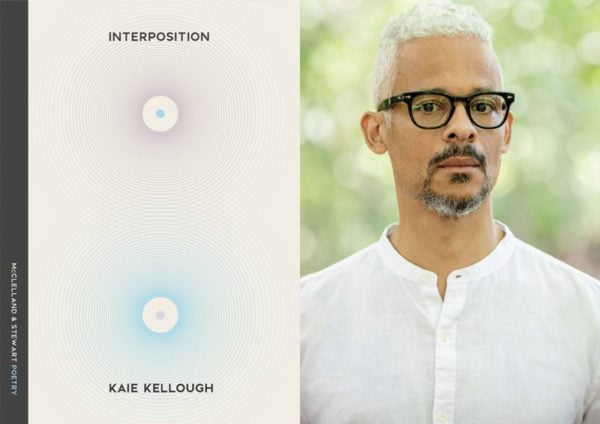
An apparently throwaway line at the end of Kaie Kellough’s acknowledgements provides a key to unlocking his latest book of poetry: “These acknowledgements were written while watching snow fall in Kingston, Ontario, listening to Lester Bowie’s silver trumpet.” The significance is found not simply in the reference to American jazz musician Bowie, a key member of the Art Ensemble of Chicago, though that provides one point of entry. An obituary published in The Guardian on the occasion of Bowie’s death in 1999 stated that the ensemble’s “performances could resemble a sermon, a drama, a stand-up comedy routine and a history lecture all at once.” Add Bowie’s penchant for improvisation, and this could act as a serviceable description of Kellough’s long poem Interposition.
But more than this, the reference to the poet watching snow fall while listening to jazz is indicative of the kind of patient, contemplative removal from the chaotic speed and dissociation of modernity that Kellough longs for throughout his latest volume. Interposition is many things: a challenge to bring language to the edge of fracturing while always maintaining a submerged control over the material (in this sense, a better musical analogue than Bowie might be John Zorn); a barbaric yawp in the face of dehumanizing, parasitic technologies that co-opt our labour to enrich a privileged few while impoverishing everyone else; a lament for a world free of corporate or technological mediation; and a cri de cœur about humanity’s apparent willing complicity in its ongoing degradation.
The poem is broken down into three parts, which together read “to be / between / betweens” – the first indication that Kellough’s focus will be on liminal spaces, those ruptures in ontology and consciousness that permeate an increasingly isolated and mediated world. The poet makes this explicit when he writes, “this is not written, it is collected / & assembled to move to a broken, repaired / interruption.” As its title implies, Interposition splices (breaks, interrupts) syntactical coherence to throw up new ways of hearing and experiencing the text on the page. The first line of the first section, “to be,” reads, “bcuz i can’t think,” at once leaning into the current argot of texting and offering a postmodern rebuke to Descartes’s most famous dictum.
Kellough’s ontological anxiety is furthered as the poem progresses and the pronoun “i” is replaced with the anonymous “x” – “the inverse of i” or “who i is not.” The designation “x” is many things: a signifier of someone or something unknown, the traditional mark of an illiterate, a symbol of nullification, and a mathematical notation. Kellough nods at all of these connotations, for example by asking how hollowed out human consciousness might be expected to “read” our unstable geopolitical environment and noting ironically the formula for a globe “mined for labor & profit,” which can be mathematically stated as “terra nullius x old stock hubris.”
X is, of course, also the new name of the social media site once known as Twitter; Kellough does not let that slip his gaze either, noting the moment in which the current U.S. president – caricatured as an “antic, black & white protagonist” who “rode out of the civil war in a red baseball cap” – encountered “the colonizer of mars in mortal combat.” Here, too, the slipperiness of language is apparent: the meeting takes place “at the crossroads,” implying a deal with the devil (or two devils?), while the reference to “mortal combat” alludes to the type of mindlessly violent video game that has desensitized large swaths of humanity to the reality of human suffering (see, cf., the current war in Iran, which has been described in various locations as a video game war).
Kellough’s approach in Interposition is allusive and mosaic, building a series of implications through suggestion and elision. His poem rails against “the artificial poise of a text” while also self-consciously highlighting that very artificiality. The job of the poet, he asserts, “is to undo, to leave unfinished,” which helps explain the lack of capitalization, the sentence fragments, and the plentiful white space throughout. These are lines that exist “on the crum / bling ledge / of sol- / ven / cy,” the very place so many of us seem to find ourselves at this particular historical moment.
In his acknowledgements, Kellough notes that much of the book was composed “in the winter of 2021,” at a time when pandemic lockdowns were isolating humans from one another and imposing a screen-based mediation upon contact and intimacy. Kellough seems to feel, along with many observers, that the pandemic experience fundamentally fractured something essential in humanity, leaving us open to manipulation by bad actors and disconnected from our fellow humans and, no less significant, from ourselves. How to reconstruct some sense of meaning and belonging in a world dominated by tech oligarchs, racist warmongers, and artificial intelligence is the thematic bedrock of this challenging, provocative, and anxious look into our modern abyss.




 Contact us via email