l to r: Catherine Little and Sae Kimura
Written in commemoration of Jane Austen’s 250th birthday, Catherine Little and Sae Kimura’s picture book Jane and the Blue Willow Princess introduces readers to young storyteller Jane, her supportive sister Cassie, and her large, boisterous family. On a lovely day full of sunshine, tea, and cheese toasties, Jane shares her ever-growing story ideas with her mother and sister, hoping to pin down an especially fantastic story that she and her siblings might perform for their father’s birthday. A closer look at an intricately designed plate from her mother’s tea set – and the tragedy that soon befalls the piece of china – inspires Jane to write a play about a princess who has no need for a prince.
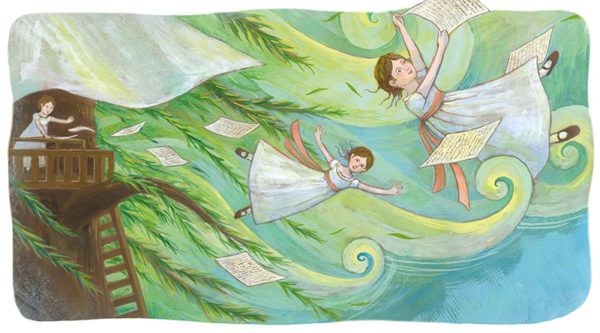
Illustration: Sae Kimura.
Kimura’s illustrations – the panoramic scenes in particular – evoke feelings of innocence and nostalgia set in dreamy countryside lushness; and Little’s storytelling is clearly done with great care and reverence for its beloved subject. Ultimately, though, while the story of Jane and the Blue Willow Princess is charming and encouraging, it is not quite satisfying. The book requires more focused, tethered dialogue between characters and a more intuitive and natural flow between the motivations of the characters and the key moments of the story. For example, while the idea of Jane’s creative mind being ignited by a story on a delicate china plate is intriguing, the sudden focus on the plate and its place within Jane’s childhood is both slightly surprising and stilted.
When readers reach the author’s note at the book’s end, they learn that an archaeological dig at Steventon Rectory – the birthplace of Jane Austen – unearthed a fragment of the English-made, Chinese culture–inspired, 18th-century Blue Willow plate, which inspired Little’s story. The end note is fascinating, and answers some questions to be sure, but perhaps not enough – and too late – to help gel the story for younger readers. For readers broadly familiar with the early life of Jane Austen and her close bond with sister Cassandra, there may be some sweet comfort and sentimentality found in the story’s references to Austen’s most famous works. However, the pieces of Jane and the Blue Willow Princess, as well-intentioned as they may be, do not end up dovetailing sufficiently to tell an entirely cohesive tale.




 Contact us via email