It’s no understatement to observe that Canadians are enduring an anxious era, with threats of military invasion emanating from the U.S. ambassador, American officials openly meeting with Alberta separatist organizers, and U.S. President Donald Trump calling successive prime ministers “governor” of a potential 51st state.
How we’re responding to such existential challenges is the subject of two worthy, complementary additions to Baraka Books’ TRACTION imprint. The new series is designed to produce timely, relatively short, highly readable responses to contemporary issues in the pocket books tradition (slightly larger than an iPhone, without the thin paper and impossibly tiny print of the paperback’s golden age).
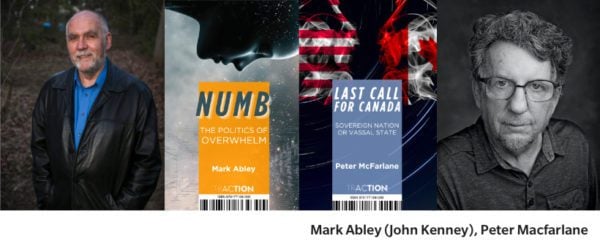
Long-time authors Mark Abley (Strange Bewildering Time: Istanbul to Kathmandu in the Last Year of the Hippie Trail) and Peter McFarlane (Brotherhood to Nationhood: George Manuel and the Making of the Indian Movement) both bring authoritative voices to their titles, providing readers with digestible, well-documented, blog-length chapters that combine righteous rage and reasoned arguments.
Last Call for Canada: Sovereign Nation or Vassal State is a damning indictment of what McFarlane coherently argues is Prime Minister Mark Carney’s complete capitulation to his U.S. counterpart. McFarlane ably highlights the growing disconnect between Carney’s 2025 “Elbows Up” election promises and much-applauded messaging at Davos and other global summits, and the very different agenda he’s implemented to date. It’s the kind of analysis one might not otherwise clearly discern given our fractured daily news media landscape and Carney’s almost daily international trips and policy pronouncements, which appear to reflect Trump’s strategy of overwhelming our senses by “flooding the zone.”
Employing the lens of philosopher George Grant’s landmark 1965 Lament for a Nation: The Defeat of Canadian Nationalism, McFarlane situates the present era in the context of an earlier historical moment. Similar questions of social, cultural, economic, and military independence framed a 1963 election in which Canadian elites conspired with the Kennedy administration to remove then prime minister Diefenbaker over his refusal to arm U.S. Bomarc missiles with nuclear warheads, and to install Lester B. Pearson, the “defrocked prince of peace” who agreed to accept them.
Grant’s concern about Canada becoming a vassal state is writ large throughout Last Call, which illustrates how 21st-century economic and military integration with the U.S. continues to leave Canada vulnerable to becoming an entity akin to Puerto Rico, with limited self-governance and little independence. While McFarlane does not envision Yankee tanks patrolling Canadian streets, he outlines the surrender of sovereignty by stealth via trade agreements and military commitments destined to further cement this country’s traditional role as America’s junior partner.
The notion that there is no alternative is countered here through examples such as Mexican President Claudia Sheinbaum, who has successfully negotiated a relationship with the always mercurial White House occupant without significantly altering her country’s domestic and foreign policies. McFarlane similarly points to the success of China and other BRICS trading bloc countries of the Global South, whose combined economic strength has led them to chart a pathway increasingly independent of U.S. global control.
Despite some concerning ideological judgments (downplaying serious human rights abuses against Muslim Uyghurs in China and soft-pedalling Russian responsibility for its invasion of Ukraine), Last Call’s urgent alarm bells are worth responding to in a similar manner as Canadian nationalists heeded Grant’s call 60 years ago.
But whether readers can and will activate themselves is a question addressed in Mark Abley’s Numb: The Politics of Overwhelm, a personal reflection on the effects of doom-scrolling through the daily barrage of polycrisis – genocides, climate breakdown, economic uncertainty – that leaves many of us flailing between genuine concern and feelings of despairing disempowerment.
Abley’s framing device is the haunting image of a lonely and baffled quagga (a now extinct zebra species), whose empty gaze from the brutal confinement of her 1800s London zoo cell he recognizes in himself and his friends whenever they discuss those suffering in Gaza or Sudan. It’s a numbness he recalls from his disaster zone reporting, noting with irony that he wrote with a heart of stone while seeking to help others feel.
While dread and despair are not new to the human experience, Abley reminds us that we are never far from what largely generates those feelings, the electronics and social media to which so many of us have, in the course of a generation, become hard-wired. It is this oddly disconnected connectedness, he argues with a nod to Marshall McLuhan, that limits our ability to focus, to empathize, and to be in community.
While not a self-help book, Abley’s title poses critical questions about how we can remember who we are as human beings and how we can lift our spirits without sequestering the truth. He seeks not to avoid the horrors of the world, but rather to find grounding mechanisms that sustain the role of active citizenship and responsible stewardship in response to the images and headlines bombarding our social feeds.
Towards that end, he raises the importance of connection to nature, avoiding social isolation, and finding joy in the modest acts of daily life and our warts-and-all family and friends. His understanding of kindness and goodness is not the Pollyanna pablum of greeting cards, but rather the notion of beloved community that opens the door to acts of resistance that generate hope, a process that cannot be undertaken while feeling discombobulated with numbness.
While Abley understandably views the U.S. as a major source of global violence and horror (one of his conscious coping mechanisms is refusing to write the U.S. president’s name), Numb could have benefited from more acknowledgement that sources of discontent also emanate from the government in Ottawa, especially since Canadian readers might be wondering how they can resist closer to home.
If newspapers and news media provide the first draft of history, Numb and Last Call for Canada capably demonstrate that the latest entries in the TRACTION series serve as admirable, thoughtful second drafts.




 Contact us via email