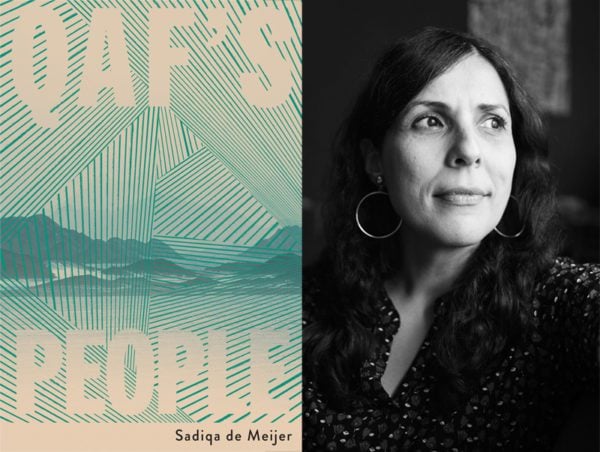
Sadiqa de Meijer (Liz Cooper)
Qaf’s People marks Sadiqa de Meijer’s return to poetry after the 2020 Governor General’s Award–winning memoir alfabet / alphabet. In Qaf’s People, the poet laureate of Kingston, Ontario, resurfaces questions about diaspora, belonging, identity, language, and home that have shaped her body of work thus far.
In the opening poem, “Creation Story,” de Meijer imagines the meeting of a father and mother, and their child to come “whom her country has no word for.” This poem holds a paradox: it is both epic in feeling and exquisitely detailed; the father “is another country, darker, everyone / holds their breath,” while the mother country has a “loom” in her that “clacks and swooshes, / striated tissue, electric, slow-twitch.” The people in these poems are as dynamic and alive as the worlds they move through, so that there is no separation between person and place.
The publisher describes Qaf as “an imagined landscape drawn from Islamic mythology”; Qaf hinges on conflation as de Meijer wholeheartedly embraces the story of a place that holds shape-shifting multiplicities, a necessity for mixed-race writers like De Meijer, who, as disclosed in alfabet / alphabet, “was born in Amsterdam to a Dutch-Kenyan-Pakistani-Afghani family, and moved to Canada as a child.”
De Meijer’s conception of Qaf is both playful and profound:
nobody told me the earliest stories
but, invisible conspicuous, I did
overhear a few, and my blood knew—
Qaf is a letter,
is salt in the mail.
Later, she writes, “some say Qaf is entirely interior / and found on faith.” In the closing line of the book, Qaf emerges with an exclamation mark after a green umbrella opens. For de Meijer, Qaf is more than shelter or place, and beyond utopia; it is constantly being created, as all stories are.
Qaf’s People is a lyric portrait of a diasporic speaker fluent in cultural code-switching but astute and aware of her negotiations. In a consulate’s office where the river Rhine and Gerrard Street arise in the same breath, the speaker still wants “the document that lets me move or stay,” despite the interrogation of the exact colour of her skin.
De Meijer dives into the deeper histories of racial and other categorizations. In “Paper Records of the Tropics,” de Meijer writes a litany of praise in response to a quote that deems the tropics as the worst climate for libraries and museums:
Praise
the unreliability of local postage services. The clerks who
question for what purpose they are numbering ethnicities.
Praise the half-life of a half-truth told withholdingly.
That there will be few materials to make repairs. The
consequences of the moisture-trapping dust. Praise every
omission that preserved us.
Qaf’s People interrogates such constructs of classification with humour and nostalgia. Prose poems riff on “teen spirit” through Nirvana, long poems explore identity by integrating sources such as interviews on mixedracefaces.com and Josef Albers’s Interaction of Color, and shorter lyrics are sprinkled with Kiswahili and memories of the Kenyan coast. Despite sprawling through music and place, de Meijer often returns to the ineffable that makes us who we are.
In Qaf’s People, de Meijer achieves a Promethean feat where Qaf is not a place lost to myth but a way to be. The collection is truly generous in this regard, but spacious, sharp, and witty too. Multi-hyphenates may feel an immense relief reading this book as they imagine yet another turn in the story of Qaf and its people.




 Contact us via email