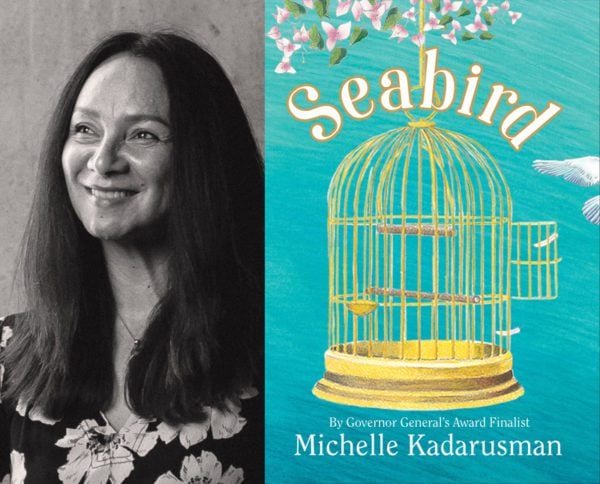
Governor General’s Award finalist Michelle Kadarusman brings an inspiring tale that centres her proud Indonesian heritage in the historical middle grade retelling, Seabird.
Readers are introduced to Raden Adjeng Kartini, a real 19th century female activist in what is present-day Indonesia who fought against an imposed marriage and house confinement at the age of 13 to pursue an education.
Kadarusman networks Kartini’s experiences into three overarching tensions: as a girl in a patriarchal society that favours educational opportunities for men; as a Javanese girl living under Dutch colonial rule, and as a member of royalty within a hierarchical system.
Details are laid out with precision, from elements as fine as the nets surrounding the royal beds to the epistolary component between Kartini and her Dutch friend Lesty, whose letters, upon returning to the Netherlands, offer key observations on brutal colonial legacies.
The fictionalized accounts of her maids Uka and Yant introduce my favourite part of the book – the golden combs mystery – where the girls are given a set of combs and rely on Kartini’s ability to read to decipher its sender. This was fun and truly felt like a middle grade mystery, but the scenes felt too cursory, a small blip in the story later re-introduced and hastily summarized.
Simply put, Kadarusman writes beautifully. She carves out places and worlds; grounds them in historical facts; then elevates them with the stories we’re more familiar with, particularly coming-of-age stories of young female protagonists, such as Louisa in Kadarusman’s Music for Tigers, who sets out to save the enigmatic Tasmanian tiger, while also navigating the nuance and subtlety of childhood through themes like new-forged friendships and family relationships.
Overall, I still found it hard to connect with Kartini. Her voice ran tepid, constrained by formality in the narrative and dialogue. It was hard to find one main undercurrent to propel oneself amidst all the components of Kartini’s struggles, hard to sit alongside Kartini’s story with pathos, and to feel emboldened and inspired by it.
Seabird concludes with a glossary, along with pictures of the real Kartini, her biography, and additional historical notes; these elements tie the story together and add a new dimension and appreciation to the tale.




 Contact us via email