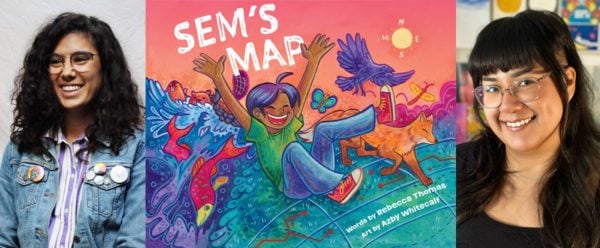
l to r: Rebecca Thomas and Azby Whitecalf (Credit: Nancy Whitecalf)
Sem’s Map by Mi’kmaw author Rebecca Thomas, with illustrations by Plains Cree artist Azby Whitecalf, introduces readers to ways of thinking about place names and maps that may be different from what they’re used to. Readers follow Sem, whose teacher shows the class a map of North America with place names that are unfamiliar to him. When Sem mentions this, his concerns are dismissed.
Sem grew up with his Kiju (grandmother) telling him stories about the land, stories with place names that are much more informative than the lines and boxes on the map Sem sees at school. He decides to stand up for his map, and his kiju is invited to teach the class more about the map and stories she’s passed on to him.
The book is inspired by Thomas’s childhood memories of reading Western atlases as well as the reclamation of Indigenous – in particular, Mi’kmaw – place names that happened later in her life. Sem’s Map teaches readers new ways of thinking about the origin of these place names and what those names tell us about a given place – for example, Unama’ki, which means “land of the fog” in Mi’kmaq, tells us far more about people’s experience of the land than “Cape Breton,” its English place name.
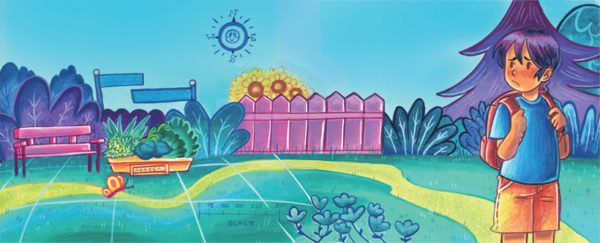
Illustration: Azby Whitecalf.
The book begins with a map of northern North America. The provinces and states shown are clearly labelled. The book ends with a similar map, only the place names have been replaced with their Indigenous language names, drawn from The Decolonial Atlas by cartographer Jordan Engel. Although this map communicates the main point of the book – the many ways of thinking about land – clearer information about the languages being represented on the map would be helpful. The Indigenous language map appears to draw from local community place names and languages, but that’s not clearly communicated, nor is how the framing of place names might differ from culture to culture.
Overall, Sem’s Map serves as a solid introduction to different ways of thinking about the land and names, providing a jumping-off point for further discussion and research. It is a strong addition to library and teaching collections for young readers, but it would benefit from additional contextual material to promote a greater understanding of Indigenous conceptions of land and language.




 Contact us via email