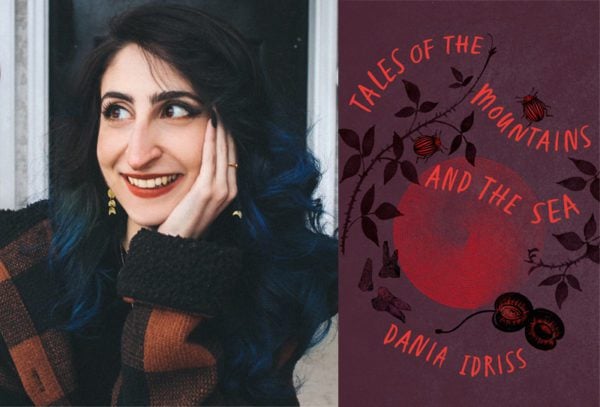
Dania Idriss (Rayane Sabbagh)
Dania Idriss’s Tales of the Mountains and the Sea is a cross-genre debut collection in which characters’ lives, beliefs, and actions are interwoven with Middle Eastern folklore and superstition. In five stories set in Lebanon over various time periods, jinn, cannibalistic mother figures, and hyenas unravel the impact of the otherworldly through haunted bodies to make the unconscious conscious; each tale offers unrelenting shock and beauty.
In the opening story, “The Brass Bowl,” a 16-year-old grapples with the birth of a baby fathered by a travelling salesman. The young mother, horrified by the “thing” she has given birth to, refers to her baby as “beastie,” recalling the affection of Angelina Jolie’s Maleficent toward her goddaughter in the Disney films. Idriss’s stories are all filled with similar shadows; darkness infuses every turn in the plot, including the teenage protagonist’s relationship with her mother when her baby supposedly disappears: “I imagine my baby’s corpse on the stone ground. My mother cutting her open to teach me a lesson. … the fetid smell of birth fills my head. It’s nauseating.”
The titular brass bowl is also described unsparingly: it “sits on the bed tangled in the sheets. Something resembling a slab of petrified meat sits in the dented bowl. I think of the baby and wonder if my mother has cut her up to eat.” While this is shocking and absurd, it rightly belongs in the world of the young mother whose post-birth disorientation allows revelations about the baby’s disappearance to surface. Idriss layers the emotional truth of this complicated tragedy through the story of Umm Iraideh, a jinn-like figure who “will cut the baby up into pieces and eat it with her tea,” recalling other jinn-related tales such as that of Umm as-Subyan, a demon who causes miscarriages, well known in Iranian folklore. Ultimately, the truth of the story speaks to the closing theme of the collection: the bond between mothers and daughters, which endures when cultural and patriarchal norms threaten the dignity of innocent women who choose to indulge in a little pleasure.
In the story that follows, “The Muslin Shroud,” community secrets of a similar tenor are revealed when the family’s grandmother dies. Gashes beneath her kneecaps and severed Achilles tendons expose the belief that “she was afraid of becoming a ghoul in death … by cutting her tendons she won’t be able to come back.”
The preteen protagonist has saved dirt from her grandmother’s garden but is forbidden to visit the cemetery to contribute to the burial (women are discouraged or not permitted to attend burials in most Islamic funeral rites). This thwarted gesture coincides with the beginning of menstruation: but the lack of knowledge about the physical change leads the girl to believe she is being haunted by her grandmother. While the cause and effect between superstition and bodily changes sustains an innocent narrative voice, what’s more striking is how the character’s perspective provides glimpses into the complex web of relationships among the characters. Through her eyes, we see the segregated worlds of men and women, which coincide when her grandmother’s Christian friend confesses to the murder of her grandmother’s husband whom she had never wanted to marry.
The closing story, “Our House in the Valley,” takes place after the end of the Syrian occupation. We follow Aya, visiting from Canada, who roams the house inherited by her father (from which the Syrian border can be glimpsed and which for a time was under occupation). Fond of climbing the walls of the ruined building, she suffers a concussion after falling and subsequently mistakes her aunt for her mother, attributing her aunt’s too-tight hugs to her mother’s controlling nature. Later she is gently corrected by a relative who reveals that her aunt had married a soldier because she got pregnant – an echo of the opening story that reveals the depth of the bonds among women, decentring male perspectives. In an evocative fairy-tale-like sequence, Aya chooses to rest in the vines that envelop the house where she “close[s] her eyes and let[s] the plants mend her,” suggesting the complex embrace of family.
As in the liminal worlds of Lauren Groff and Carmen Maria Machado, where characters experience bodily trauma, slips and slides, and encounters with animals, Idriss’s stories dwell in the threshold spaces where what is real is also what is shared, instinctive, and supernatural. The generous length of these short stories allows for a fantastical weave of folk tales and realism that makes Idriss’s characters leap off the page; the worlds they inhabit are always beyond the expected.




 Contact us via email