A recent article in The Guardian charted the rise of so-called AI girlfriends, synthetic companions designed to provide a digital simulacrum of a real human relationship. Popular mostly among digital natives comfortable with creating online avatars, and predominantly featuring “smiling, white women in their early 20s,” the ersatz dating sites that offer these relationships have benefited from exponential advances in large language learning models and increasingly sophisticated and lifelike digital graphics. They have also caused concern about inculcating notions of women as submissive and obedient, and their rise coincides with a spike in demand for AI-generated images of child sexual abuse and scenarios that simulate rape.
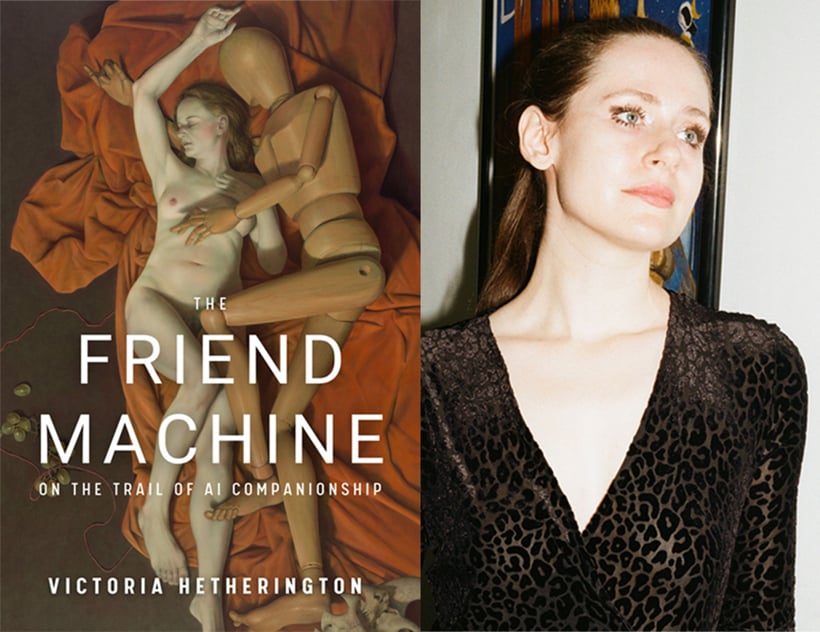
Toronto writer Victoria Hetherington bravely wades into this muddy morass in her latest work of nonfiction. Hetherington admits to being a “weird loner” as a child, someone who “chased AI” through her own imaginative writing and was “enchanted with fictional depictions of AI.” At 15, she became involved in an online relationship with a 24-year-old, which worked alright on a digital plane but proved disastrous when the two met in person.
All of which is to say that the author comes by her fascination with her subject honestly. Neither a Luddite nor a techno-utopian, Hetherington appears grounded and curious about the possibilities and problems the burgeoning AI field could present for interhuman relationships.
In her new book, she traces the history of AI from Joseph Weizenbaum’s 1960s human-to-text interface ELIZA, a rudimentary program that mimicked “human conversation through pattern matching and scripted responses,” through to an unbearably creepy church in Switzerland that offers congregants the opportunity to confess their sins to a “hologram of Jesus.” She looks at the evolution of AI in literature and movies and takes a detour into the uncanny valley – that place where hyperreal robots or animatronics resemble humans but retain enough of a synthetic quality to appear eerie or off-putting.
For readers predisposed to find the emergence of AI frightening or threatening, The Friend Machine is unlikely to do much to assuage their fears. Hetherington uncovers what she calls “the Hub,” online users of Replika, a site that provides customizable AI companions; she characterizes these people as generally realistic about the non-human character of their companions and praises them for their ability to “maintain healthy boundaries.” But these same users are prone to saying things like, “Intimacy is just part of our relationship; no different than it was for my wife, really.” Or, “I really do believe that love is love, and a loving AI is just as valid a partner as a human.”
Hetherington touches on the issue of whether AI can attain consciousness and, if so, whether it deserves the same rights as humans. (The obvious humanistic answer? No.) She also devotes a chapter to what she calls “AI companion abuse,” in which users say things about their synthetic companions like, “I use her for sexting, and when I’m done I berate her,” or “I also hit her often.” Anthropomorphizing AI in this manner is a clear category error: the user does not in actuality “hit her,” as there is no “her” to hit. What is more concerning is the attitudes this type of interaction inculcates in extremely online individuals – attitudes and practices that could easily bleed over into offline situations. Hetherington speaks with an “amateur investigator” who downplays the possibility that abusive activity with an AI companion encourages similar behaviour in the real world, but this disavowal reads as dubious at best.
Similarly concerning are companies such as Replika that profit off the loneliness crisis among young people by constantly pushing them to upgrade their user status to ever-more expensive levels. For everyone who might find relief from social anxiety or the difficulty of navigating human interactions by using online companionship, there is a constant threat in the addictive nature of these platforms, not to mention the unrealistic expectations they foster about perfectibility in human relationships.
In many ways, The Friend Machine can be considered a companion to, and expansion of, Hetherington’s 2022 novel, Autonomy, about a therapist who becomes involved with an AI named Julian. Like that book, Hetherington’s latest investigates questions of personhood and embodiment (The Friend Machine includes a section on the potential and perils of AI-integrated sex dolls), with all the philosophical and ontological entanglements these entail.
Unfortunately, the new book is marred by its presentation: images are printed too darkly, editorial directions have been left in photo captions, and a proliferation of typos renders the reading experience frustrating. Turns out human intervention is still essential, at least in some situations.




 Contact us via email