Jennifer LoveGrove (Sharon Harris)
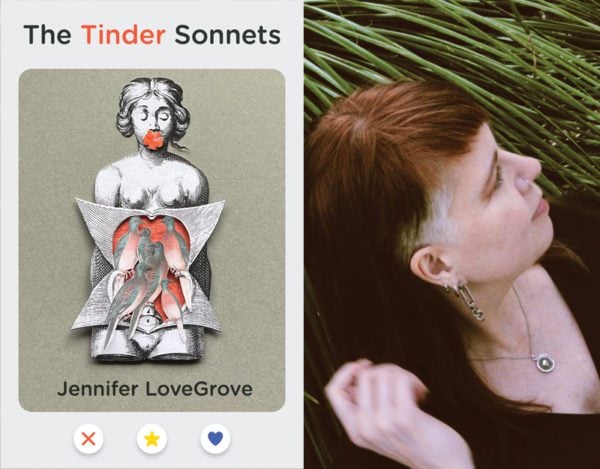
The Tinder Sonnets by Jennifer LoveGrove has everything I want from a book of poetry. Needle-sharp metaphors and language play. Immersive imagery that assaults your senses and makes you forget you’re reading a book. A guarded – yet completely unbarred – poetic voice that reveals its wisdom through fatigue-tinged social commentary and self-aware, sometimes self-critical sarcasm. And dynamite line breaks, like the speaker describing a date as “Too wealthy to be more than a poor / impersonation.” These are poems grown from immense research, years honing craft until it comes like breath, and pain.
The back cover description of the collection seems to soft pedal the book’s impact. For me, this is a collection that moves far beyond desire, dating, and misogyny. It’s about rape culture and the moral selectivity that tries to obscure sexual violence. The poems examine how glossed-over, casual misogyny made permissible at the macro level (by organized religion, capitalism, modern technology’s disposability culture, etc.) trickles down to create more intimate acts of violence and hypocrisies. Such as a young girl doing morality homework to not get in trouble with her Jehovah’s Witness father, while babysitting her younger male cousins who have been left a film “about monster / trucks,” featuring a rape scene, for their entertainment.
Maybe I see more violence here because LoveGrove has made space in the collection for readers to confront our own hurts, too. To hold them up to the light of the poems – like an entomologist does an invasive beetle – understand them, and maybe shrink some of their power over us.
The book comprises 26 sonnet triptychs for a total of 78 sonnets, split into five sections delineated by sketches of girls’ Victorian dresses with flowering plants (or, at the rage-filled emotional apex of the collection, a jagged mineral formation) protruding from the neck holes. Like much of the book, the sketches invite contrary interpretations. Does this figure want her body to be a flower, identifying with its healing properties and protective powers? Or has she been made into the flower’s image by a man who “need[s] to feel that [she’s] miniature”?
These are sonnets in form, 14 lines each with 10 syllables per line, though without the traditional rhyming scheme. And they’re about love and longing. But what this speaker longs for is almost never a man, and almost always clarity of thought, basic regard for her and others’ bodily sovereignty, and a sense of peace. She’s more than a bit disgusted with the un-natural world, maybe even with herself – the self she had to put on to survive the man-made mutation of society’s moral DNA.
Sometimes the poems feel like they want to break out of their form, but the tension of being contained creates its own kind of wildness. They insist on being read slowly. If you get too taken by the rhythm of the structure, skip over a word you don’t know or a syntactically complex phrase, you risk overlooking the dynamic energy living inside each and every line.
As a reader, I feel not only entrusted with the speaker’s tender truth-wounds, but empowered by new language to wield so that I, too, can be unmistakable in my fury and freedom. I’m grateful for this collection.




 Contact us via email