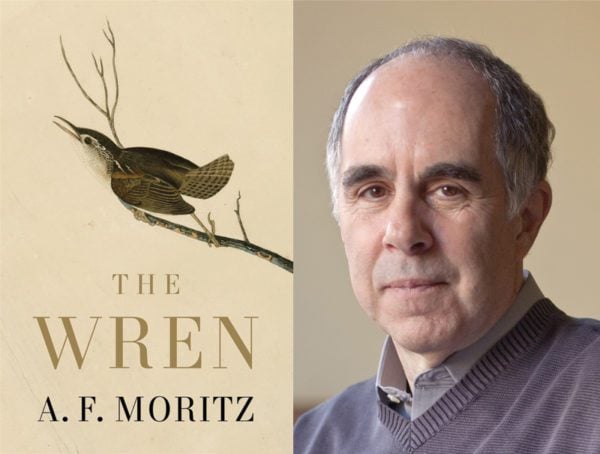
A.F. Moritz (Steve Payne)
A.F. Moritz’s The Wren is a book of Zen koans written by an urban monk posing as a poet. Suggestive of a reflective period after facing health concerns, the poems bypass ordinary logic to flirt with mortality with reckless abandon. There is a Zen saying, “If you die before you die, then when you die, you don’t die.” The “great doubt” (existential questioning that results in dissolution of self-identity) rises around the koans. I even hesitate to call some of these poems at all; “Faithfulness” is the epitome of a succinct conversation with the self:
Time will run out on you,
they say. No. Time never
runs out.
The Wren is pithy compared to Moritz’s past works. Moritz employs an unusual precision in this collection of poems. His poetic skill and philosophical contemplation show the hand of a master at ease with his craft. Here, wisdom is distilled into spare and few lines. Past, present, and future entangle with mortality. Phronesis, or practical action, is personified as a cricket, followed by “Powerlessness,” “Légitime défense,” and “Attempted Retrospect,” which, together, speak to John Milton’s famous poem “When I consider how my light is spent,” an intimate reflection on the struggle to serve God or the divine, though Moritz remains entirely secular within The Wren.
These late-breaking retrospectives belong to the realm of mature poets, and Moritz confronts his own existence in these deceptively spare grains of insight. Here, the poet reveals a world view, his view of himself, and all of humanity and its foibles in an economy of space as effective as Yoda’s famous aphorism: “Do or do not. There is no try.”
What remains consistent through all Moritz’s works – he is the author of 22 previous poetry collections (not including translations), and is the winner of the Griffin Prize and the Al & Eurithe Purdy Poetry Prize – is his prowess with metaphor, constructions that shape-shift reality into paradoxically concrete and ephemeral notes, as in “Voice: Ruin”:
My voice is a ruin of the great building
which was nothing but a hollow in the ordinary hills,
their streams and coverts, slopes and meadows.
It had been built by song beyond
all towers of materials that can be
mined and fused from a wasted ground. My voice
is a hollow grown from the long-ago, long-gone
coming of the poet whose voice was a song
of unaccustomed joy here
in the sky’s silence. In that ruin of a vale.
Sounds and substance morph into maranasati, the contemplation of one’s own death as a practice toward fuller awareness.
“The Wren,” the namesake poem of the collection, may be the most Buddhist of all. The bird becomes a symbol for the transience and elusiveness of a lifetime, and perhaps even of the glimpse of wisdom the Zen practitioner hopes to attain:
and jerks and flutters, peering out, being glimpsed,
withdrawing again—into the thick of the doll forest
to be guessed there, its existence, the sighting of it
doubted, a legend of memories and hints.
In the collection The Sparrow, Moritz teased out the ways the sparrow is a citizen of unseen places. Staying with the bird motif, this new, deeply philosophical collection questions the ephemerality of the individual within the grand narrative of time with irreverence, humour, and sorrow, most briefly noted in the one-line poem “Discouraging Assurance”: “You have already been eternal.”




 Contact us via email