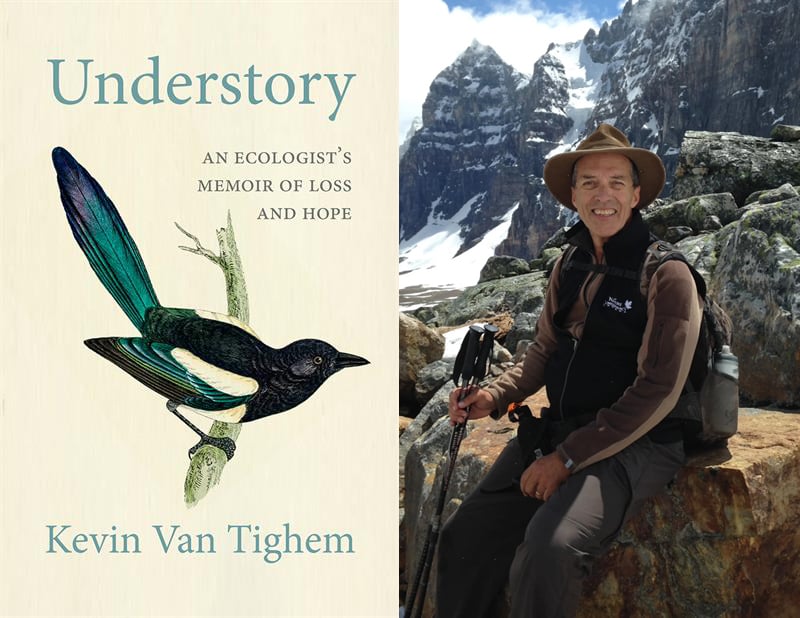
Kevin Van Tighem’s Understory: An Ecologist’s Memoir of Loss and Hope asks readers to look past the trees and kneel down to see the plants, insects, and birds that fill the forest floor. He illuminates both the small and large connections found in this layer of forest, the understory that reveals a healthy or failing ecosystem. He also shines a sometimes painful light on his own family’s dark hollows.
Van Tighem dedicated his career to working in Canada’s national parks, which are the spectacular settings for much of his writing, each with unique challenges in conservation and human use. His earlier works, including Wild Roses Are Worth It: Reimagining the Alberta Advantage and Our Place: Changing the Nature of Alberta, showed Van Tighem’s prowess as a naturalist and conservationist. This memoir reveals his sense of himself as an outsider who worked within the system, even as he rose to the top ranks of Parks Canada to become superintendent of Banff National Park. There is a tension between his outspoken advocacy for environmental protection and the revelations of Parks Canada’s failings – one of the understories examined in the book.
Some of the understory that informs the book is Van Tighem’s own experiences and understanding; the memoir begins by noting the Van Tighem family’s Catholicism, and ends on a spiritual note that embraces Indigenous ways of seeing. A penitent theme dampens every page. He offers up his mistakes, such as a moose hunt foiled by his lack of preparation, which wasted the animal’s sacrifice. The slip of the knife, the long walk back to his vehicle, bleeding all the way to the emergency room, tells not only of his youth and hubris, but the blood he sacrificed to learn the lessons of the Iyarhe Nakoda (Stoney Nakoda Nations): take only what you need and no more. The scar he carries carved the lesson deeply.
Van Tighem distills the ethos of two-eyed seeing (the combination of Indigenous wisdom with Western knowledge), but the imperfect reality of humans is ever-present, both as it relates to his work and personal life. Van Tighem recounts efforts to reverse the 1902 Canadian government exclusion of the Iyarhe Nakoda from Banff National Park, their traditional lands. Through collaboration with Stoney Nakoda chiefs, Elders, and knowledge keepers, and Pam Veinotte, then-superintendent of Lake Louise, Yoho, and Kootenay field units, fundamental changes were accomplished with a new parks management plan written, and commitments made to restoring plains bison to the ecosystem. Yet on the ceremonial day marking this change in 2010, Van Tighem’s female counterpart, Veinotte, was not allowed inside the teepee for a pipe ceremony.
Van Tighem warns that the understory also holds darkness, which is revealed in the final chapters when he writes about an uncle, a priest who was charged for grooming and sexually assaulting young girls in his parish. The pain inflicted by this pedophile uncle is unsettling, as is the family’s coping mechanism of silence. Van Tighem shows courage in acknowledging both the crime and his unrelenting willingness to engage, to communicate, and even to sit in silence with his dying father knowing he will never get to ask what his father knew. Van Tighem’s decades in the mountains resonate here: silence before an avalanche, and the aftermath of never knowing.
There is something of Norman Maclean’s A River Runs Through It in this memoir. Foreshadowing predicts tragedy and the characters – colleagues and family – seem unable to alter their fates. When Van Tighem returns us to the Oldman River, on whose shores his story begins, there is a sense of coming full circle. The natural world has shaped him, his life has been moulded and etched by years of hiking mountain trails, hunting, and fishing; he in turn has shaped some of what the rest of us see as nature, through species inventories, the reintroduction of plains bison, wolf pack monitoring, and working to dismantle more than a century of Indigenous exclusion.
Now retired, after decades of environmental advocacy, Van Tighem lays bare the challenge of conservation based on the Western idea that humans somehow operate outside of nature. He shows time and again a commitment to relationships, to dialogue, and collaboration with everyone, from Indigenous Peoples to tourism operators to bicyclists in Jasper. It is clear Canada’s conservation system is flawed, but Van Tighem is less clear about workable alternatives, and what lessons can be gleaned – even as Canada moves toward creating 15 national urban parks with Reconciliation with Indigenous Peoples as a key goal. Van Tighem trained as a botanist, but with his consistent focus on the relationships between all living things, he embodies what it means to be an ecologist. His journey to understand kinship and reciprocity in our relationship with nature illuminates these pages, respecting the life force in every rock, river, and tree.




 Contact us via email