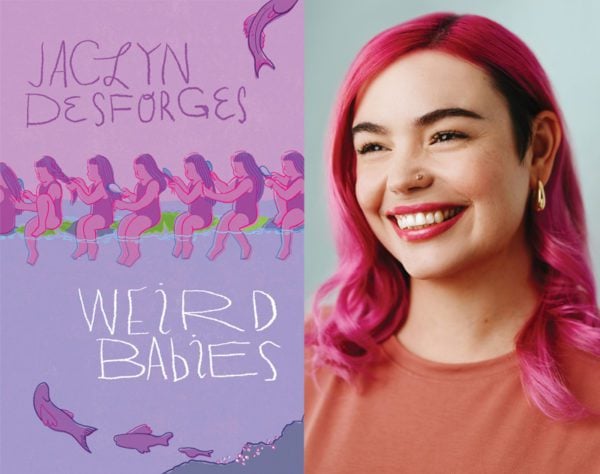
Pleasure and danger commingle within the pages of Weird Babies, the striking and provocative fiction debut by RBC/PEN Canada New Voices Award–winning poet and children’s author Jaclyn Desforges. So do realism and the absurd. Over the course of 13 stories, the reader is presented a kaleidoscopic view of human relations: obsessive mothers, overbearing sisters, and “squishy and warm” little babies. Sharp, clear prose and a willingness to bend the boundaries of objective reality combine to render a collection that is refreshing, unpredictable, and utterly distinctive.
The Hamilton, Ontario–based author of the poetry collection Danger Flower identifies as both neurodivergent and queer – and this outsider perspective is reflected in the way these stories consider the myriad ways women can inhabit their bodies and process their experiences. On Earth, on other planets, as ghosts.
Reproduction and its repercussions factor prominently among the book’s thematic preoccupations. There are mothers who are fixated on their offspring and others who are absent, would-be mothers struggling to conceive, and one who gives birth to the son of God. In “Molt,” a story by turns comedic and tender, a virgin nerd living in her mother’s basement develops sexual agency and participates in enthusiastic consent. “Dust” explores the strange lives of a set of quadruplets exploited by their father.
Weird Babies showcases its author’s poetic gift for rhythm and repetition, lending the prose an incantatory feel, frequently conferring a surreal, dreamlike quality to the stories. In “Yes, And,” a story about two best friends in a moment of transition, Desforges writes: “Quail is secretly in love with Tulsie. Quail is secretly in love with Tulsie’s fiancé. Quail is secretly in love with no one, but masturbates frequently to the thought that she is.” Another story, one that involves a shocking act of sexual violence, ends ominously: “Don’t be such a baby. It’s just a story, it’s just a story, it’s not real.”
Desforges consistently deploys the present tense, establishing a necessary immediacy in stories focused on the current moment, when the experience of both time and place feels fractured and destabilized.
Shifts between past and present events – and between realism and the fantastic – disorient and confound expectations. In “Grief,” a woman takes a lover who is the size of a bird, and a baby is spawned from within the body of a fish. “Mothworld,” the collection’s closing story – also its lengthiest and most surreal – profiles an entomologist who takes a job on a world in another part of the galaxy. The time is 2040; passenger buses now float on air but Wikipedia is still a thing.
Encompassing intergenerational trauma, OnlyFans, supernatural entities, sensory overwhelm, voyeurism, and mourning, Weird Babies offers a perspective on contemporary society (and the cosmos, and the realm of the imagination) that is at once particular and expansive. Despite many flashes of humour, the collection does not refrain from exploring dark and often uncomfortable themes and topics. The reader may not finish this book feeling better about the world, but will almost certainly come away from the experience feeling more intensely about the world.




 Contact us via email