
l to r: Shauntay Grant (Steve Farmer) and Letícia Moreno.
How often have you found yourself reciting a saying your grandmother taught you? Shauntay Grant’s picture book Where There Is Love: A Story in African Proverbs, illustrated by Letícia Moreno, captures a girl’s introduction to life lessons in the comfort of her grandmother’s home.
Excited to attend a family gathering at Nana’s, the young girl enters a home full of sweet smells and good food, where Nana awaits with a warm smile. As the food needs many hands to prepare it, she gets to work helping Nana in the kitchen.
Nana teaches her granddaughter through proverbs that relate to her process of learning to cook – “Don’t worry. She who does not know can know from learning.” The girl acquires patience and a sense of self-worth while nourishing her body.
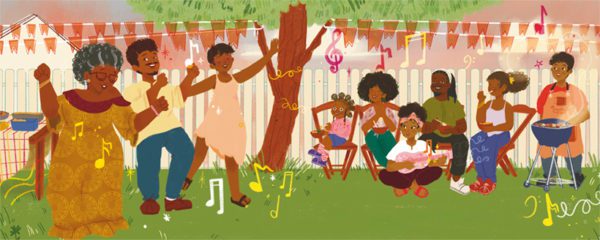
Illustration: Letícia Moreno.
Nana’s home and the food they prepare are as much characters as the family members, with Moreno’s illustrations communicating the brightness and joy of this world. Nana’s house is full of Easter eggs – additional proverbs and symbols, such as the Sankofa bird – hanging on the walls. And the food’s delicious scent appears as a golden, sparkling trail wafting across the pages, guiding the reader through the evolution of the backyard feast.
The family eats with traditional calabashes for bowls, and the meal then transitions to a family jam session where even Nana joins in the dancing, before they settle in front of a crackling fire. Safe with Nana, the girl realizes she has spent the day making memories to last a lifetime.
In the backmatter, many of the story’s proverbs appear in their original continental African languages, and we learn of the personal significance these sayings hold for Grant. With her brilliant mixing of a girl’s experience of a family gathering and proverbs passed down to children from elders, Where There Is Love exposes readers to different ways wisdom can be shared, and the idea that it isn’t possessed by a single set of people. Grant reminds us that “[a] person should take as their companion someone older than themselves,” and when we listen to our elders, we participate in the traditions of our ancestors.




 Contact us via email