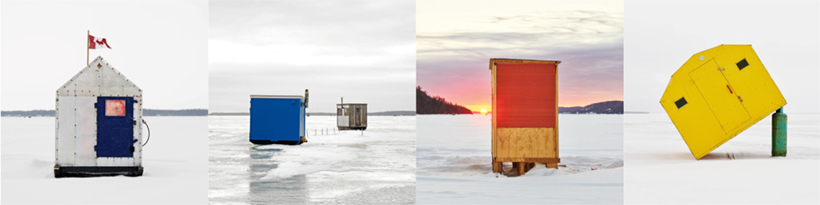
Photographs from Richard Johnson: Resilience—Ice Huts and Root Cellars (2007–2021) by Lucie Bergeron-Johnson and Tom Smart. Photography by Richard Johnson, courtesy of the Estate of Richard Johnson. © 2025 Lucie Bergeron-Johnson. Reprinted with permission from Figure 1 Publishing.
When people come into the Richard Johnson Studio in Toronto and express an interest in purchasing a print of one of his photographs of ice huts, Lucie Bergeron-Johnson, his widow and art trustee, puts them through a bit of a test.
She gives them a printout of the image they’re interested in and sends them home with instructions to tape a box the size of the print they’re looking to acquire onto the wall they’re planning to hang it, tape the image inside the box, and sit with it for 24 hours.
“The idea is that they walk in the space where the print’s going to be and then they know how it’s going to feel, the energy of the print that’s coming into their space is starting to build,” Bergeron-Johnson says.
In a way, Richard Johnson: Resilience—Ice Huts and Root Cellars (2007–2021), the forthcoming book that features a selection of images from both his Ice Huts and Root Cellars photo series, exists because of a similar testing process. Collectors had long asked Johnson and Bergeron-Johnson whether they had a book of his works; a limited edition the pair printed in 2016, however, was a disappointment, with inconsistent inking that left colours varying from copy to copy.
Johnson photographed ice huts in every Canadian province over many years, starting in 2007. After he died in 2021, clients started to ask after a book again. And though the idea of a book was not top of mind for Bergeron-Johnson, “it was always present, it was present but in the background – never something that I set out to do.”
But that changed when she saw a book a friend had published with Figure 1 Publishing. After getting in touch with Figure 1 in early 2024, the project came together quickly. Working with Steve Cameron at Figure 1, Bergeron-Johnson enlisted Tom Smart, the retired director of Fredericton’s Beaverbrook Art Gallery, to write an essay about Johnson’s work. She nervously asked photographer Edward Burtynsky, a longtime friend, for a 300-word foreword. He said yes without hesitating and wrote 1,300 words.
“Mind blown,” Bergeron-Johnson says. “It was a beautiful process all the way through.”
Johnson worked professionally as an architectural photographer, making sure to capture the assets, or buildings, of his clients in the best possible light. But in his personal creative practice, he was drawn to smaller, imperfect, utilitarian structures like the ones featured in Resilience – the temporary huts that anglers set up on frozen lakes across Canada for ice fishing, the dilapidated and overgrown root cellars carved into the hillsides of northeastern Newfoundland.
Tara Westermann, the gallery director of Hamilton’s Smokestack gallery, helped select the more than 200 images for the 224-page, full-colour book – a process that Bergeron-Johnson says made her look at some of the photos in a new light.
In 2017, a selection of the ice hut images were installed at Toronto’s Pearson International Airport. In a video introducing travellers to his work, Johnson explained how he photographed the huts using the same square format, the same overcast light, and the same placement of the structures in relation to the horizon line, so that the huts themselves are easier to compare.
“What interests me about the ice huts is their simplicity. They’re often built by the hut owner with reclaimed materials for very little cost,” he said. “It’s funny how architects want to control everything in the building process, the planning, the materials, the joinery, and here you have a guy with three sheets of plywood and he puts together an ice fishing hut. They’re rough and ready, and that’s what makes them such powerful objects.”
Bergeron-Johnson thinks the images succeed because they spotlight the beauty in the overlooked. People spend a lot of time looking down at the screens of their phones and, when travelling, often opt for the main highway instead of the side roads, and in so doing miss out.
“People have forgotten how to look, you know?” she says. “[Johnson’s work] resonates with people because it gives them another window into what’s going on around them.”
Her favourite ice hut image is included in the book: “Ice Hut #019” is a grey two-box structure covered in metal sheeting that glows in the overcast light. Johnson photographed the hut in Gilford, Ontario, on Lake Simcoe in 2007. A red horizontal strip runs across the front, at the top of the structure, at a slight angle to the horizon line.
“It’s the quietness of it with this little spark of colour, just this simple red line. It’s the brilliance of it on a cloudy day,” Bergeron-Johnson says. “It’s just been my favourite forever.”




 Contact us via email