Riding the Wind
The Creative Process
I don’t know exactly when autumn arrives. The calendar sets a date, but the slow burn of leaves, the grass crisp in the deep arrival of frost, the green stalks of rye and wheat, their blond heads bowing, makes a presence known. Nevertheless, the defining moment of autumn’s arrival eludes me. The geese flock, ducks, magpies, robins, and other songbirds layer fat and leave our sleep in their reply to the silent, distant call of the south. A flicker lifts its head off the ground, consumes the last grub, and leaves for another season. It lifts in flight and bobs on the waves of the wind. The fall arrives so slowly, then so quickly with the sudden arrival of cold rain, harsh, bitter winds, and the trees are bare.
For some time the tree has been slowing its breathing and the sap is but a trickle, just enough for the tree to know that its umbilical cords are still tethered to the earth. The leaves struggle to maintain their own flow; they twist and turn with the sun, whipped and rattled by the winds. Life slowly drains and they take an unwilling leap from their blood source. They either twirl to earth gracefully falling face first at the foot of their mother, or they blow far from home and are slammed into their earth where they crumble and return once again as our food source. Writing is like that.
Some refer to their inability to generate fresh sap as writer’s block. I prefer to call this stillness a slow trickle of my life source. It moves silently and gradually fills the artesian well once again. Giving birth is not pretty. Breath is hard and short, gasping. The body contorts, opens and closes the channels of birthing. The breath is held, expelled, held even harder, blows forcefully. The drive to give birth is an excruciating search for relief. The womb releases and everything explodes, blood, water, and guttural screams. The birth of writing ideas may not be so dramatic, but they do have a long gestation and are accompanied by great relief when they arrive and take breath.
Today the landscape is alive with the cry of coyotes, a buck saunters in rut before the scent of settled snow, a hawk’s last flight following a wayward rabbit, and winter is on the small hairs of my arms. The seasons creep into me. In the spring I can hardly sit. Spring rises, its lightness on the tips of a ballerina’s toes. I become electric. I am impatient to dig my shovel into the thaw, to plant a seed and nourish it. I want to create a labyrinth, take photographs, welcome songbirds, unfurl the buds of the trees, visit crocus hill, and plant saplings. My belly, my thoughts are explosive in energy, not inclined to pound keys. The air draws me outside, but I still try to channel the creative flow.
Summer rang my doorbell. I never heard its approach; did not see it crawl up the road. She invited us to pitch our tent, camp with the rocks, the water, paddle our canoe, drink camp coffee, and eat burnt toast. Some summers the saskatoons hang like grapes; other times they are stingy, shrivelled currants. In the summer scorch I worry about my saplings, haul buckets of water up a slow incline from our lake, splash my bare legs. I can lose half of my precious life giver as I quench the thirst of those sun-dancing trees. My eyes search for dark bulging clouds, listen for the call of the thunder beings, watch for the big eye of lightning. I am entranced, glued to the rhythm of the operatic sky as it conducts its own life.
Before I am at all prepared, fall brings the abandonment of freedom, brings forth loneliness, sadness. When we were children, my siblings and I would quiver, knowing we would be leaving again for residential school. Who would know when we would see our parents or play freely with each other again? As year upon year passed I lost the meaning of home. Autumn forces me to hibernate, to go within. I don’t need the fasting lodge I build in spring, the cabin on the reserve where I was raised. I simply go home within. Much like my grandmothers, who sat with their medicines, drying, sorting, crushing, or braiding different plants, I am drawn back to my computer.
The winter keeps me at this post, huddled in sweaters, blowing frost on the windowpane, travelling with the snow-snakes on the hills, drifts thick with thought. I am back gestating. Waiting. Fingers work slowly, walks are cumbersome, and thoughts mirror and bounce on the glistening snow. Sometimes they send shivers up my arms and down my back.
When I was younger, living in the lost valley of fossils, thunderous rain drenched me through to where my tears had frozen. I danced wildly in that rain, alone. Many years later I bathed in the deep red waters of Prince Edward Island, wearing a thin cotton dress and revelling in my sensuality. While canoeing the whitewater of northern Saskatchewan, the voice of the ancient rocks took me into the dream-water of the lake where the grandmothers said, “Dive deep.” So I write from this place of irrationality to bring it to life, to bring it to the place of consciousness.
I believe many writers have a muse, practise some ritual, or weave a magical spell. Perhaps they throw salt over their shoulder, chant and beseech their God, will their fingers to write, or, like me, simply walk the land. On CBC one day I heard a woman describe how in the act of hanging her laundry, a poem called from the wind, travelled like a caped rider or perhaps a herd of horses swirling rapidly toward her. She ran into the house, hanging onto the coattails of the poem before it escaped her. Writing is like that. If you don’t write it immediately, the gift may blow away. In essence it is the meditation and deeper awareness found in paying attention with all the senses.
There is a variety of seeds that float in the wind. Not every seed germinates. This spring I planted exactly twenty-six seeds of sweet peas. Only three made it up the trellis. I need and want to be obsessed and possessed by an idea. Like a cat I will bat it around, play with it for hours, days, months, or perhaps more accurately it plays with me until she is ready to show me the way. I become its mistress. The idea will reveal its secrets and I will grow up the trellis, with all its demands. I will wake up filled with dreams and visions at all hours of the night; it will present itself at a coffee shop, someone’s speech, or jump at me from a passing vehicle and wrestle me down. I trust that I will be shown the way.
Generally speaking, we think we create our thoughts. In my humble opinion, all this activity is simply part of the greater Mystery which we should receive with gratitude. I participate in the ceremonies of my culture, listen to the teachings and observations of my Elders. This is collective knowledge, experience, and oral tradition. Spirit lives and is manifested constantly, both in nature and the stories we share. This knowledge is an open doorway. It is up to oneself to discern how to act with this awareness and the received gifts.
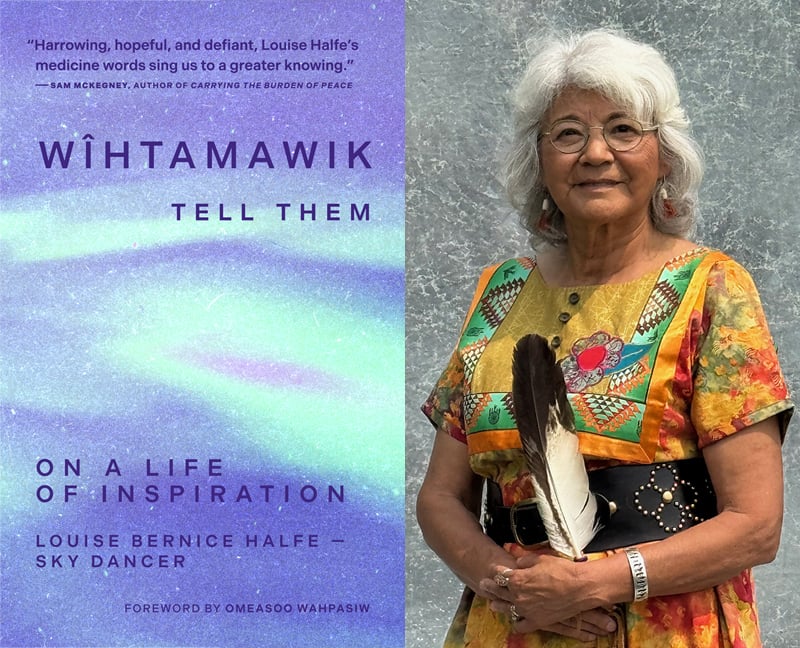
Louise Bernice Halfe – Skywalker (Craig Richards)
Louise Bernice Halfe – Sky Dancer is an acclaimed nêhiyaw (Plains Cree) poet and writer from the Saddle Lake First Nation in Alberta. She is an award-winning poet with five previous collections of poetry, including a selected works, Sôhkêyihta. She is former Canadian Parliamentary Poet Laureate and Saskatchewan Provincial Poet Laureate, Member of the Order of Canada, and recipient of the Latner Griffin Writers’ Trust Poetry Prize, the Kloppenburg Award for Literary Excellence, Saskatchewan Centennial Medal, and Queen Elizabeth II Diamond Jubilee Medal among others. Louise Bernice Halfe – Sky Dancer resides on the northern plains outside of Saskatoon, Saskatchewan.
Excerpted from: Wîhtamawik / Tell Them: On a Life of Inspiration, a book of never before collected essays interspersed with new poetry from Louise Bernice Halfe – Skydancer, with a foreword by Omeasoo Wahpasiw. Copyright 2026 © Louise Bernice Halfe – Skydancer. Published by University of Regina Press. Reproduced by arrangement with the publisher. All rights reserved.
Wîhtamawik / Tell Them: On a Life of Inspiration publishes on March 3.




 Contact us via email