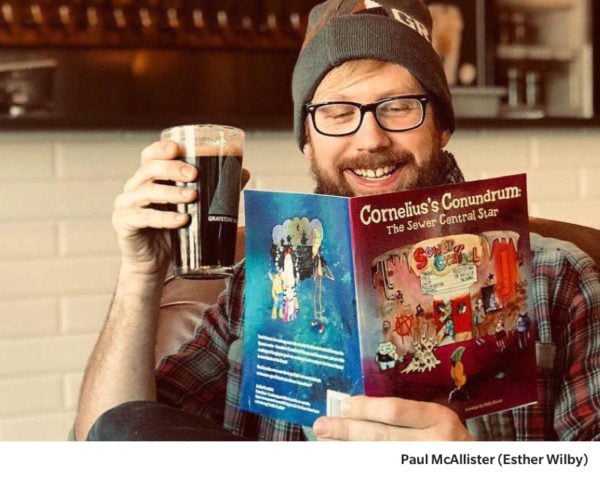
The picture book was called There and Back Again, a Herman Tale (about a shy monster who lives under a bed and yearns to know more about the rambunctious street monsters).
Paul McAllister had written it in 2014, and the following year approached Julie Scriver, creative director of Goose Lane Editions, whom he had known for years, to see if they’d be interested in publishing it. Goose Lane doesn’t publish picture books, but Scriver suggested he consider self-publishing.
“So, I went ahead and put together a GoFundMe campaign, and it wound up exploding. We sold nearly 1,000 copies right off the bat, and had great promotional support from author Sheree Fitch,” recalls McAllister on the phone from Fredericton. “The books arrived on Dec. 16 of 2015, and I remember that very specifically because I had to get about 700 books out the door before Christmas.”
McAllister’s day job at the time was running the not-for-profit arts organization Feels Good, and after the book’s publication, the artists, musicians, and writers he worked closely with started approaching him with the same question: how did you do that? The questions led him to take a closer look at the publishing industry. The only children’s publishing company in the vicinity was Bouton d’or Acadie in Moncton, a predominantly francophone publisher with a few English-language titles.
“One thing led to another,” McAllister recounts. “I went out to Library and Archives, and they said you had to list the publishing company [of the book]. On the fly I said Herman’s Monster House Publishing not thinking it would ever come to anything. And that’s how Monster House Publishing was born.”
The small children’s press started as a sole proprietorship in 2016, and was incorporated in 2020.
It’s a venture McAllister would never have imagined in his early 20s. He had what he refers to as the classic “I gotta get out of this town, go to the big city, and make a life” mentality. And he did get out. He got an agent, did some acting and commercials, and what he found was that it’s a really big pond, and he was a really small fish. And that making any kind of inroads or impact in the arts, which he has always been passionate about, was really hard. So, he came home to New Brunswick for what he thought would be a brief stay to find that home was quite a small pond, and all of the fish were leaving.
“I decided to stick around and work within the arts communities here, which are quite strong and supportive of each other,” he says. “When I started Monster House, I thought it would be an opportunity to change that narrative, where, as opposed to having to leave to find work in creative spaces, you need to be in this space to work with us.”
Ninety per cent of the press’s books, most of which fall in the picture book category, are from New Brunswick creators, but almost everything is created by Atlantic Canadians.
This local focus has led Monster House to work closely with both Indigenous creators and Indigenous organizations. One such collaboration is with Wabanaki Visual Arts, part of the New Brunswick College of Craft and Design; Monster House publishes the students’ final project, one of which is Mitzy’s First Time Picking Sweetgrass. Monster House also works with Kehkimin, a Wolastoqey Language immersion school, to develop early language materials.
They’ve also worked with different universities; with St. Thomas University, they developed the Mi’kmaq Alphabet Book, which has sold 15,000 copies to date, and with Mount Allison University they created Painting Our Legacy, an outlier for the press as it’s not a picture book. Monster House’s list now includes more than 25 titles, including What’s in Alanna’s Secret Sauce?, Alphabet Pie! and Other Poems, Tilley’s Tail and the Herman series, which comprises four titles.
McAllister’s aim was to increase the catalogue by about two titles per year, with the hope of publishing eight titles annually by now, but, sadly, funding didn’t work out. Monster House has four titles slated for this year, and they have a schedule through to late 2028. “We stick to four,” he says “and we hope to increase that as we move forward because there are so many stories that we want to share.”
Over the winter, the Monster House team tallied six, which included McAllister, Danelle Vautour, the creative director, and several interns from the University of New Brunswick and St. Thomas University. Now they’re back to a three-person team for the summer, which includes McAllister’s wife, Emma, who’s focusing on sales streams and publicity. She’s come on board through the Canada Book Fund’s publisher wage subsidy. (Monster House is represented to the trade by Ampersand Inc. and distributed by UTP Distribution.)
To say the funding space has been tricky for the press would be an understatement. “There are a lot of legacy publishers, [and] funding for federal programs hasn’t had the boost needed to support all of us upcoming publishing houses,” McAllister says. “We’ve applied for Canada Council project funding nine years in a row now, and we keep getting denied. It has been very challenging to just make a go of it day to day.”
This leads to a lot of pivoting. And one of those pivots is that McAllister has accepted Goose Lane’s offer to work with them to help establish their export lists. He starts the role this month with the idea that he can bring what he learns to Monster House.
When McAllister looks ahead, one of his missions for the children’s press is to improve literacy rates. “A 10-year pulse check has revealed that in New Brunswick the literacy rates have actually gone down,” he says. “We’ve been looking at different ways to address that, and one of them is we’ve developed a literacy application that’s piloting in New Brunswick schools right now using the Herman series. It’s a platform that will turn children’s books into interactive augmented-reality games based on the science of reading.”
It’s a deeply personal endeavour for McAllister, who struggled with learning to read as a child. It wasn’t until grade 4 that he learned he had ADHD and dysgraphia. Fortunately, he comes from a long line of educators who were ready and willing to help him, an opportunity he knows a lot of kids don’t have.
“Sheree Fitch came to our school in 1994 or thereabouts, and read some poems from Toes in My Nose and Other Poems and mentioned she was from Fredericton,” he remembers vividly. “That really resonated with me. I kind of had it on my bucket list to become an author, and then realizing down the road that I could potentially be that catalyst for other kids who were struggling to read was one of the biggest motivators.”
He sees developing a love of immersive literary fiction from an early age as one of the most profound tools we can give the next generation, because it develops cognitive, bias, and critical thinking skills, as well as empathy. “The importance of reading,” McAllister says, “that’s really why I do this.”




 Contact us via email