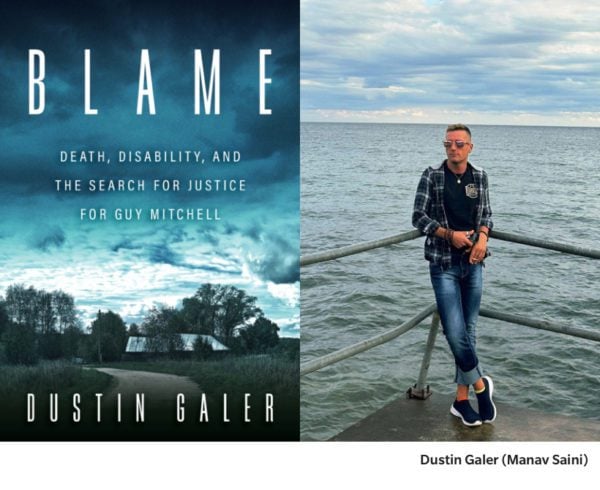
Historians who hope to author books for a broad public will struggle with how to best move away from academic writing toward engaging and accessible creative nonfiction. In Blame: Death, Disability, and the Search for Justice for Guy Mitchell, historian Dustin Galer explores the complexities of blame in the death of a disabled man, hoping to create “dramatic nonfiction that reads like a legal thriller.”
On April 29, 2012, Guy Mitchell drowned in a cistern on the farm west of Hamilton, Ontario, that had been his home and care home for most of his life. A 38-year-old man with developmental disabilities – meaning disabilities both physical and cognitive – Mitchell struggled with vision and mobility challenges and was diagnosed as having the intellectual capacity of a young child. All who testified at the coroner’s inquest described Mitchell as a friendly, helpful man who loved bowling and played a brotherly role to other disabled adults and foster children who shared his home. He died in squalor. Police investigating his death found feces-smeared walls, mattresses reeking of urine and vomit, a fridge with rotting food, no heat or running water, and toilets and bathtubs overflowing with human waste. The stench was unspeakable.
Galer does an old-school historian’s meticulous job documenting the blame for that stench. Drawing largely on the coroner’s inquest, Galer proves that every level of care failed Mitchell for years. The home’s owner lied, evaded home visits, neglected and abused residents. Choices Familyhome Program, the service agency responsible for oversight, failed to enforce its own home-provider contract and chose instead to discipline caregivers who raised concerns. While the SPCA seized neglected and abused animals from the farm, and the Children’s Aid Society removed neglected and abused foster children, the Ministry of Community and Social Services left disabled adults with the capacity of children in a “home” unfit for human habitation. In short, no one empowered to ensure Mitchell’s quality of life and prevent his death made any attempt to do so. Galer indicts us all: “We must therefore turn our gaze upon ourselves – our institutions, our governments, our beliefs and our societies – to discover the deeper causes of Guy’s death and discern the changes we need to better protect others like him from the same fate.”
Mitchell’s story is told in the voice of a dramatic omniscient narrator, as found in fiction, which undermines some of the credibility of the author’s intentions. Galer attempts to enter the minds, and create the voices, of individuals involved in ways that muddy factual accuracy. He paints a stereotypical, overly sympathetic portrait of Mitchell’s mother, concluding the book not with Mitchell, but with a scene centring her inner thoughts and emotions: “As she stood in front of the grave, Diane couldn’t help but feel a sense of comfort.”
The disability community that has fought the neglect and abuse of governments for decades is also unlikely to be comfortable with another of Galer’s choices: the inclusion of a fairy tale passage of feel-good, abled saviourism in which Galer imagines an alternative, happy ending, where a government advocate saves Mitchell’s life.
As a committed, non-disabled ally, Galer includes every disability-adjacent, caregiving voice, but unfortunately does not include the most important perspective – that of local disability activists such as Hamilton’s Disability Justice Network of Ontario. Including their authoritative analysis of ableism and Disability Justice would have brought true justice for Guy Mitchell.




 Contact us via email