
With a burgeoning national consciousness and the beginnings of a Canadian children’s publishing industry in the 1960s and ’70s, there were those who felt there was a need for an organization that would help bring together all who had a stake in children’s publishing.
Irma McDonough, a coordinator for children’s services for the Ontario Public Library Service, got together with like-minded individuals to apply for funding and establish a working group to explore the idea of such an organization. Original funding and support came from the Ontario Royal Commission on Book Publishing and led to the launch of a six-month research project.
The project saw McDonough (later Irma Milnes) travel across Canada speaking with interest groups. “She talked to more than 3,000 people,” says Stephanie Wells, executive director of the Canadian Children’s Book Centre (CCBC). “And the goal was to really see if people were reading Canadian books, if they knew about them, if they felt a centre would be useful to help promote and learn about children’s literature, and they got a resounding positive response. McDonough confirmed what everybody believed: that not only did people want such a centre, but also they really believed it was important.”
From that research, the Children’s Book Centre (“Canadian” was added to the name in 1987) was born. The first directors were Milnes, Annabel Slaight, and Carol Martin, with Phyllis Yaffe as executive director.
The centre was originally, and still is, located in Toronto, but in the ’80s it had branches across Canada – initially in Alberta, Saskatchewan, Manitoba, and one for the Atlantic provinces – that were overseen by regional officers. Throughout the years, some branches came, and others went: Saskatchewan’s branch disappeared, but one was added for B.C., and these continued until 2010.
“The centre decided to get rid of those part-time positions and hire a full-time marketing position,” Wells says. “For the people in the different provinces the branches really were their regional representation. Looking back, those decisions were important, but I think having someone on the ground in the different provinces was important, because they would coordinate Book Week and roll out all of the coverage for local books.”
The centre’s initial methods of outreach took a few different forms. Our Choice, a 12-page review of books, now called Best Books, started in 1977. It was geared toward librarians and teachers, featuring reviews of new releases as well as showcasing classic titles. The Canadian Children’s Book News followed in 1978.
For many years, the CCBC hosted a children’s literature round table that brought together thinkers and influencers within the industry to discuss all things children’s books. And, of course, there was the creation of the annual Canadian Children’s Book Week, originally called the Children’s Book Festival – initially, just 12 authors toured, among them Alligator Pie author Dennis Lee.
In 2020, due to the pandemic, the in-person tour was cancelled and replaced with a virtual option with pre-recorded videos available for free on CCBC’s Bibliovideo YouTube channel, launched that year. The tour remained virtual for the next two years. Book Week 2021 had 348 virtual presentations across all 10 provinces and three territories, and in 2022, 236 presentations that reached more than 21,000 viewers. A partnership with Montreal’s Communication-Jeunesse in both years allowed the CCBC to offer a bilingual Book Week, with creators presenting in English and French. Since 2024, the CCBC has been offering both virtual and in-person presentations, with approximately 30 authors and illustrators participating each year.
Funding has been one of the biggest challenges for the CCBC. “I hear from people that the early ’90s were a really difficult time for the centre,” recounts Wells. “They were down to one staff member, and much of the running of the magazine and a lot of the programming was done by volunteers. We’re a service organization, a support organization, so arts funding is always the first to be cut.”
For Wells, another challenge is hitting the right balance for stakeholders. Primary among them are authors, illustrators, and publishers, but there are also teachers, librarians, parents, and children. What’s right for one isn’t always right for another. So the centre aims to provide meaningful resources for all.
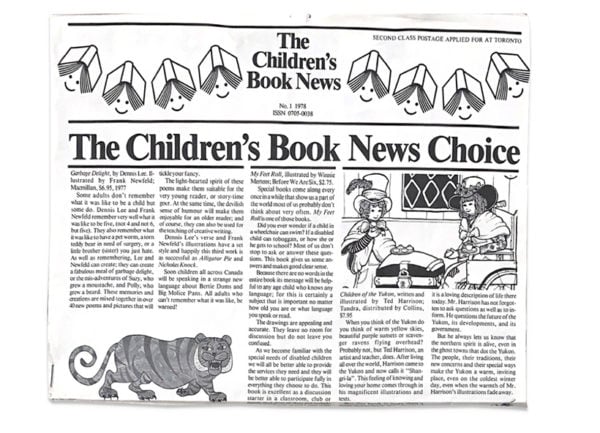
The inaugural issue of The Children’s Book News (Canadian Children’s Book Centre).
“I’d say over the last 10 years the centre has really broadened out the kinds of book lists we’re doing, and being purposeful in making sure that we are inclusive in our reviews,” Wells says. “Being able to answer how we’re responding to the Truth and Reconciliation Commission [Calls to Action], and how we’re making sure that we’re covering BIPOC authors is important to me.”
Another thing that has been vitally important to Wells, which she also considers a milestone in the CCBC’s work, is changing the mindset that it’s only about the authors when it comes to children’s literature. “There’s this huge piece played by illustrators, but what I was seeing when doing grant applications is that it’s all about how many authors we are reaching,” she says. “What’s being measured doesn’t speak to our reality, because in the kids’ book world, we have two contributors who are equally deserving. When Sydney Smith won the Hans Christian Andersen Award for illustration, that was great recognition, and in his speech he talked about the many layers to a story an illustrator can bring above and beyond the author. And I was like, ‘Yes, this is so wonderful. This needs to be printed and shared with everybody.’”
When it comes to milestones, Wells proudly points to the TD Grade One Book Giveaway. For 25 years, the program put about half a million books in the hands of grade 1 students every year. “I don’t think children’s literature has seen anything like it before or since,” she says.
The funding for the program ended in 2025. “The loss has been a huge blow to the centre, but even more so to the children’s book industry, because there’s nobody else who’s taken up that position to say reading for fun is important, children’s books are important, and we are going to make sure that Canada and the world knows it.”
Wells stepped into the role of executive director in January 2024, just as TD Bank Group decided to end their sponsorship. Her main objective was to transition the centre through the change, and she developed a three-year strategic plan with a particular focus on creating new, sustainable partnerships.
“We’re making sure that we have a good, sustainable Book Week. Plus, we have seven awards that we want to make sure continue, because now our awards ceremony is really the only big celebration for children’s literature that happens with the creators of the literature,” Wells says. “When we do our gala, it’s the one time and space they have to really connect and pat each other on the back. And as an industry, we need to celebrate that. We need to celebrate each other.”
Today, CCBC’s office is virtual, but its book collection, rehomed with Toronto Metropolitan University Libraries, continues to grow. The organization has transitioned to more online outreach, which has included turning the Canadian Children’s Book News into an online magazine. The decision to get rid of the paywall and make it free has allowed the centre to once again reach a wider audience. For Wells, it’s much more important to establish a large readership, because funding and partnerships can follow from there.
The CCBC will soon be down to a two-person staff, due to the departure of full-time events and program manager Carol-Ann Hoyt, which was a budget-related decision. That leaves Wells and Meghan Howe, director of operations, to maintain the CCBC’s programming initiatives. They plan to hire a contractor to deliver Book Week next year, and are actively looking for a sponsor.
Wells is also working on a big passion project: establishing Canadian children’s literature ambassadors, which she hopes to launch if new funding support comes through. Wells says these ambassadors would work to “raise national awareness of the importance of children’s literature, as it relates to lifelong literacy, the joy of reading, and for developing empathetic, engaged citizens; provide a platform to increase the public’s knowledge about the diverse stories Canadians are telling through Canadian children’s books and showcase Canadian authored and illustrated books; and ultimately increase sales of Canadian children’s books.”
Wells’s hopes for the future of the CCBC are simple: “that we’ll be able to do this for at least another 50 years,” and “that we’re busy helping people discover new books, because there’s something for everyone.”




 Contact us via email