Poet and essayist Theresa Kishkan was just 23 when she met painter Jack Wilkinson at an art opening on Vancouver Island. Wilkinson, who was the same age as her father, became enchanted by her. “Was I taken in?” she writes in the opening of her stunning new memoir. “I was.”
When Wilkinson, one of a group of Victoria artists known as the Limners, noticed Kishkan, she was just shifting “from wallflower to attractive young woman.” Wilkinson, who was married, wanted to see her daily. He drew her obsessively, and pressured her to pose nude.
In his gaze, and in his representations of her on canvas, she sees a self that is not her exactly. Or is it?
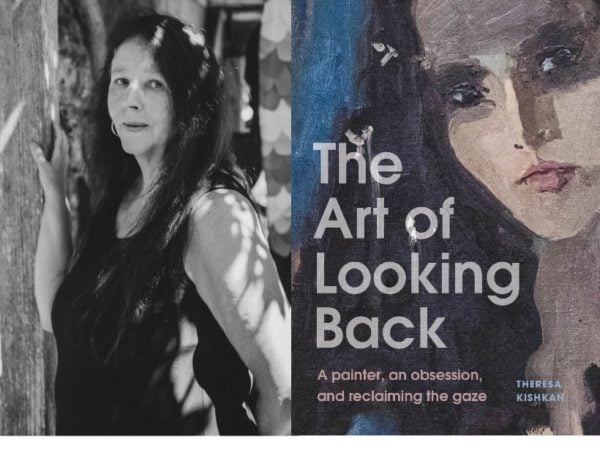
Nearly five decades on, in The Art of Looking Back: A Painter, an Obsession, and Reclaiming the Gaze, Kishkan turns her own gaze on their relationship, one that continued until his death in 2007. Her entry points are a portrait he painted of her as a young woman (featured on the cover of this beautifully designed book), and his letters, “a narrative of obsession.” She picks up the work of self-examination she left unfinished when, as a young woman, she lay naked and shivering on a divan in his studio. Kishkan interrogates everything, including her own complicity, ready at last “to ask questions I never knew were mine to ask.” Why did she have difficulty denying him? Did she have any power in this transaction? Could she say no?
Nothing in her life prepared her for the difficulties his fixation would bring, she writes. Nor did anything prepare her for the “whiff of scandal” of another obsession he would later confess to: that he had fallen in love with his own daughter. All of it became “a weight, an unnecessary guilt,” even as she rejected his lust, moved on, married, and had a family with someone else.
Kishkan deftly uses her inward journey to look outward: what does it mean to be a young woman, to be sexualized, to be defined through the male gaze, to be a mother, to age and become invisible, and to accept oneself?
Although Kishkan’s image in Wilkinson’s artwork was public, on display in both private collections and galleries, she had kept their relationship private. “I didn’t wear my trauma on my sleeve or on social media when that became a thing. It was never my party piece. I didn’t perform my private life.” Now Kishkan delves into the questions she could not ask before, her every word as exact as a brushstroke.
Kishkan’s beautifully rendered story explores power dynamics, personal responsibility, the relationship between artist and model, bodily autonomy, betrayal, and redemption. This story is many things: a reclaiming of identity, the setting straight of a historical record, a handbook for girls becoming women, a grace note – but most of all, it is a provocative and thoughtful work of art.




 Contact us via email