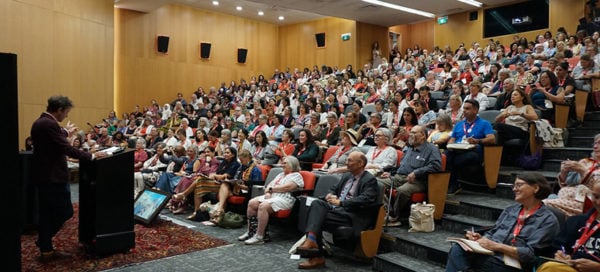
Sydney Smith delivering his keynote speech at 40th IBBY World Congress (IBBY Canada).
The 40th World Congress for the International Board on Books for Young People (IBBY), held from Aug. 6 to 9 at Ottawa’s Carleton University, marked IBBY Canada’s first time hosting this global event. More than 500 children’s literature authors, illustrators, academics, publishers, booksellers, librarians, and literacy experts from almost 60 countries – representing every continent except Antarctica – gathered with a shared commitment of bringing books and children together, promoting international understanding through children’s books, and supporting every child’s right to become a lifelong reader.
The opening ceremony, emceed with aplomb by author and artist Jay Odjick, both honoured and centred the importance of Indigenous languages, storytelling, and culture. Speaking from the heart about the power of children seeing themselves as the heroes of their own stories, Odjick remarked how “mind-blowing” it is for a kid who grew up on a reserve without paved roads to be at the podium of a global conference, while also challenging attendees to “share, learn, and build a better tomorrow together.”
Odjick was followed by Elder Barry Sarazin, a member of Algonquins of Pikwàkanagàn First Nation, whose gracious address included inviting a Sámi delegate from Northern Europe to hold a ceremonial drum while he sang a traditional welcome song in a touching cross-cultural exchange. The ceremony concluded with Inuit writer, storyteller, and residential school survivor Monica Ittusardjuat narrating her wordless sequence book Lighting the Qulliq and lighting a traditional Inuit soapstone oil lamp, setting a warm, reflective tone for the proceedings.
Centred around the theme of “listening to each other’s voices,” the importance of authentic representation in children’s books was echoed by all three Canadian keynote speakers. Sydney Smith, the 2024 Hans Christian Andersen Award winner, reflected on the unique ability of picture books to foster empathy and connect readers across cultures and experiences, saying that “the spark of humanity is carried in the particulars of another person’s life.”
Bahamian-Canadian writer, spoken-word artist, and anti-racist educator Khodi Dill highlighted the power and potential of hip-hop as a form of literature, which he’s dubbed “Lit-Hop.” This was accompanied by a thoughtful exploration of the cultural cornerstones of Black oral traditions (“Ebonics is both the medium and the message”), and a riveting spoken word performance of his poem “Blackcent.”
Two-time Governor General’s Literary Award winner David A. Robertson spoke about the need “for kids to feel inspired and to see pathways to tell their stories, because without them we lose ourselves.” He also spoke to the importance of children’s books as tools for passing languages on to the next generation, strengthening cultural identity, and ensuring knowledge is not lost. “Without the language,” he said, “you don’t have the culture.”
An especially memorable moment of the congress took place onstage at the Canadian Museum of History during a gala celebration when nine-year-old Yekaronyohs (Kanyen’keha), winner of the Celebrating Young Indigenous Voices: From Sea to Sea to Sea writing contest, read her bilingual story, “Mohawk Names,” with her older sister standing beside her, holding her hand.
Outstanding children’s books from around the globe were on display in several public exhibitions at Carleton University, including the inaugural IBBY-UNESCO Collection of Remarkable Books for Young Readers in Indigenous and Endangered Languages, which showcases and aims to preserve nearly 170 books in more than 150 endangered languages. The collection will travel to the Frankfurt Book Fair in October, and the Bologna Children’s Book Fair in 2027. Its permanent home will reside at the UNESCO Library in Paris, France.
Another historic launch, which received a standing ovation, was Alberta Senator Dr. Kristopher Wells’s Reading with Pride: Stories for Everyone; personally curated, it is believed to be one of the world’s largest collections of 2SLGBTQI+ picture books. The collection spans 50 years, with close to 300 titles, including nearly 100 Canadian books. In this time of book bans, Wells encouraged the IBBY community to help the archive grow into an international “archive of hope,” by not only translating these crucial books but also offering suggestions and making donations.
For four inspiring days, panel sessions detailed pioneering projects being done around the world, from the creation of tactile, accessible books for children with visual impairments (a project founded by Dr. Namita Jacob of India’s Chetana Trust) to the empowering literature workshops educator Hooria Rezaei facilitates with children experiencing the traumas of war in Tehran. Frank discussions took place about the systemic and structural barriers preventing marginalized voices from being heard.
As the congress came to a close, delegates were buoyed by a shared vision of the importance of ensuring all children have access to books, and the necessity of language revitalization and meaningful, accurate representation in children’s literature. Listening to each other’s voices calls for putting what you hear and learn into action. David A. Robertson’s reflections on a quote by Edward Everett Hale, found in his late father’s notebook, resonated deeply: “I can’t do everything, but I can do something. One person can make change.”




 Contact us via email