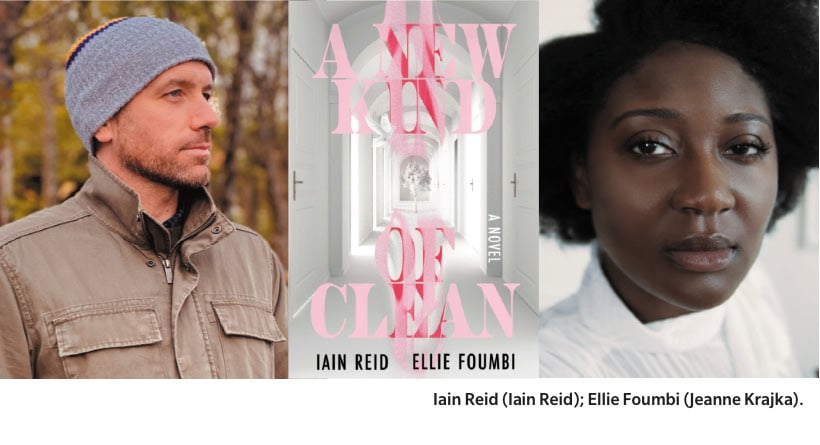
 When he first reached out to filmmaker Ellie Foumbi with an out-of-the-blue note congratulating her on the success of her first feature film, novelist Iain Reid wasn’t thinking about working with her or even hearing back. The pair lived in different countries – he in Canada, she in the U.S. – and had never met. He hadn’t yet seen the film himself, but something about the way it was being written about piqued his interest.
It was late June 2022, and Foumbi’s debut feature film, Our Father the Devil, had just won the audience award at the Tribeca Film Festival. Reid had started paying more attention to the film world after his debut novel, I’m Thinking of Ending Things, was adapted into a 2020 film of the same name. Unbeknownst to Reid, Foumbi had recently read his sophomore novel, Foe.
From that initial contact, the idea of working together arose naturally, and the pair soon found themselves collaborating on turning a short story Reid had written into the screenplay for a film, which they then decided to adapt into a novel. A New Kind of Clean, out this week from Simon & Schuster Canada, follows Missy Djalo, a struggling actress who is invited to audition for a commercial that could prove to be the breakthrough role she’s been hoping for. But the dream audition turns sinister as the lines between reality and fantasy blur in this philosophical horror that explores themes of identity, ambition, and our relationship with technology.
Reid and Foumbi spoke with Q&Q last month from their respective homes to talk about the book and their unexpected – and unexpectedly fruitful – collaboration.
Let’s start at the beginning. Iain, I’m curious to know what prompted you to reach out to Ellie in the first place. You hadn’t yet seen her film. You’d only read about it, is that right?
Iain Reid: There was an article, and the way it had described her film I found really intriguing. It felt different. It had elements of suspense, but it didn’t feel like a full genre movie, which is interesting for me as someone who likes to use elements of genre. At that time I wasn’t necessarily writing a straight genre piece. It felt like a hybrid and something that didn’t fit into any particular category. Something about Our Father the Devil felt that way to me at the time. It was clear, too, that the film was being received in such a positive way, so that is exciting, especially because it’s Ellie’s debut movie and you never know how things are going to be received. I just felt I’d like to say congrats and I look forward to seeing the movie when I get a chance. That was the extent of it. I didn’t think she would know who I was or anything.
Ellie Foumbi: I had just read his book, so I was doing a double take.
Reid: I had no idea. So I sent that note off and then I was shocked when she replied and said, “I know who you are and I read your book.” So then I said, “Wow, that’s crazy, really? You have all this cool acclaim for your movie. I’d love to see it.”
When she sent me the link, I watched the film with my mom. We were talking about it after: it was so subtle. It was completely original. It was unsettling. It was very sensitive. It was filled with so many elements, I couldn’t believe this was her first feature. The performances were amazing. There was just so much about it I sincerely admired and enjoyed. It was very exciting to me that someone was doing that kind of work. I didn’t think anything would necessarily come of it, but after seeing her film, I sent her a message letting her know how much I loved it and said something like, you know, it would be great to work together at some point down the road. She replied, yeah, that would be fun, probably not thinking it would be imminent, but it just so happened I had finished this story. My agent’s plan was to send it out to filmmakers, but I said, hold on a sec. Wait. In the film world, very often you get encouraged by agents to meet people; sometimes there’s a coordinated effort to put people together, but this wasn’t. This was really natural. I had this little story and I sent it to her and she read it that weekend.
Foumbi: Like that day.
Reid: Yeah, it was really fast. She really liked it, and what was exciting for me and started the idea of a collaboration was that she didn’t just like it; she also had ideas right away. It sparked something in her as a way to expand it. It was obvious then for me that yeah, if Ellie’s up for this, I don’t want to send this to anybody else. Let’s just see where it goes if she and I take a stab at building the story into a film.
How much has the story changed from its initial state?
Foumbi: I feel like it expanded. The kernel of the original idea is still very much there. What I love about Iain’s writing is its sparseness and that he allows the reader to fill in a lot of the details and a lot of the gaps. It takes confidence to write like that and to not feel you have to connect all the dots. To me, particularly when you’re playing with genre, having that breath in the writing is really important. His initial short story was sparse and very atmospheric, but there was a kernel that was so specific that I immediately connected with in Missy, in who she was. He was touching on something that to me felt very urgent, and it was just taking this character and filling her in a little bit. We enjoyed that process, seeing how the story evolves as we get to know her, as we start to figure out what makes her tick and what she wants, and how to build those obstacles for her to allow the reader to go on this ride while also homing in on what we wanted to say. The themes were something that we both connected on in terms of technology and how we as humans are interacting with it, how we’re giving ourselves over to it, in many ways unconsciously. We talked a lot about that. We talked a lot about identity, and that’s a recurring theme in my work. Even though this is an idea that started with somebody else, it felt so personal to me.
I’m still amazed at how a story that someone else wrote, that I joined, just feels so much like both of our stories. It doesn’t matter that I’m writing a Black female character as a Black woman. There’s so much of Iain in Missy. That to me is the thing I think I’m the most proud of, the way we were able to work together. It reflects both of us in this really beautiful way.
How did you manage the writing process together?
Reid: Because we’d started writing a screenplay – we wrote several drafts of a screenplay – we had notes and we’d been living in this world so long that we really did just send it back and forth. I’d write 10 pages, send it back. She’d write 20 pages, send it back. Once we had something, then we’d revise and again, we’d each take time revising different parts. There wasn’t really a formal this-is-how-we-do-it conversation, and we just kind of took that into the novel writing, too. It felt like a natural way to do it, to send it back and forth and not feel precious about our writing. Ellie might want to tweak something of mine; I might want to suggest a tweak for hers. If I sent something for her to work on and she was going to add something, she might go back and read something of mine first. We were never actually writing in the same room together – we were in different countries – so there were lots of phone calls to discuss different sections. We talked a lot on the phone about different ideas and we brainstormed a lot together.
Foumbi: One thing that almost scared me is the number of times it really felt like Iain and I shared a brain on this. It was insane to me how I would drop a thread and Iain would pick it up and develop it in a way that I was like, yeah, that’s where my brain was going. I’d pick the thread back up when he passed it back. It was kind of scary; it was exciting. For me, it was just another sign that this was meant to be. We just fit as writers. We have different strengths and weaknesses and I think we complement each other really well. We were so locked in, we were so connected, we were so on the same thread of what this story should be, and in the grand scheme of things, we had very few disagreements. It was magical.
Reid: When a collaboration like this goes well, it is so fun. There are times when you’re writing alone, which I’m used to doing so much, where you run into difficulty and then you feel like, “I don’t know what to do now.” Or you do research on something for a month and you’re like, “I don’t really know what to do with this,” or, “I don’t know why I did this.” There’s something comforting in knowing, okay, maybe this person will know why we did this.
Just to confirm the trajectory of the project: Iain, you wrote a short story and sent it to Ellie, then the two of you decided to adapt the story into a screenplay, and then you decided to adapt the film into a novel?
Reid: Yeah. We weren’t writing under deadlines, so it really goes back to that analogy of writing music in a garage with your friends when you’re a teenager. No one came to us and said, “We want the book version.” We just said, we’re going to try it, and we’ll see if anybody wants it. No one was steering the ship except for us, so we could really try to be creative and bold.
Foumbi: I really felt like there was more to the story between Missy and her mom. I kept trying to find the space for it in the screenplay, and Iain was like, “It doesn’t fit there, you know,” and I was like, “Yeah, he’s right.” It never occurred to me that Iain would be open to expanding it into a novel.
So when is the film going to be released?
Foumbi: After we make it. We’re making progress. We have our lead actress. We’re working on our financing, and putting the other pieces together. My hope is for us to be in production sometime next year. Now that we’ve written the book, we’re coming back to the screenplay and experimenting with doing different things, bringing in new elements. The screenplay is now changing again because of the book.
It sounds like you’re still working together on this project, but do you have any future plans to work together on something new?
Reid: I think so. At this point, it seems silly not to.
This interview has been edited and condensed.




 Contact us via email