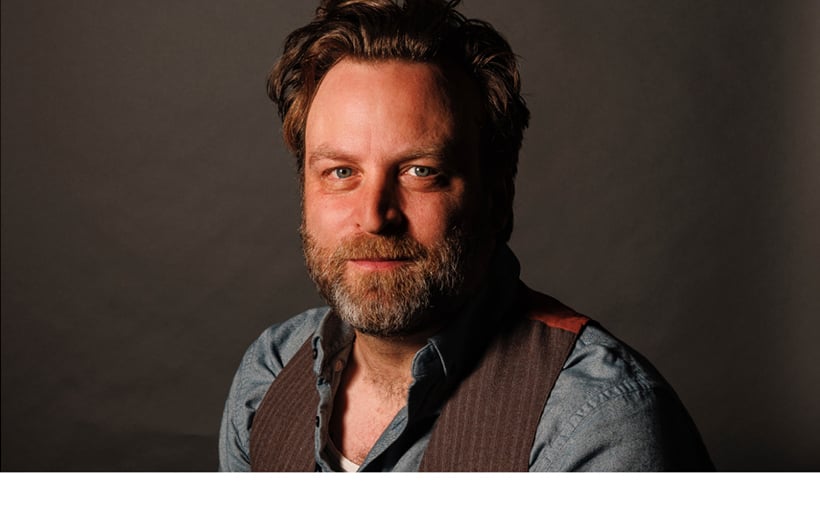
Gil Garratt, the artistic director of the Blyth Festival, is adapting Timothy Findley’s The Piano Man’s Daughter for the stage. (Alex Franklin)
Gil Garratt, the artistic director of the Blyth Festival in southwestern Ontario, has been carrying the story of Timothy Findley’s The Piano Man’s Daughter with him for decades.
Garratt first read the novel, the CanLit giant’s eighth, shortly after it was published in 1995 and around the time he was graduating from high school, and was immediately blown away.
“It utterly opened a fissure in me that I didn’t realize was there,” Garratt says. “I fell in love with the novel and read it several times as a teenager, and then continued to carry it around as one of those totem pieces in my mind.”
The novel, which opens in 1939 just before the Second World War breaks out, follows piano tuner Charlie Kilworth as he examines his life and the life of his mother, Lily, in search of answers to two questions: who is his father? And does he dare to become a father himself, given his mother’s madness?
Garratt felt a personal connection with the material because it echoed parts of his family’s history: his paternal grandmother spent parts of her adult life at the Queen Street Mental Hospital, where Lily spent her later years. And his grandfather, her husband, was a sign painter in Toronto, who at one time painted a billboard for a piano factory.
As Garratt studied and then went on to pursue a career in theatre, the story of Charlie and Lily remained in the back of his mind. It would occasionally come to the forefront, such as once, early in his career when he found himself at lunch in Stratford with his mentor, playwright, and director Paul Thompson, where they serendipitously joined Findley for a meal. The vague idea he had had of somehow bringing this beloved novel to the stage clarified when he read Tiff: A Life of Timothy Findley, the 2020 biography of the author written by Sherrill Grace.
Garratt was so moved by her book that he decided to write to her and tell her how much he admired it. The pair began to correspond, at which point he mentioned he had long thought that The Piano Man’s Daughter would make a beautiful stage play. Grace put him in touch with Findley’s literary estate. Garratt acquired the stage rights and got to work adapting the expansive novel for the stage.
The adaptation of the work, which Garratt is also directing, has been a project unlike any other he has undertaken.
“Because I am an actor and a writer and also a theatre director, I’ve often written plays off the side of my desk: I’ve got an hour here, I’m going to pound out this scene,” says Garratt, who has previously been able to squeeze playwriting into spare time between meetings. But that method didn’t work for The Piano Man’s Daughter, which he began to work on in earnest in late 2024.
“With this piece in particular, I’ve found it is mercilessly unforgiving if I try to do that,” he says. He had to work in isolation, away from his daily duties and his family, including a week away at a writing retreat in Canmore, Alberta, to be able to meditate on some of the novel’s more heavy themes, particularly Charlie’s difficult childhood.
The result is a two-play production that will launch the Blyth Festival’s 2027 season next June. The play is scheduled so that theatregoers can see both plays in one day, with a country supper at the theatre’s lower hall as an option between performances. The production, some details of which are still being pinned down, features a nine-person cast – all of whom are musicians who will be performing the story’s early 20th jazz standards live on stage – and two child actors.
In some ways, this two-play stage adaptation will bring the novel back to the stage at the Blyth Festival. In May 1995, the theatre held a used book sale fundraiser at which Findley, a dedicated supporter of Canadian theatre, read from The Piano Man’s Daughter, his latest book, an event captured in The North Huron Citizen newspaper at the time.
Garratt believes present-day audiences are especially keen to experience a whole-day theatrical epic, particularly with the longform storytelling currently in vogue through television streaming.
“I think folks are primed for it. I mean, first of all, the story, the epic itself is so compelling and so enormous, and I think there’s something really to immerse yourself in,” he says. “Culturally, I think we’re in a moment where folks are looking for that kind of IRL immersion. We want those kinds of cultural experiences that are not attached to the thing in our pocket.”


 Contact us via email